What Are the Most Interesting Python Books to Read?
The most interesting Python books to read are the ones that give you a reason to open your editor. For a complete newcomer, that might mean getting a first program running. For someone who knows the basics, it could mean building a small chess engine, understanding generators, or improving code that has become difficult to maintain.
A useful starting shortlist is Python for the Greenhorns Book-1 for a gentle introduction, Python Programming Exercises, Gently Explained for small challenges, Programming a Mini Chess in Phyton for a focused project, and Python Distilled for a closer look at the language. More experienced readers can consider Python How-To, The Python Master, or the software-design case studies in 500 Lines or Less.
These are different kinds of reading, not positions in a universal ranking. The guide below explains their appeal, their limitations, and how to choose a book you can actually use.
Python books to read, matched to your interests
Start with the question you want a book to answer. “How do I write my first program?” calls for a different resource from “Why does attribute access work this way?” The experience levels below are editorial judgments based on the supplied catalog descriptions, not measured learning outcomes.
| Book | Suggested starting point | Distinctive focus | What to know first |
|---|---|---|---|
| Python for the Greenhorns Book-1 | Complete beginner | Setup, Thonny, and basic concepts | No previous programming knowledge required by the catalog description |
| Python Programming Exercises, Gently Explained | Beginner who has covered the basics | Short programming problems | Variables, conditions, loops, and functions |
| Programming a Mini Chess in Phyton: How to Make a Funny Mini Chess – An Experiment | Project-curious learner | A compact chess-programming experiment | Comfort reading functions, loops, and collections; familiarity with chess helps |
| Python Distilled | Programmer seeking a stronger foundation | Core language concepts and Python’s object model | Basic programming experience |
| Python How-To: 63 Techniques to Improve Your Python Code | Reader already writing small programs | Practical coding decisions and maintainability | Working knowledge of Python fundamentals |
| The Python Master | Experienced Python reader | Descriptors, metaclasses, and object internals | Functions, classes, exceptions, and object-oriented programming |
| 500 Lines or Less: Experienced Programmers Solve Interesting Problems | Reader comfortable studying unfamiliar code | Compact software-design case studies | Programming fundamentals and patience with implementation details |
Notice the distinction between a tutorial, a practice book, a project study, and a language guide. A book can be excellent for one purpose and frustrating for another.
For beginners who want an approachable start
Python for the Greenhorns Book-1: reduce the first hurdle
If your main obstacle is not knowing where to write or run code, Python for the Greenhorns Book-1 offers a narrow, beginner-oriented starting point. The catalog describes an introduction to Python, installation of the Thonny development environment, variables, constants, and simple exercises with answers.
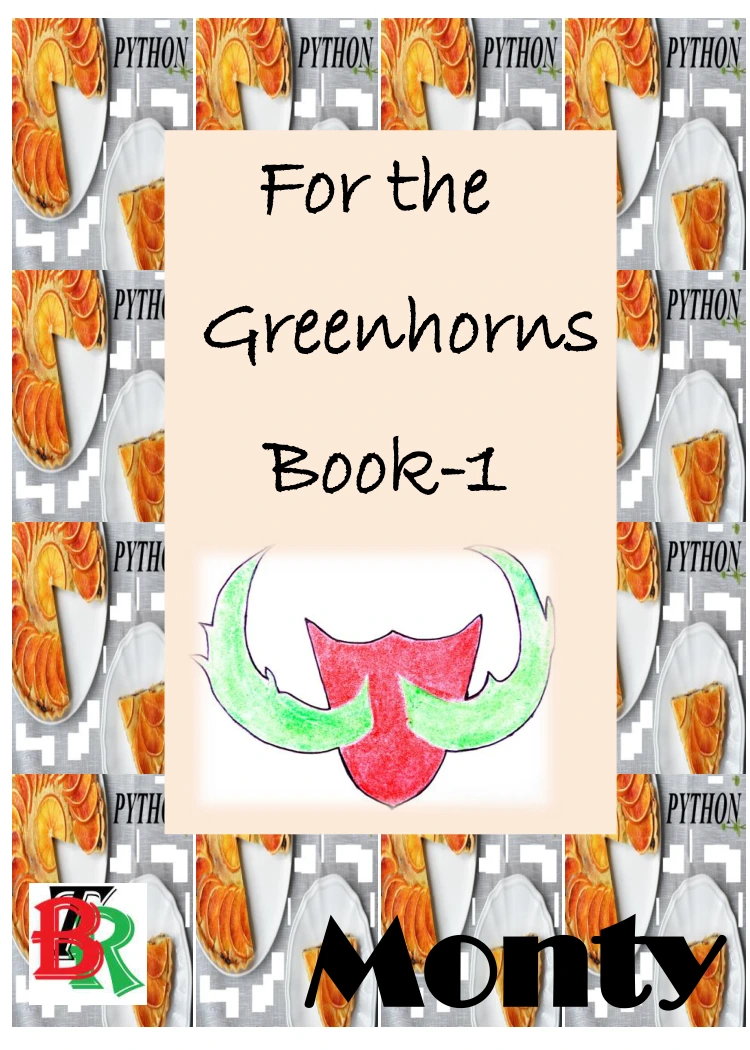
Python for the Greenhorns Book-1
By Monty
Newcomers who need help with setup, Thonny, and initial programming concepts.
Its appeal is the limited scope. You can concentrate on getting comfortable with the basic workflow rather than immediately choosing a web framework or learning a large collection of libraries.
Choose it if: you have never programmed and want an initial orientation. Keep its limits in mind: this first volume is not presented as a complete course covering the full language or substantial application development.
For an original practice task, store the title of a book and the number of chapters you have read, then print a short progress message. Change the values and run the program again. The goal is simply to connect the code you write with the result you see.
For readers who enjoy small coding challenges
Python Programming Exercises, Gently Explained: practise producing code
There is a useful difference between following an explanation and solving a problem without its solution in front of you. Al Sweigart’s Python Programming Exercises, Gently Explained addresses that second activity. The supplied Digital Delights catalog describes 42 short problems, arranged roughly from easier to more difficult, with explanations and supporting guidance.
This format can suit readers who know what a loop or function does but struggle to decide how to start a program. A small problem gives you a defined target without asking you to design an entire application.
Choose this kind of resource if: you enjoy clear challenges and want to practise the fundamentals. It is better treated as a companion to introductory explanations than as a replacement for learning the basics.
- Write down the expected inputs and outputs before coding.
- Try a solution before reading the explanation.
- If you need a hint, return to your own attempt afterward.
- Compare your approach with the worked solution and identify one meaningful difference.
Programming a Mini Chess in Phyton: follow a problem with moving parts
Programming a Mini Chess in Phyton: How to Make a Funny Mini Chess – An Experiment by Gerald Wartensteiner takes a more specialized route. The unusual spelling of “Phyton” is part of the supplied title; the programming language discussed is Python.
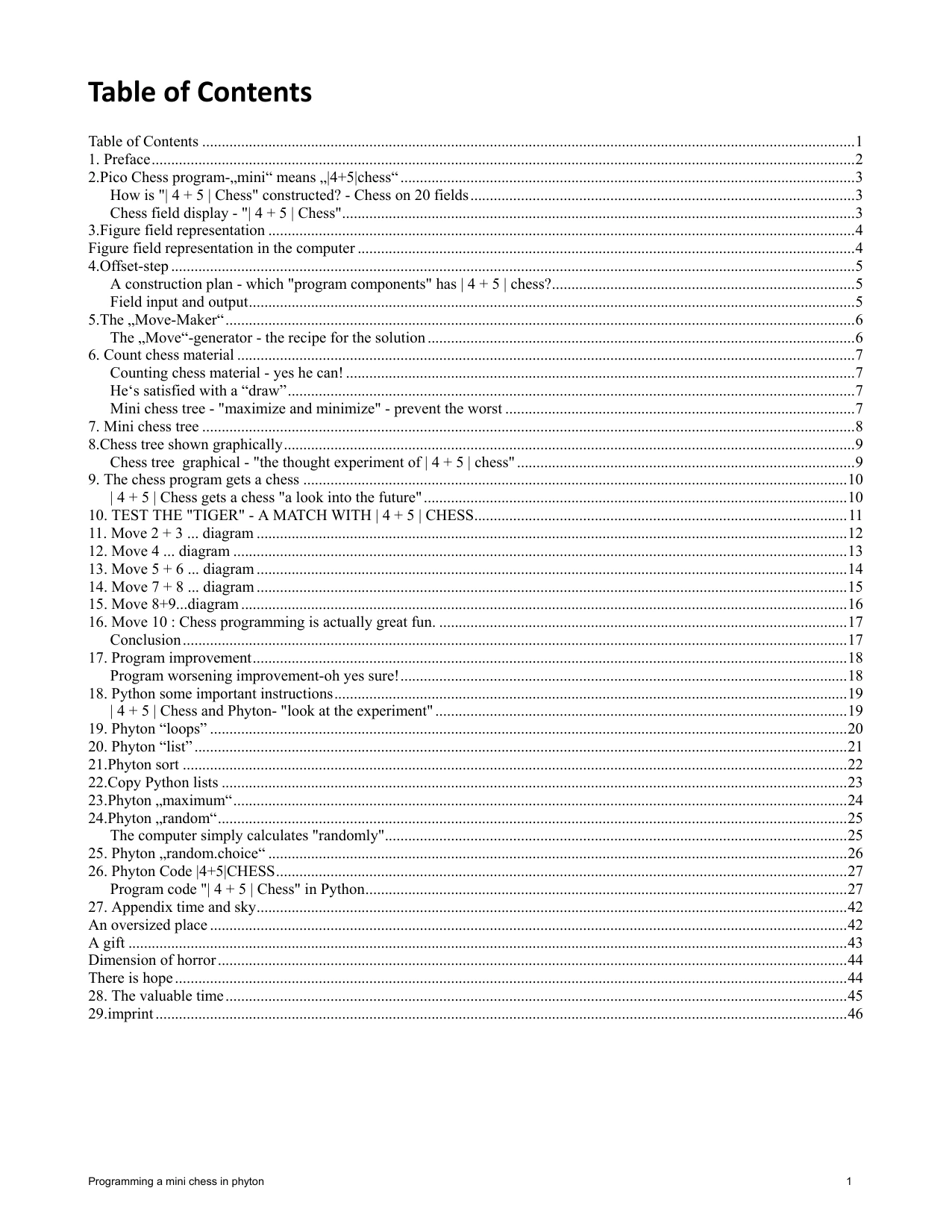
Programming a Mini Chess in Phyton: How to Make a Funny Mini Chess – An Experiment
Readers who know basic Python and enjoy chess rules or algorithmic experiments.
The catalog describes a reduced chess variant and an implementation that explores board representation, move generation, material evaluation, and game-tree search. That makes it a project study rather than a general introduction to programming.
Its interesting question is not merely “How do I code chess?” It is “How can rules become data and functions?” A board needs a representation. Pieces need movement rules. The computer needs a way to compare possible positions. Those decisions offer something concrete to reason about.
Choose it if: you like chess, algorithms, or examining how a small program fits together. The catalog characterizes it as an experiment, not a polished commercial engine. It also notes German labels in the diagrams, which may matter when assessing a sample.
A manageable reading goal is to understand one component first. For example, trace how a piece’s position becomes a set of possible moves before trying to follow the entire search process.
For understanding Python more deeply
Python Distilled: connect the language’s core ideas
David M. Beazley’s Python Distilled focuses on the language itself rather than trying to teach every popular framework. The catalog covers fundamentals, functions, exceptions, modules, object-oriented programming, generators, decorators, context managers, and asynchronous functions. The publisher’s listing for Python Distilled provides an additional source for reviewing the book’s scope.
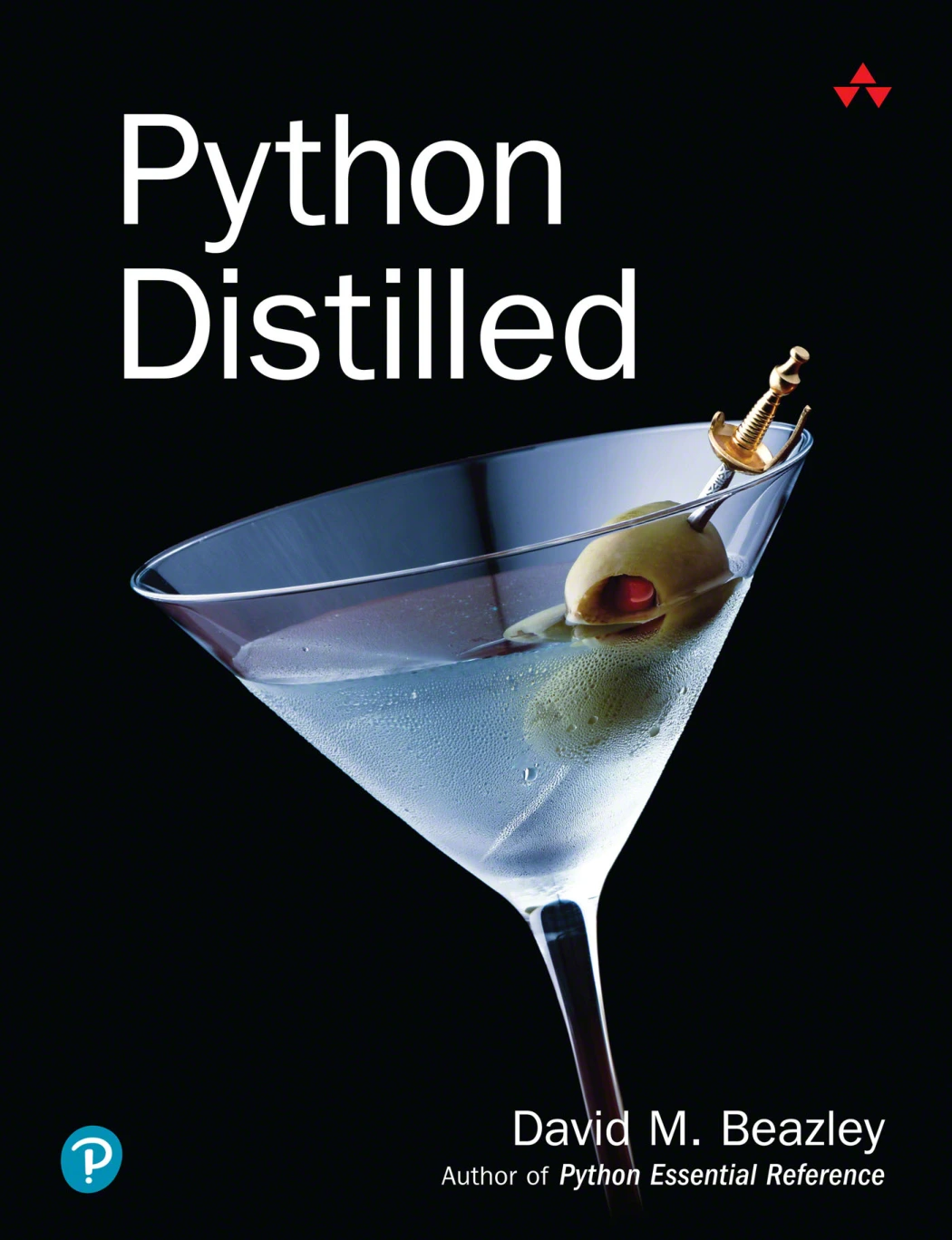
Programmers who want to connect everyday Python features with deeper language concepts.
This is a useful direction when you can write a working script but want a clearer explanation of how its parts relate. Instead of collecting more library names, you can strengthen your understanding of the language those libraries use.
Choose it if: you already have some programming knowledge and want a focused Python language guide. A complete beginner should inspect a sample to decide whether the pace provides enough support.
One active-reading approach is to explain a concept in your own words, then build a tiny example. After reading about generators, for instance, compare a function that returns a collection with one that yields values. Ask how you would consume the results and what assumptions the calling code makes.
The Python Master: investigate advanced mechanisms
The Python Master by Robert Smallshire and Austin Bingham moves into advanced flow control, byte-oriented programming, object internals, descriptors, instance creation, metaclasses, class decorators, and abstract base classes, according to the catalog.
Experienced Python readers curious about descriptors, metaclasses, and class behavior.
These subjects can be interesting because they expose mechanisms hidden beneath ordinary application code. They are also a poor substitute for learning functions, classes, and exceptions first.
Choose it if: you are comfortable reading and writing Python classes and want to understand deeper customization. If basic inheritance or attribute access still feels mysterious, strengthen those foundations before tackling the advanced material.
Read with a practical question in mind: “What problem would justify this technique?” Understanding a feature includes recognizing when ordinary code would be clearer.
For improving code you already write
Python How-To: turn everyday choices into deliberate decisions
Yong Cui’s Python How-To: 63 Techniques to Improve Your Python Code is organized around focused techniques rather than a single application. The catalog describes explanations, examples, and challenges addressing questions such as choosing data structures and using type hints to clarify functions.
Python How-To: 63 Techniques to Improve Your Python Code
By Yong Cui
Learners already writing programs who want clearer data-structure and function-design choices.
Its appeal is the connection to decisions you already face. Should a collection be a list, tuple, dictionary, or set? Is a function’s purpose obvious from its interface? Can another reader follow the code without reconstructing your intentions?
Choose it if: your programs work, but you want them to be easier to understand and maintain. You can read selectively, starting with a technique that applies to an existing project.
Keep an unchanged version of your code before revising it. Then compare the two versions against specific questions: Is the intent clearer? Did the change introduce an unnecessary abstraction? Do the same inputs still produce the expected outputs?
500 Lines or Less: study how software is designed
500 Lines or Less: Experienced Programmers Solve Interesting Problems broadens the discussion beyond a conventional Python tutorial. Its case studies include systems such as a web crawler, a Python interpreter, static analysis, and a simple web server. The collection’s introduction explains its educational emphasis on understanding implementation and design decisions.
500 Lines or Less: Experienced Programmers Solve Interesting Problems
Code-curious programmers who want to examine decomposition, abstractions, and tradeoffs.
Not every chapter is a Python lesson, so choose this for software-design curiosity rather than comprehensive Python syntax coverage.
Choose it if: you enjoy asking how programmers divide a problem into parts. The distinctive value lies in examining why a design takes a particular shape, not just copying the finished implementation.
Before reading a chapter’s solution, sketch your own approach. Identify the inputs, the output, and the main responsibilities. Then compare your decomposition with the author’s decisions.
How to choose one book—and what to read next
Use three filters: your current ability, your preferred reading format, and one concrete goal. “Learn Python” is broad. “Write a program that summarizes my reading log” gives you a way to choose material and assess your progress.
A path for complete beginners
- Learn the workflow: get comfortable writing, running, and changing small programs.
- Build the fundamentals: learn conditions, loops, collections, and functions through a suitably paced introduction.
- Practise small problems: attempt exercises without immediately consulting solutions.
- Choose a modest project: build something that combines a few familiar concepts.
A beginner project might be a reading-log program that accepts book titles and displays them in alphabetical order. Add one feature at a time rather than starting with accounts, a database, and a web interface.
A path for readers with programming experience
- Strengthen language knowledge: use a focused guide such as Python Distilled.
- Improve existing work: apply selected techniques from Python How-To to a script you already understand.
- Follow your curiosity: choose advanced language mechanisms, a chess experiment, or software-design case studies.
You do not need to finish every introductory chapter before exploring an interesting topic. Equally, you do not need an advanced book simply because you have finished a beginner one.
Use a read, change, rebuild routine
For any book, try this practical reading cycle:
- Read: understand one explanation and run its example.
- Change: alter an input, a rule, or the required output.
- Rebuild: create a smaller related program without copying the original.
- Explain: write a short note about what worked and what remains unclear.
For example, after studying a function that counts items, change the requirement so that it ignores blank entries. Then rebuild the idea using a different collection. These are suggested practice activities, not claims about exercises included in the books.
Common mistakes that make a good book feel unhelpful
- Choosing advanced material too early: terminology can overwhelm the idea you are trying to understand.
- Collecting overlapping introductions: another explanation of variables may not address your actual need for practice.
- Reading without coding: recognizing an example does not show that you can adapt it.
- Treating every technique as a rule: a useful feature can still be the wrong choice for a small program.
- Confusing breadth with depth: a book mentioning many topics may be a survey rather than a detailed treatment of each.
If a book feels unsuitable, identify the mismatch before abandoning the subject. You may need slower explanations, smaller exercises, or a more compelling project—not a completely different learning goal.
Before you commit: check editions and setup requirements
A recent edition does not guarantee that every example will work unchanged with your interpreter and installed libraries. An older book is not automatically useless, either. Inspect the requirements for the particular material you want to use.
- Read a sample to assess the pace and assumed knowledge.
- Check the contents for the topics you actually need.
- Look for book-specific errata and supporting code.
- Follow stated interpreter and dependency requirements.
- Check whether exercises require extra files, services, or hardware.
- Confirm that the digital format is comfortable on your reading device.
The supplied records do not establish compatibility with every current Python or third-party package release. If an example fails, compare your environment with the book’s instructions before concluding that the underlying explanation is wrong.
Frequently asked questions
Which Python book can I start with without programming experience?
Python for the Greenhorns Book-1 is explicitly aimed at first-time learners in the supplied catalog. Its scope is introductory, so expect to continue with a broader fundamentals resource after that initial orientation.
Should I choose projects, exercises, or a reference book?
Choose projects when a finished result motivates you, exercises when you need practice turning requirements into code, and a reference when you already know enough to ask specific questions. A newcomer usually needs explanations alongside either projects or exercises.
Are older Python books still useful?
They can be useful for concepts and design reasoning, but check their syntax, interpreter assumptions, and library instructions. Material dependent on external tools needs particular attention. Do not assume either that everything is obsolete or that every example remains compatible.
When am I ready for advanced Python books?
A practical checkpoint is whether you can write a small program using functions and classes, understand exceptions, and follow imports without constant help. If those tasks are manageable, sample an advanced chapter and assess whether you can explain its example—not merely run it.
Do I need to read several Python books at once?
No. Start with one main book and one achievable coding goal. Add a second resource when it fills a clear gap, such as practice problems or a deeper explanation, rather than duplicating your first book.
Choose the book that makes you want to write code
The most interesting choice depends on the question you want to pursue. Start gently if setup is your obstacle. Choose challenges if you need practice. Follow a project if you enjoy seeing pieces fit together. Explore language internals or design case studies when understanding the decisions becomes more compelling than learning new syntax.
When browsing the Python books collection at Digital Delights, compare a title’s scope with your next goal—not simply with its length or how advanced it sounds. One well-matched book and one program you can explain are a useful starting point.
Sources and selection notes
This selection uses the supplied Digital_Delights_product_1008_1235.xlsx catalog for product titles, descriptions, and intended coverage. Publisher and project sources are linked alongside the relevant discussions. The exercise count comes from the catalog entry for Python Programming Exercises, Gently Explained.
Suitability judgments and suggested practice activities are editorial guidance. This is not an exhaustive survey, a popularity ranking, or a claim that any title produces better learning outcomes than another.