

Programming a Mini Chess in Phyton: How to Make a Funny Mini Chess – An Experiment
Original price was: $5.00.$2.50Current price is: $2.50.

Gerald Wartensteiner
Product Specs:
- File Type: PDF
- File Size: 1.7 MB
- Book Language: English
- Total Page Count: 46
- Instant Download
A 20-Square Laboratory for Chess Programming ♟️
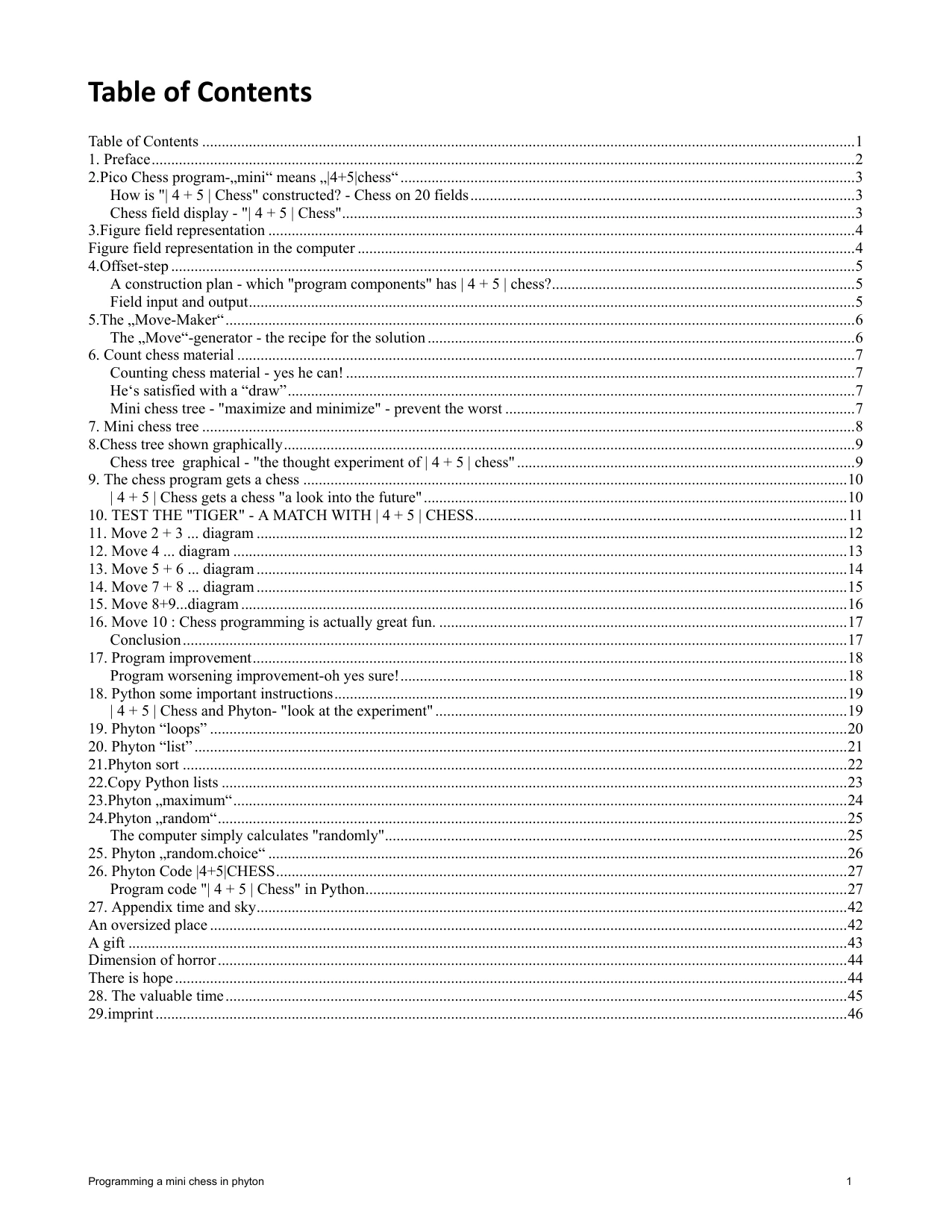
Most chess engines are built on 64 squares, years of optimization, and enough search depth to make your head spin. Gerald Wartensteiner takes the opposite route. In Programming a Mini Chess in Phyton, he shrinks the board to 20 fields and turns chess programming into a compact experiment. The variant, called |4+5| Chess or Pico Chess, keeps the essential ingredients—rooks, queen, king, pawns, captures, and check—while removing enough complexity to make the inner workings visible.
The result is not a polished commercial engine. It is a working notebook of ideas, written in Python (spelled “Phyton” throughout) and aimed at readers who want to understand how a chess program is put together.
What the Experiment Builds 💻
The book walks through the program component by component:
- Board representation: pieces become numbers, with positive values for Black, negative for White, and twos marking the edge of the 4×5 board.
- Offset steps: movement is calculated with simple arithmetic, so a rook’s legal directions become a set of offsets such as 1, -1, 6, and -6.
- Move generation: a recipe for collecting pseudo-legal moves, filtering captures, respecting friendly pieces, and stopping at the board edge.
- Material evaluation: each side’s pieces are added up, giving the program a basic way to compare positions.
- The mini chess tree: the computer tries moves, imagines replies, and chooses the option that prevents the worst material loss.
Inside the Chess Tree 🌳
The most interesting part is the search logic. |4+5| Chess looks ahead only two half-moves, but that is enough to demonstrate the core idea: generate candidate moves, test them, calculate the material difference after the opponent’s best reply, and then pick the move with the least bad outcome. Wartensteiner explains this with move lists, difference lists, and a graphical chess tree. The program is openly imperfect—full of bugs, as the author puts it—and even has a comment section that adds its own remarks during play. That honesty makes the project feel like a real experiment rather than a finished product.
Who Should Read This?
This is a short, focused guide for beginners and hobbyists who are curious about the machinery behind chess software. If you already know some Python and want to see how arrays, offsets, lists, and simple evaluation functions combine into a playable game, the book offers a gentle entry point. It is also useful for readers who have wondered how a chess engine “thinks” but do not want to start with a massive open-source codebase. The diagrams are labeled in German, so a little tolerance for mixed-language materials helps.
A Small Project with a Clear Goal
Programming a Mini Chess in Phyton is less about building a strong opponent and more about understanding the blueprint. It covers the move maker, the material count, the minimax-style decision, and the limitations of a tiny chess world. For a programmer who enjoys chess, or a chess player who enjoys programming, it is a compact invitation to look inside the engine.
User Reviews
Be the first to review “Programming a Mini Chess in Phyton: How to Make a Funny Mini Chess – An Experiment”
You must be logged in to post a review.
Original price was: $5.00.$2.50Current price is: $2.50.


There are no reviews yet.