
Python vs C++: Which Is Better for Beginners?
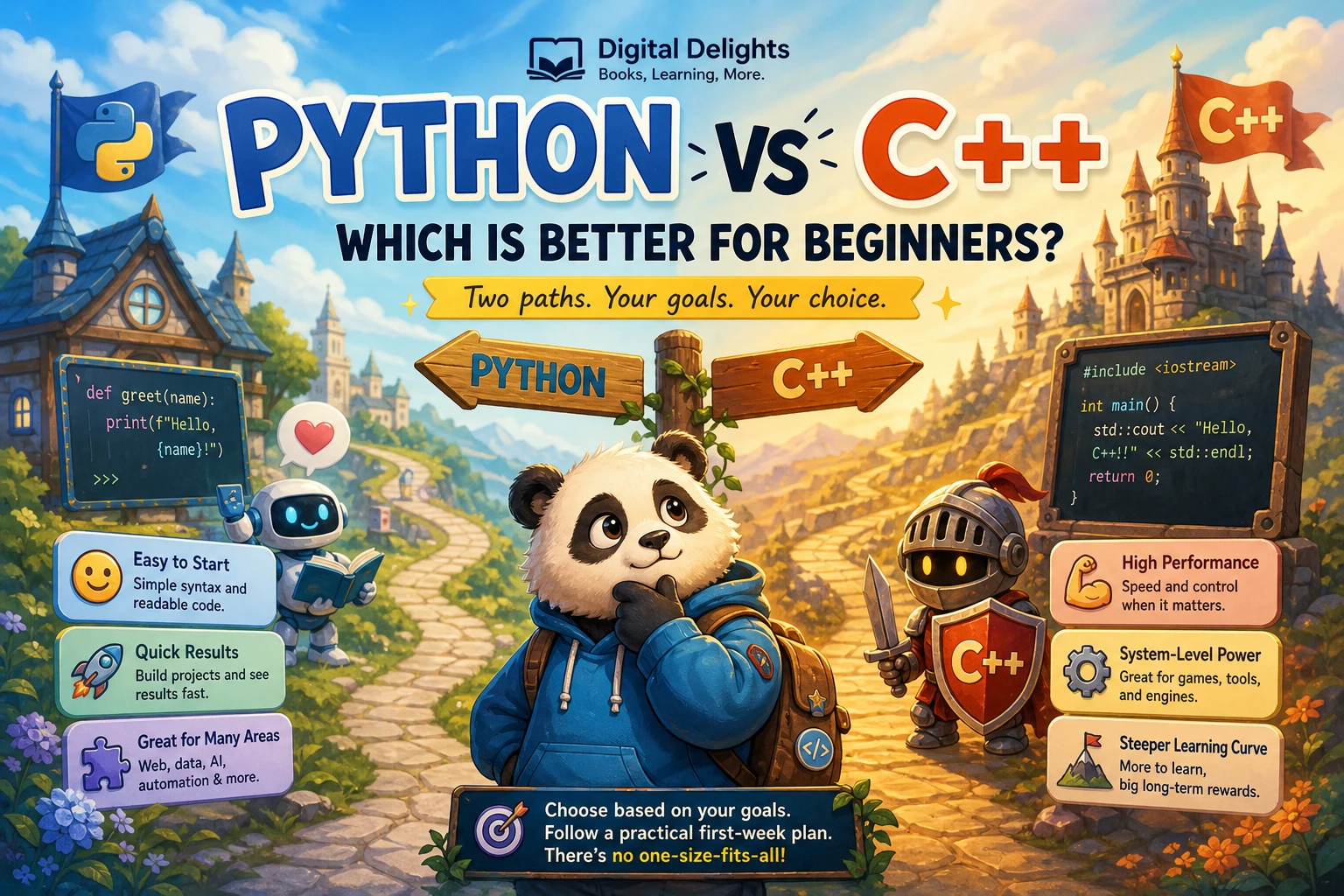
Quick answer: Python is a sensible default if you are new to programming and want to start experimenting with code with relatively little setup. C++ may be the better first choice if a class, project, or specific goal requires it. Neither language is the right choice for every beginner: your destination matters more than a general claim about which one is easier.
Python’s official tutorial describes a high-level language with dynamic typing and an interactive mode, but it also assumes readers already understand some programming basics. C++ can be taught to people with no prior programming experience, too, although its beginner materials may introduce compiler setup and concepts such as pointers. This guide compares the practical starting points, helps you choose based on your goals, and offers a small first-week learning plan.
Python vs C++ for beginners: the main difference
Both languages can teach you core programming ideas: storing information, making decisions, repeating actions, organizing code, and solving problems step by step. The difference is in the tools and details you encounter along the way.
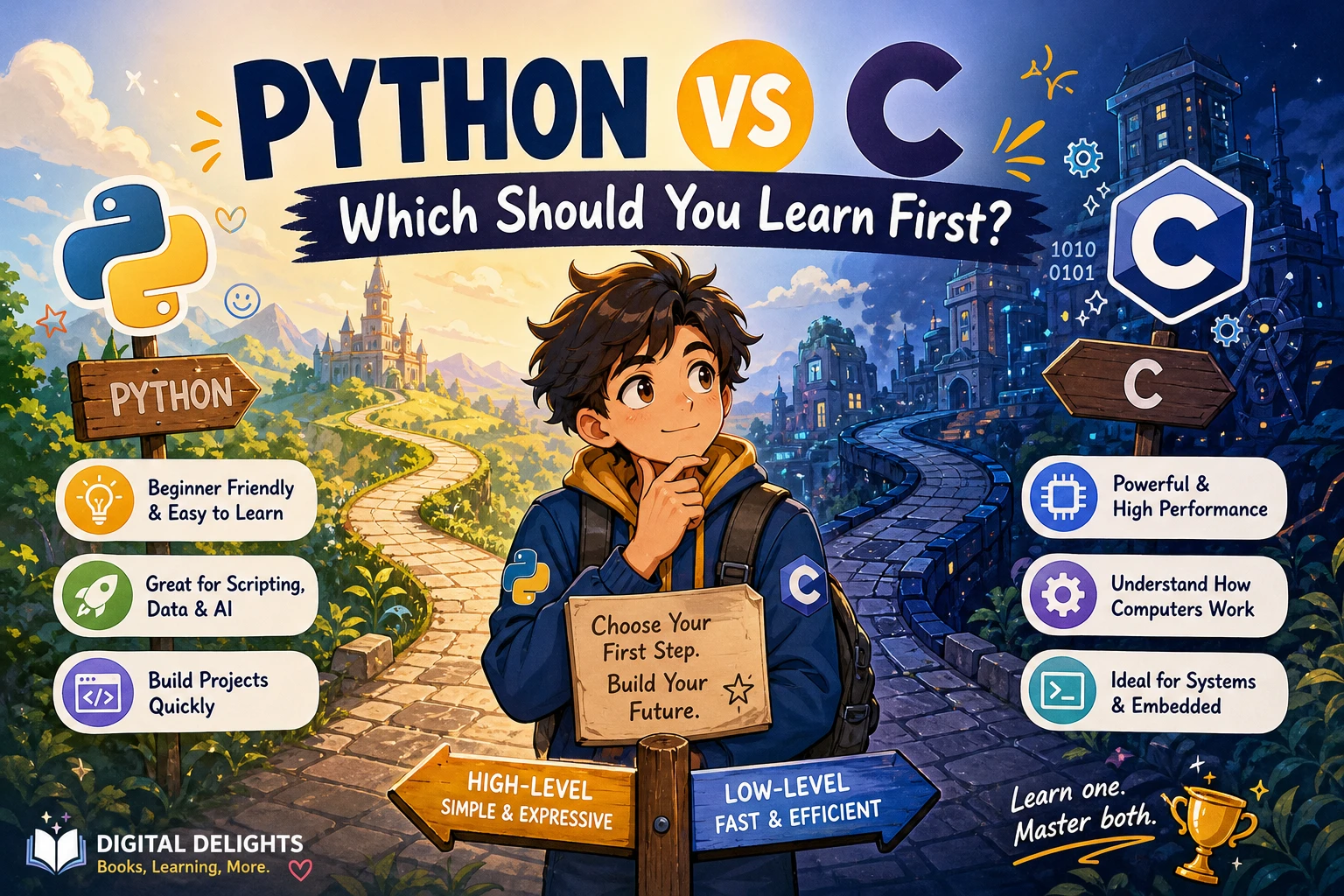
Python’s syntax is designed to be readable, and its interactive interpreter lets learners try short snippets directly. C++ is commonly written, compiled, and then run, so getting a first program working can involve a compiler and a build process. This does not make one language universally better or worse; it means the early learning workflow feels different.
Python uses dynamic typing: a variable does not need a declared type in the same way as a typical beginner C++ example. C++ generally asks programmers to specify types, and its wider set of topics can include pointers, references, and how memory is managed. Those topics are important to C++, but a well-paced beginner course can introduce them when they are relevant rather than all at once.
Python vs C++: side-by-side comparison
| Consideration | Python | C++ |
|---|---|---|
| Getting started | Often offers a short path from installing Python or opening an interactive environment to trying a small example. | Usually involves a compiler and a build step; setup can vary with the computer, course, and tools used. |
| Early code style | Readable syntax and dynamic typing let beginners focus on program logic, though indentation is meaningful. | More explicit syntax and type declarations appear early in many learning materials. |
| Concepts to meet | Variables, built-in data structures, conditions, loops, functions, and exceptions are common foundations. | Similar foundations, with types and compilation in the workflow; pointers and memory topics may appear as learning progresses. |
| Trying changes | An interactive interpreter can make it convenient to test small expressions and ideas. | Many changes require compiling again before running the program. |
| Potential fit | Useful for scripting, quick experiments, and a broad introduction to programming. | A good fit when a course or project specifically calls for C++, or when learning C++ is itself your goal. |
| What to check in a resource | Confirm that examples and setup steps suit your installed Python version and experience. | Check which C++ standard and compiler the lessons expect, and whether the setup matches your system. |
This comparison describes common learning workflows, not a controlled test of how quickly different people learn. The official Python tutorial, for example, is intended for people new to Python but says it assumes basic programming knowledge. Publisher descriptions show that C++ can also be taught from the beginning. Those details are useful when choosing materials, but they do not prove that every learner will find one language easier.
When should a beginner choose Python?
Choose Python if you want a lower-friction first step and do not have a specific reason to start with C++. It is a practical option for learning general programming ideas and then trying small scripts or projects. Its interactive mode can also help when you want to check what an expression does without building a large program first.
Python can be a good match if you want to:
- Practise core programming concepts with short examples.
- Write small scripts or automate a repetitive task.
- Explore possible areas of programming before settling on one.
- Build a foundation before choosing a more specialized learning path.
Learning Python still takes practice. Readable syntax does not remove the need to understand logic, break a problem into steps, test code, and work through errors. Start with small exercises rather than expecting a language choice to do the learning for you.
When should a beginner choose C++?
Start with C++ if your class, team, or project requires it, or if you specifically want to learn the language. In that situation, beginning with Python first could mean learning one set of tools and then changing over to another. Follow the version and compiler requirements set by your course or project rather than guessing which setup is appropriate.
C++ can also suit learners who are interested in understanding topics such as explicit types and memory concepts as part of their programming education. You do not need to master every advanced feature before making useful progress. Look for material that introduces fundamentals in stages, includes practice, and explains how to compile and run the examples on your system.
Publisher descriptions of beginner C++ books demonstrate that the language is taught to people starting from zero. Their contents may include compiler setup, control flow, functions, arrays, pointers, and object-oriented programming. A table of contents can help you decide whether a particular resource fits your starting point, but it cannot guarantee a learning outcome.
Can you learn Python and C++?
Yes. Learning one language first can help you recognize ideas that also appear in the other, such as variables, loops, conditions, and functions. But switching is not just changing keywords: you will also need to learn new conventions, tools, and details of how each language handles types and program execution.
If you have no external requirement, start with one language and build a few small programs before adding another. If your goal is specifically C++, begin there and use a beginner resource that explains its workflow. If you are curious about both, comparing equivalent small exercises—such as a number guessing game—can make differences in syntax and setup easier to notice.
A simple first-week plan for either language
This is a flexible practice plan, not a promise that you will master a language in seven days. Adjust the pace to your schedule and make sure each new idea is something you can use, not just recognize.
- Choose based on your goal. Check whether a class, project, or intended use specifies Python or C++.
- Set up the required tools. Follow instructions for your operating system and the language version used by your learning material. For C++, confirm the compiler and build steps before moving on.
- Write a tiny first program. Make it display a message or ask for a simple piece of input. Run it, change it, and run it again.
- Practise variables and basic values. Store a name, number, or other simple value, then use it in output or a calculation.
- Add decisions and repetition. Try an if/else condition and a loop. For example, make a program respond differently to a number above or below a chosen value.
- Build a small complete project. Make a quiz, number guessing game, or basic calculator. Keep the scope small enough to finish and test.
- Review and improve it. Read error messages, test different inputs, and change one thing at a time. Note what you understand and what you need to revisit.
For a Python-first route, look for a beginner resource that combines explanations with practice or projects. The catalog’s Python Crash Course covers fundamentals including variables, control flow, data structures, functions, and project chapters. The Complete C++ & Python Manual is a combined guide that introduces Python and then C++; it may interest readers who want an overview of both, but it is not a standalone C++-only recommendation. Browse the wider Python digital book collection to explore related learning resources.
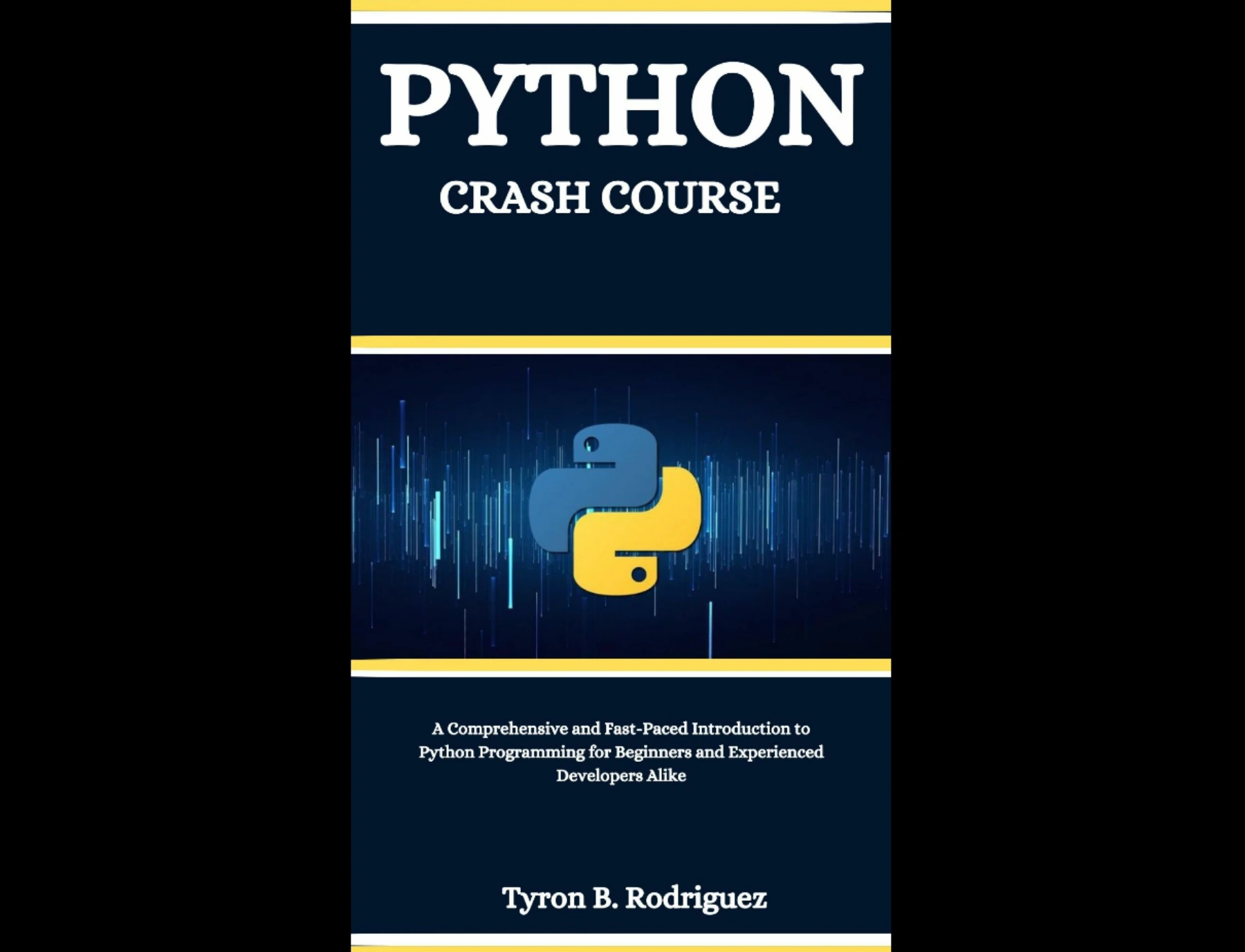
Beginners who want a structured introduction to Python concepts, with project chapters to apply them.
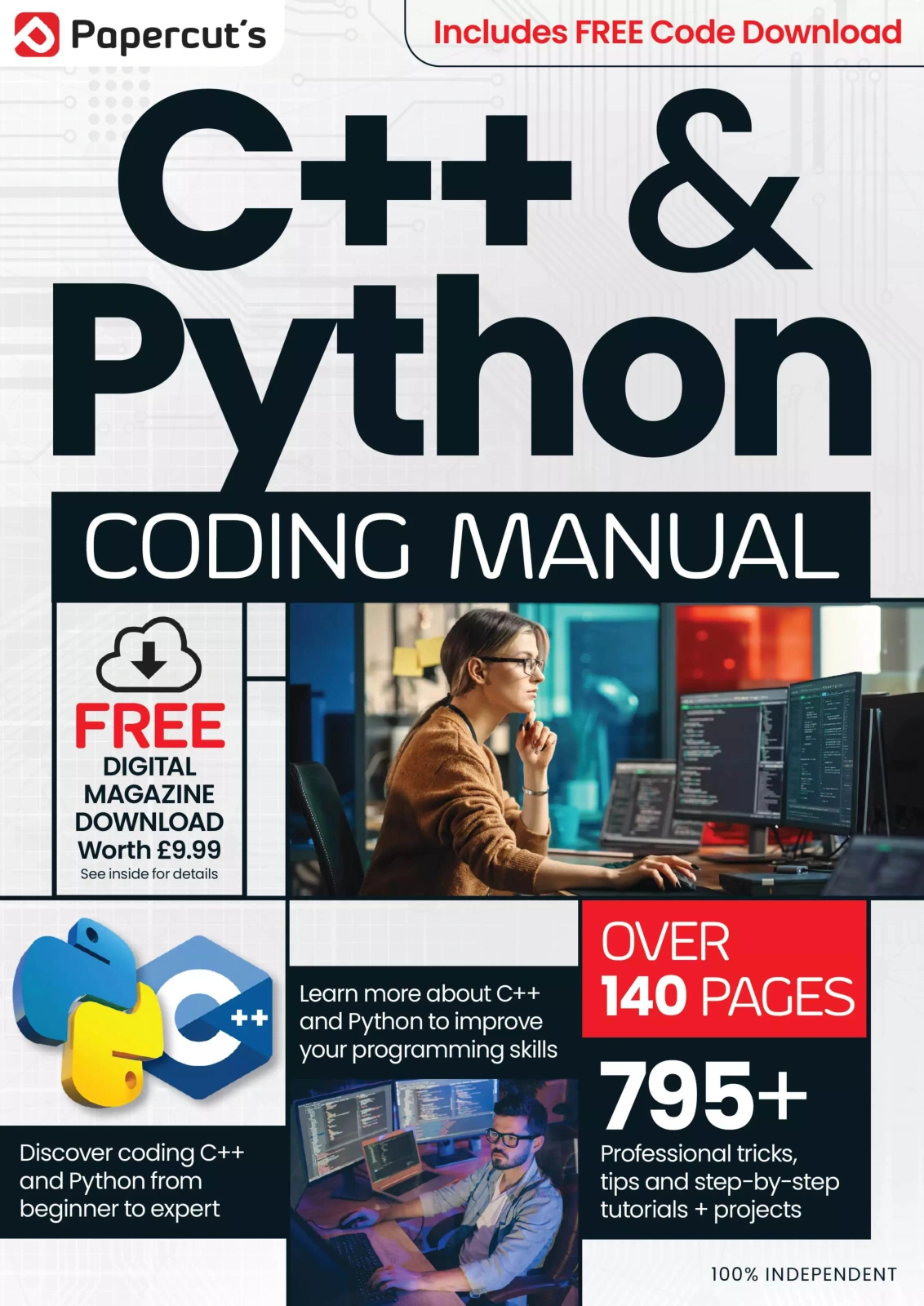
The Complete C++ & Python Manual – 19th Edition 2024
By Papercut
Readers curious about both languages who want a combined overview; it is not presented as a standalone C++ text.
Common beginner mistakes to avoid
- Choosing by reputation alone. Pick the language that fits your actual course, project, or learning goal.
- Reading without writing code. Type examples, change them, and try to predict what will happen before running them.
- Taking on too much at once. Learn a few fundamentals and use them in a small project before jumping to advanced topics.
- Treating every error as a dead end. Read the message, identify where it points, and test a focused correction.
- Ignoring tool and version requirements. Match the setup in your lessons to the version and compiler or interpreter you are using.
- Assuming a book or language will do the work for you. A resource provides structure; progress comes from repeated practice and problem-solving.
Frequently asked questions
Is Python easier than C++ for beginners?
Python is often a reasonable default for a first programming experience because its syntax is readable and its interactive interpreter supports quick experiments. However, there is no supplied head-to-head study showing that every beginner learns Python faster or finds it easier. Your prior experience, learning materials, goals, and setup all matter.
Is C++ too hard to learn as a first language?
No. C++ can be taught to beginners, including learners with no previous programming experience. Expect to follow compiler and build instructions and to encounter explicit types; more advanced topics such as pointers can come later in a structured course.
Should I learn Python before C++?
Not necessarily. Learn Python first if you want a general, relatively low-friction introduction and have no reason to begin elsewhere. Start with C++ if a course or project requires it, or if C++ is your specific goal. Either way, plan to learn the second language’s tools and conventions separately.
Which language should I learn for a programming course?
Use the language and toolchain specified by the course. Matching the course materials makes it easier to follow examples, submit work, and get help with setup. If the course does not specify a language, choose according to the projects and concepts you want to explore.
Can Python and C++ be learned at the same time?
It is possible, but beginners may find it clearer to focus on one language until they can write and debug small programs. After that, comparing similar projects in both languages can help you understand their different syntax and workflows.
Conclusion: choose the language that serves your next step
For a beginner without a specific requirement, Python is a practical starting point: it offers a readable way to practise programming basics and try small experiments. C++ is equally valid when a course, project, or personal goal points toward it. The best choice is the one you will use to write, test, and improve actual programs.
Before choosing a book or course, check its assumed experience, language version, setup steps, and opportunities for practice. The official Python tutorial explicitly expects some prior programming knowledge, so absolute beginners may prefer a resource that starts with fundamentals. C++ materials also vary, so confirm that their compiler and language-version requirements fit your situation.
Sources and further reading
- The Python Tutorial — Python documentation: describes Python’s features and notes the tutorial’s assumed programming background.
- Beginning C++23: From Beginner to Pro: publisher information on a C++ text described for learners starting from the beginning.
- Starting Out with C++ from Control Structures through Objects: publisher description of a beginner-oriented C++ textbook and its listed topics.