
Python vs JavaScript for Beginners: Which Should You Learn First?
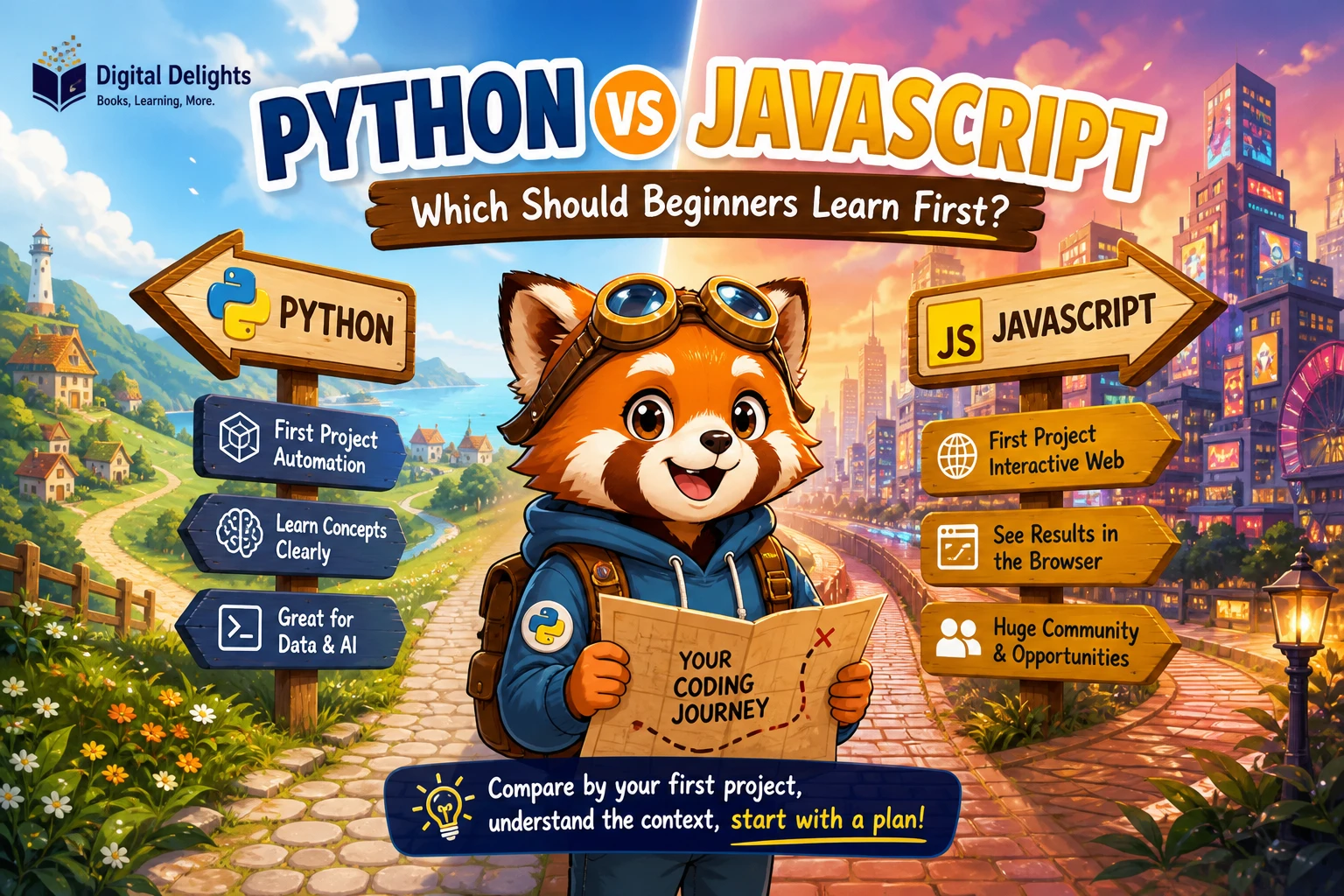
If you are choosing between Python and JavaScript, start with the kind of thing you want to make. Choose Python if you want a general-purpose introduction to programming, scripting, or small standalone programs. Choose JavaScript if your first goal is to make web pages interactive. Neither is the best first language for everyone; the right choice depends on which outcome will keep you practising.
Both languages can teach you core programming ideas, including variables, conditions, loops, and functions. The difference is the context in which you are likely to use them first. This guide compares those starting points, gives you a simple way to choose, and lays out a practical first-week plan.
Python vs JavaScript for beginners: the short answer
| Your goal | Good first choice | Why |
|---|---|---|
| Learn general programming concepts or write small scripts | Python | Its official tutorial introduces it as useful for scripting and rapid application development, with fundamentals such as control flow, functions, and data structures. |
| Add interaction to a website | JavaScript | It is used to make web pages respond to actions such as clicks and form input. Browser projects may also involve HTML and CSS. |
| You are undecided | Either one | Pick a small project you would enjoy and use it to guide your choice. The basic programming concepts you practise will be useful when you meet another language. |
That is a practical recommendation, not a claim that one language is objectively easier. The supplied research does not establish a measured head-to-head comparison of beginner difficulty.
What are Python and JavaScript commonly used for?
Python: a general-purpose starting point
Python is a general-purpose language often used for scripting and rapid application development. Its official tutorial moves through topics such as the interpreter, control flow, functions, and data structures, giving beginners a route into the building blocks of programming. You can start with short experiments and gradually combine them into a script or a small project.
Python may be a natural fit if you want to learn how programs work without making a website your first project. It is also a reasonable choice if you are curious about using code for practical tasks. The language alone will not teach every tool needed for a particular field, but it gives you concepts to build on.
JavaScript: a direct route into web interaction
JavaScript is closely associated with interactive websites. In a browser-based project, it can respond to user actions and change page content. Learning that in context often means understanding how JavaScript works with HTML, which structures a page, and CSS, which styles it. A beginner resource from O’Reilly presents these web technologies together, rather than treating browser-based JavaScript as an isolated topic.
This makes JavaScript a practical first choice if you want your early exercises to turn into visible website behaviour. It does not mean JavaScript can only be used in a browser; the recommendation here is about a common beginner route, not a limit on the language.
Which language suits your first project?
| If you want to… | Consider starting with… | A manageable first project |
|---|---|---|
| Make a page react to a button or form | JavaScript | A page that updates a message when someone clicks a button |
| Practise general programming with a small standalone task | Python | A simple quiz, number-guessing game, or text-based checklist |
| Explore before committing to a longer learning path | Whichever project sounds more interesting | Try a few small exercises in one language before deciding what to study next |
The project matters because it gives each new idea a purpose. A loop is easier to connect to a quiz that asks several questions; an event handler makes sense when a button needs to do something. You do not need to select a language based on broad claims about which one is more popular or easier.
What do the first steps involve?
Starting with Python
Python offers two useful ways to begin experimenting: enter instructions in the interactive interpreter, or write them in a file and run the file as a script. The Python documentation describes both modes of use. An interactive session is convenient for trying a short expression; a saved script is more useful once you want to keep a program and build on it.
For a first sequence of study, work through:
- Values, variables, and basic data types
- Conditions that let a program make choices
- Loops that repeat an action
- Functions that group reusable instructions
- Lists or other basic structures for handling collections of information
Starting with JavaScript
If your goal is browser-based JavaScript, learn enough HTML to identify the elements on a page and enough CSS to understand its basic presentation. Then practise writing JavaScript that responds to an event, such as a click, and updates a page element. You can keep the first page very small; the aim is to understand how the pieces connect, not to build a complete website immediately.
JavaScript can also be used outside the browser, but the supplied research does not establish current runtime or version guidance. For a browser-first project, follow a learning resource that clearly explains its setup and examples rather than assuming every JavaScript workflow is identical.
Will learning one make the other easier later?
Learning one language gives you practice with ideas that also appear in other programming contexts: storing values, branching, repeating operations, breaking a problem into steps, and writing functions. That prior practice can help you recognize familiar concepts when you encounter a second language, although the syntax and surrounding tools will still need to be learned.
Do not treat your first choice as a permanent commitment. It is usually more useful to complete a small project and understand the fundamentals than to spend a long time comparing languages before writing any code.
A practical first-week plan
This is a flexible sequence, not a promise that you will master a language in a week. Adjust the pace to your available time and give yourself room to repeat exercises.
- Choose one goal. Decide whether you would rather make a small general-purpose program or add an interaction to a web page.
- Choose one language and one structured resource. Avoid switching between several tutorials before you have completed the basics.
- Practise one concept at a time. Write small examples using variables, conditions, loops, and functions. Change the examples and observe what happens.
- Build a tiny project. Keep it simple enough to finish, such as a text quiz in Python or a button that changes page content with JavaScript.
- Review and extend it. Find one improvement, such as handling an unexpected answer or adding a second interaction. Make a note of what you had to look up.
If a book helps you keep a steady sequence, A beginner’s guide to Python covers foundational topics including variables, loops, functions, data structures, and practice problems. For a browser-focused path, JavaScript For Beginners: The Complete Modern Guide To Start Learn Quickly And Easily Javascript Language. Coding And Program With Tips And Tricks covers programming basics, the DOM, events, and forms. Its catalog description identifies an XHTML-centered approach and a 2020 publication date, so check whether that treatment matches the tools and examples you want to study today.
Beginners who want a focused first guide covering variables, loops, functions, data structures, and exercises.
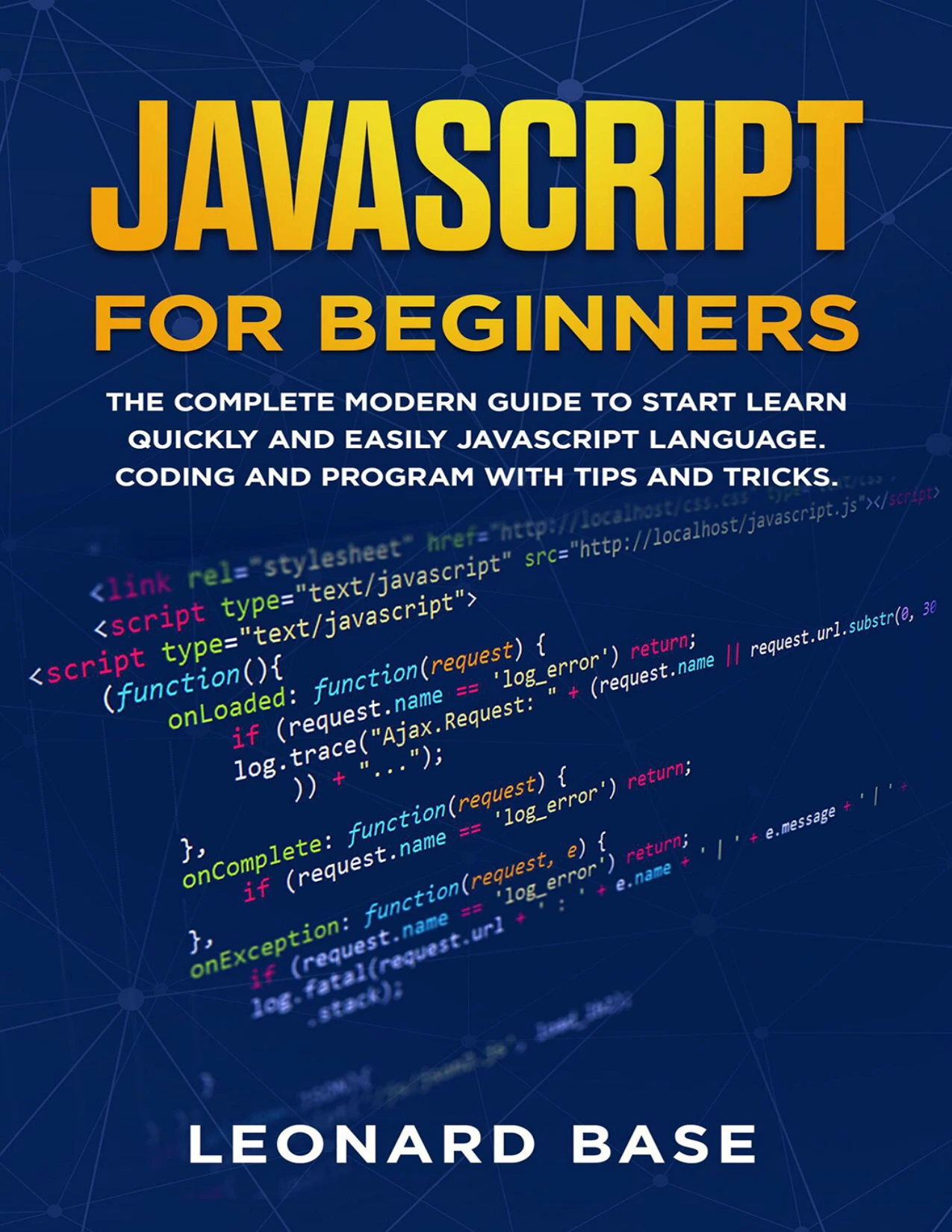
By Leonard Base
Learners exploring browser JavaScript who are comfortable checking an XHTML-centered guide published in 2020 for fit with their current learning materials.
Common beginner mistakes to avoid
- Choosing based on “the easiest language.” There is no comparative study in the supplied evidence proving that Python or JavaScript is objectively easier for every beginner. Choose by your goal and the project you want to make.
- Switching languages before practising the basics. A new tutorial can feel exciting, but frequent restarts make it harder to see how concepts fit together. Finish a few small exercises first.
- Reading without writing code. Programming concepts become more concrete when you type examples, change them, and inspect the result.
- Making the first project too ambitious. Start with one feature. A finished, simple project gives you something to learn from and improve.
- Assuming JavaScript means only JavaScript. For browser projects, HTML and CSS are often part of the learning context too. Plan for those related basics rather than treating them as a surprise.
Frequently asked questions
Which is easier for beginners, Python or JavaScript?
There is no evidence in the supplied research that establishes one as objectively easier for all beginners. Python is a reasonable choice for general programming practice; JavaScript is a direct choice for browser interactions. The more useful test is which project you want to work on.
Do I need to learn HTML and CSS before JavaScript?
You do not need to learn every part of HTML and CSS before writing any JavaScript. For browser-based projects, however, basic familiarity helps you understand the page elements JavaScript will interact with and the styles CSS controls.
Can I learn Python and JavaScript at the same time?
You can, but many beginners find it simpler to focus on one language long enough to practise its fundamentals and finish a small project. Once you have a clearer grasp of variables, conditions, loops, and functions, you can decide whether to add the other language.
Which should I learn first for building websites?
If your immediate goal is interactive behaviour in a website, start with JavaScript and learn the HTML and CSS basics needed to work with the page. If you mainly want general programming practice before choosing a web path, Python is also a reasonable starting point.
Conclusion: choose the language that gets you building
For general-purpose programming practice, begin with Python. For interactive browser projects, begin with JavaScript and expect to learn some HTML and CSS alongside it. If you are undecided, choose the smallest project that genuinely interests you, commit to one language for the first set of fundamentals, and build something you can finish.
The best first step is not finding a universal winner between Python and JavaScript. It is writing a little code, seeing what it does, and using that experience to choose what to learn next.
Sources and further reading
- The Python Tutorial — official overview of Python and core programming topics.
- Using the Python Interpreter — describes interactive use and running script files.
- HTML, CSS, & JavaScript All-in-One For Dummies — publisher material framing browser JavaScript with HTML and CSS.