
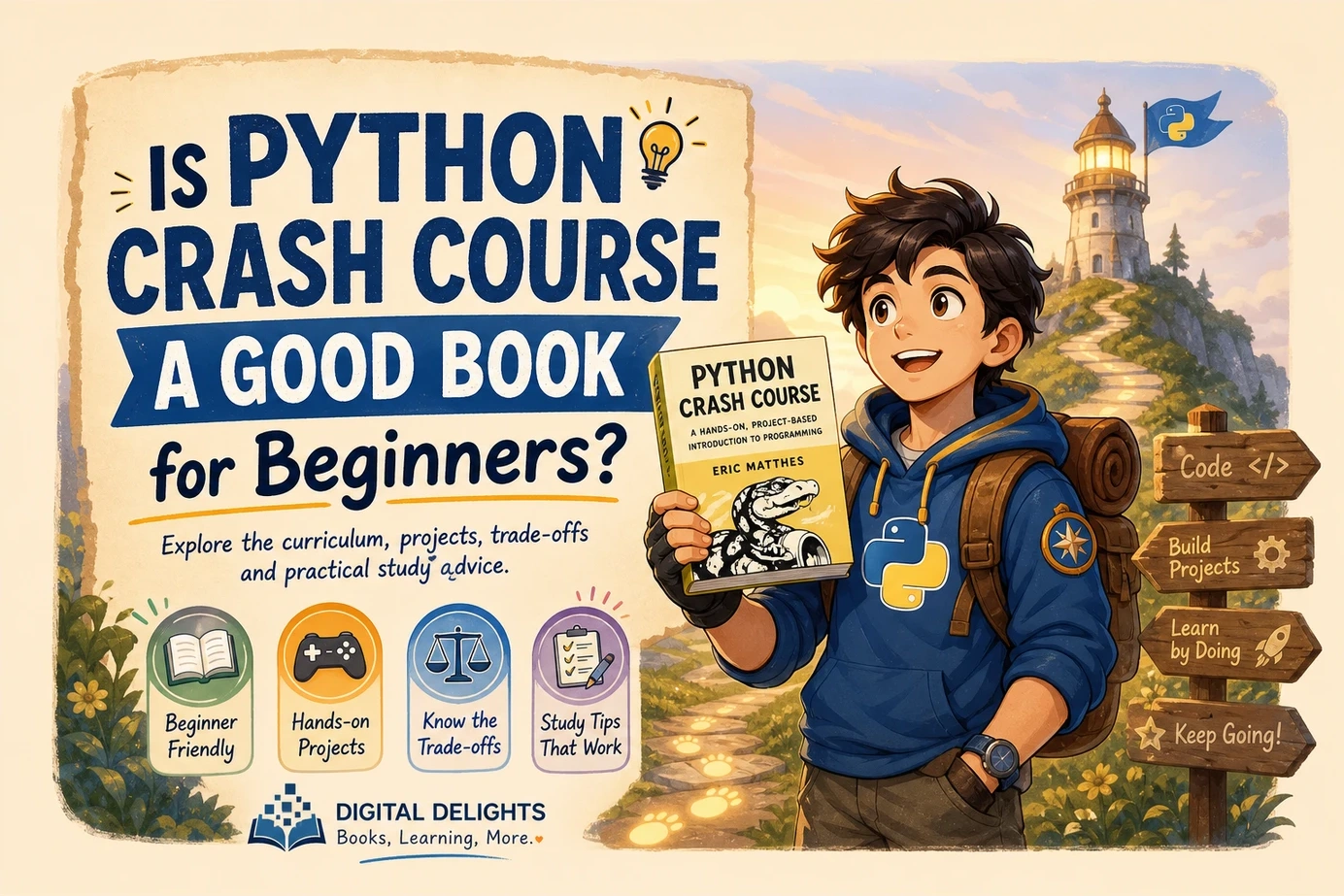
Is Python Crash Course a Good Book for Beginners?
Yes—Eric Matthes’s Python Crash Course, 3rd Edition is a strong candidate for beginners who want an ordered introduction to Python followed by practical projects. Its curriculum starts with setup and language fundamentals, then moves into building a game, visualizing data and creating a web application. That makes it worth considering if you want a path from learning individual concepts to combining them in working programs.
The qualification matters: a well-organized curriculum does not prove that every reader will find the explanations easy or the projects trouble-free. This guide assesses the book’s suitability from its documented contents, not from personal testing or measured learning outcomes. It focuses specifically on Matthes’s third edition—not other books with similar titles.
What does Python Crash Course teach?
The publisher’s detailed contents for the third edition show a progression from getting Python running to organizing, testing and applying code. This is a structured introduction rather than a collection of unrelated programming recipes.
Language fundamentals before larger applications
The foundational material covers:
- Installing Python, setting up an editor and running programs.
- Variables, strings, numbers and basic data types.
- Lists, dictionaries and ways to work with collections.
- Conditional statements, user input and loops.
- Functions, classes and program organization.
- Files, exceptions and testing.
For a newcomer, the value of this sequence is that later tasks can draw on earlier ideas. A program that processes information, for example, may need a collection to store it, a loop to examine it, a condition to make a decision and a function to keep the work organized.
The contents also include exercises alongside the lessons. Treat these as opportunities to check understanding rather than optional reading: following an example and solving a slightly different problem are different tasks.
Projects that introduce three directions
The project sections cover a game using Pygame, data visualization and a Django web application. They also introduce topics such as APIs, virtual environments and deployment, as documented in the third-edition project contents.
These choices give an undecided learner several ways to apply Python. Games involve program behavior and interaction; visualization involves working with information and presenting it; web applications involve organizing an application for users.
That breadth is useful for exploration. It should not be mistaken for exhaustive training in game development, data science or web development.
Who is Python Crash Course for beginners best suited to?
The strongest fit is a learner who wants a coherent route through the basics and is willing to spend substantial study time writing code.
Complete newcomers who prefer an ordered path
If disconnected tutorials leave you unsure what to learn next, the book’s sequence offers a practical advantage: you can follow one curriculum instead of repeatedly choosing your next lesson. Its coverage begins with setup and early programming concepts, so you do not need to arrive already knowing Python.
However, starting from the beginning does not eliminate the need for patience. You may need to revisit a concept, repeat an exercise or seek another explanation before it makes sense.
Self-directed learners who will troubleshoot
A programming book works best as a companion to active practice. Expect to edit files, run programs, read error messages and compare what happened with what you intended.
If you want someone to inspect your code and explain a mistake immediately, a book alone will not provide that feedback. A class, study group or guided learning platform may better address that particular need.
Readers who want to explore before specializing
The range of projects makes the book a reasonable candidate if you know you want to learn programming but have not chosen an application area. If your only goal is automating a specific spreadsheet task, however, you may prefer a narrower resource after learning the necessary fundamentals.
Good fit checklist:
- You prefer written explanations and a defined sequence.
- You are willing to complete exercises, not just read examples.
- You want to explore games, visualization or web applications.
- You can accept troubleshooting as part of the learning process.
Consider another format if:
- You need live explanations or frequent individual feedback.
- You strongly prefer demonstrations to reading.
- You already understand programming and mainly need Python-specific reference material.
- You need the shortest route to one narrowly defined task.
What are the trade-offs?
Breadth versus a focused goal
A broad introduction can help you discover what interests you. The trade-off is that some project topics may not match your immediate goal. A learner interested only in data analysis does not need to treat every application area as equally relevant.
Use the fundamentals to build a base, then choose a project that motivates you. There is no need to interpret a broad curriculum as a requirement to specialize in everything it introduces.
Written instruction versus immediate feedback
A book lets you pause, reread and study at your own pace. But it cannot diagnose your particular misunderstanding. If you repeatedly reproduce an example without understanding why it works, changing your study method may help more than reading additional pages.
Try explaining the code in plain language, tracing the values through it or working through a smaller example. If you still cannot identify the missing idea, seek a second explanation or human feedback.
Programming practice versus environment setup
The documented curriculum includes installation and later work with external tools. This means some study sessions will involve setup rather than new language concepts.
A useful troubleshooting distinction is whether an error concerns your program’s logic or its environment. An incorrect condition calls for examining the code; a missing package calls for checking installation and the environment in which the program runs. Treating every failure as a lack of programming ability can make routine setup problems unnecessarily discouraging.
Finishing the book versus independent proficiency
Completing guided projects is not the same as designing a new program without instructions. The next step is to make decisions the book has not already made for you: choose inputs, organize information, handle unusual cases and decide how to check the result.
The available evidence does not establish job readiness, mastery or a reliable time to proficiency. A more useful goal is to become increasingly capable of explaining, modifying and extending your own code.
How to use the book effectively
The following is an editorial study plan, not a guaranteed schedule. Move forward when you can use an idea, rather than when you have merely read about it.
- Read one manageable concept. Write down what problem it helps solve.
- Run the example. Predict its behavior before executing it, then compare the result.
- Complete an exercise. Try without copying the example first; consult the explanation when needed.
- Change one requirement. Add an input, handle another case or produce a different output.
- Explain the result. Describe how the data moves through the program and why each major step exists.
Use a small modification to check understanding
Suppose you have written a program that loops through a list of expenses and calculates a total. Instead of immediately moving on, change the task:
- Separate essential and optional expenses.
- Count how many expenses exceed a chosen threshold.
- Move the calculation into a function.
- Decide what the program should do when the list is empty.
This is an original practice suggestion, not a description of a specific book exercise. Its purpose is to turn familiar syntax into decisions you make yourself.
Keep an error notebook
For an error that took effort to solve, record the message, the cause and the change that fixed it. Include what you misunderstood—not just the corrected code. That gives you a record to consult when a similar problem appears.
Add an original feature to a project
After completing a guided project, add something small that was not part of the instructions. For a game, that might be a scoring variation; for a chart, another comparison; for a web application, a different way to organize entries.
Choose a feature small enough to reason about. The objective is independent problem-solving, not making the project impressive.
Should you choose it over free resources?
Price alone does not tell you whether two resources meet the same need. The official Python tutorial explicitly assumes a basic understanding of programming. It is intended for programmers learning Python, not readers entirely new to programming.
That distinction supports choosing by audience and format rather than assuming either a paid book or free documentation is automatically better.
| Resource or format | When to consider it | Important consideration |
|---|---|---|
| Python Crash Course, 3rd Edition | You want a written sequence from fundamentals into projects. | You still need active practice and a way to work through difficulties. |
| Official Python tutorial | You already understand programming and want to learn Python. | It assumes basic programming knowledge. |
| Interactive lessons | You prefer short tasks with an immediate response. | Check whether the resource helps you move beyond guided exercises into independent work. |
| Video lessons or a guided class | You prefer demonstrations or need opportunities to ask questions. | Watching a solution should not replace writing and changing code yourself. |
Decision rule: choose the book if its written, project-oriented structure matches how you want to study. Choose documentation if you already know programming and mainly need to learn Python’s conventions. Combine formats when another explanation resolves a specific difficulty.
Frequently asked questions
Can I start Python Crash Course with no programming experience?
It is a reasonable candidate: the third-edition contents begin with setup and foundational concepts before moving into larger projects. You should still expect to practise, revisit unfamiliar ideas and troubleshoot. Beginner-level coverage is not a promise that every lesson will feel easy.
Which edition should I choose?
This assessment covers the third edition, which O’Reilly lists as published in January 2023. Check the author and edition before choosing, then consult the publisher’s current listing. The supplied evidence does not establish differences between editions or justify calling this the latest edition.
Will the projects work with current software?
The supplied research does not confirm that every project runs unchanged with current Python releases, dependencies or hosting services. Before starting a project, check the book’s official companion guidance and errata for relevant version instructions. Do not assume an installation or deployment mismatch means the underlying programming concept is wrong.
How long should I expect to spend?
There is no supported universal completion time. Your pace will depend on prior experience, study habits, exercises and troubleshooting. Measure progress by what you can explain and build: running an example, changing its requirements and solving a related task without a complete template.
Is it enough to become job-ready?
The evidence supports describing it as an introduction, not a job-readiness guarantee. After guided work, continue with independent projects and the skills required for your chosen direction. Finishing the final chapter is a milestone, not proof of professional proficiency.
Does Digital Delights stock Eric Matthes’s full book?
The catalog records available for this guide do not include a matching listing for Eric Matthes’s Python Crash Course, 3rd Edition. Similarly named books by other authors are different resources and should not be treated as substitutes for this edition.
Final recommendation
Python Crash Course, 3rd Edition is worth considering if you want an ordered beginner curriculum, prefer learning from text and find its project areas appealing. Its documented structure gives a clear reason to shortlist it; it does not establish that it is the best choice for every learner.
Before choosing, review an authorized sample and ask whether the explanations suit you. Then plan to write code alongside the reading, complete exercises and extend a project independently. If you are exploring other learning directions, Digital Delights’ Python books and learning resources offer a browsing route—not a verified listing for the full book reviewed here.
Sources and scope
This suitability guide draws on curriculum and publication information, not firsthand testing or comparative learning studies.
- No Starch Press: detailed contents for Python Crash Course, 3rd Edition—the basis for coverage and project descriptions.
- O’Reilly: Python Crash Course, 3rd Edition—publication information.
- Official Python tutorial—its stated audience and prerequisites.