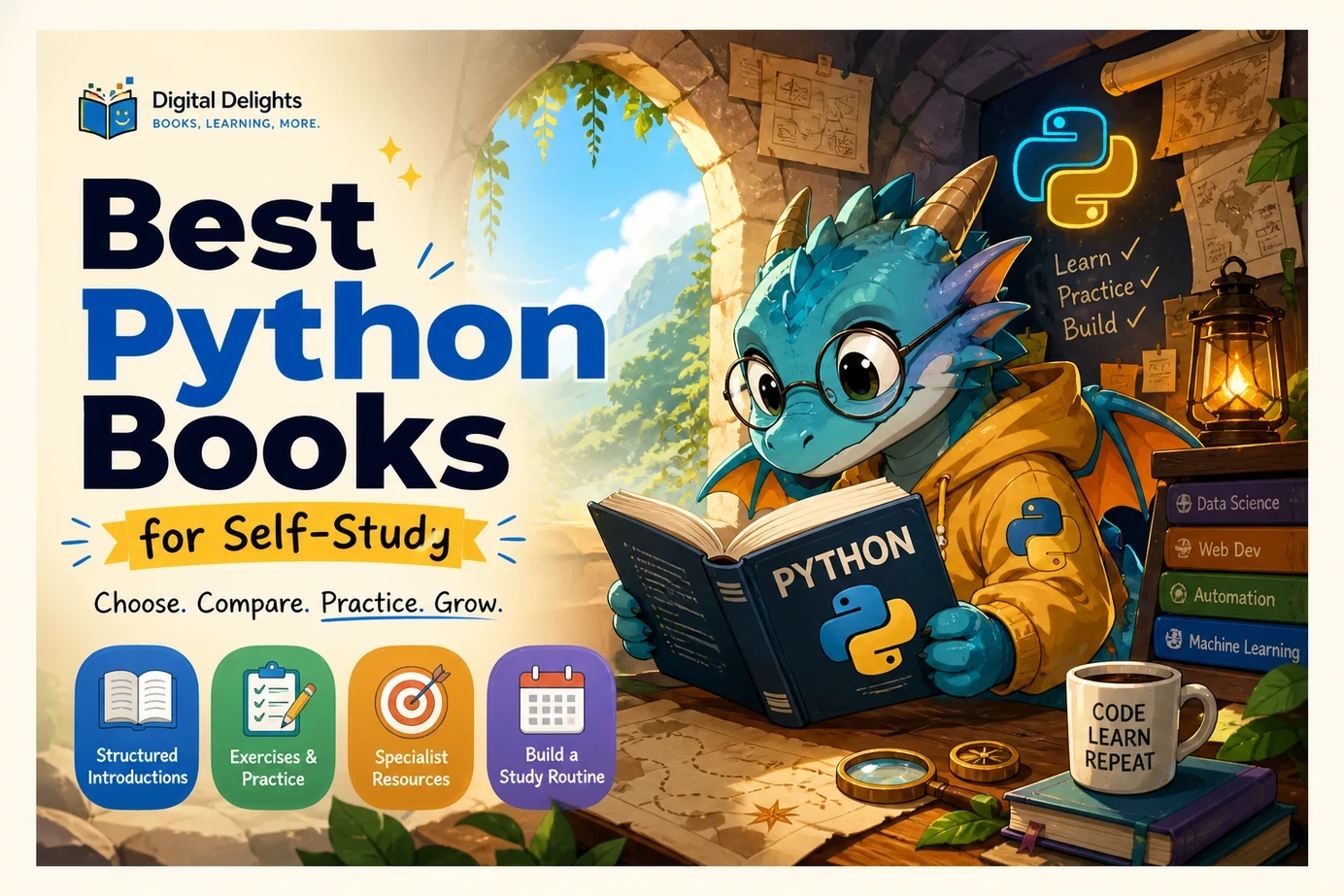
Best Python Books for Self-Study
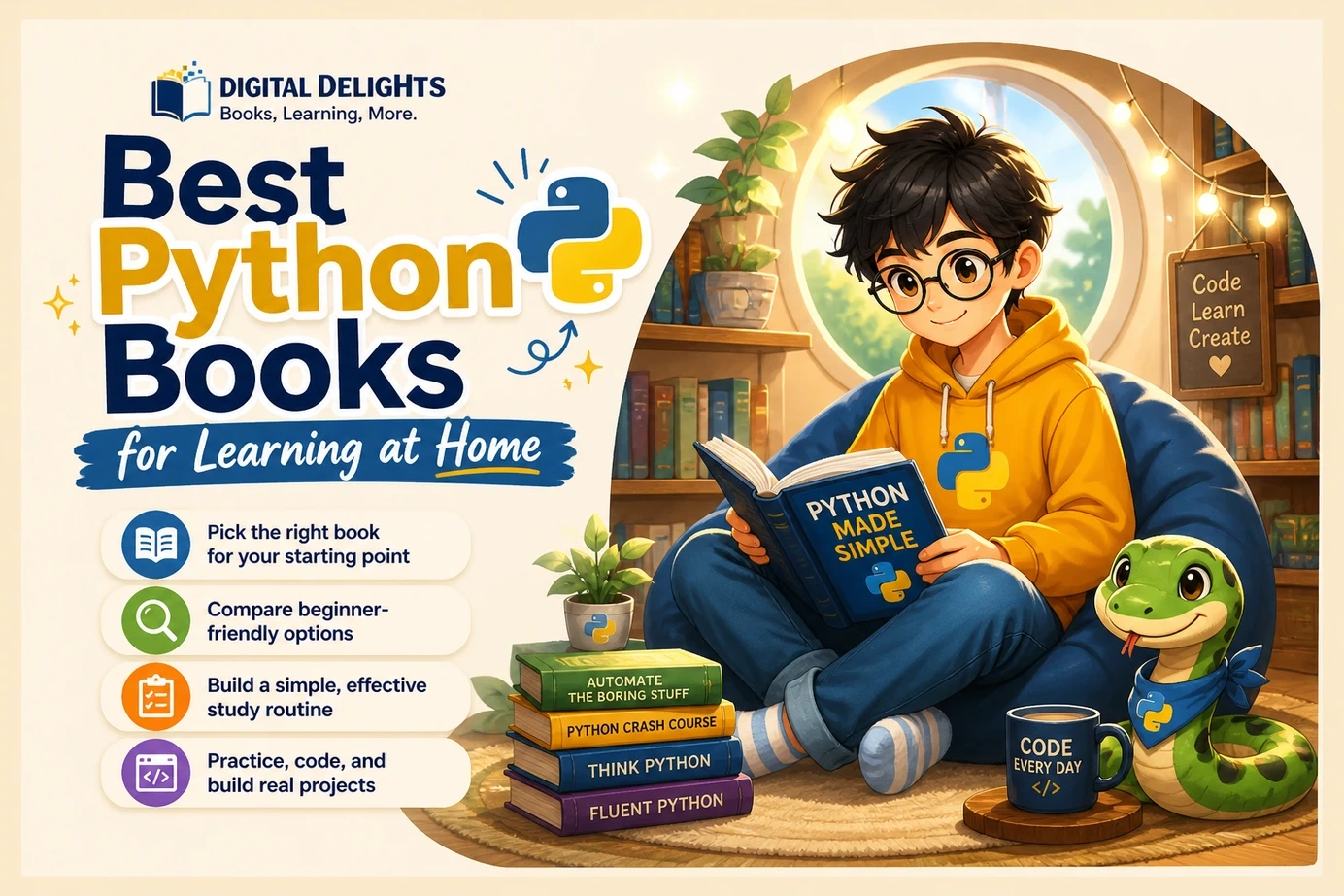
The best Python books for self-study give you more than explanations: they help you write code, check your understanding, and decide what to practise next. Start with one structured introduction rather than several overlapping beginner books. Add an exercise collection if you need more practice, and leave specialist subjects until you can write small programs independently.
For a practice-led introduction, consider Python Bootcamp: A Rapid Crash Course Featuring Q&A Sessions, Exercises, and Projects. If you prefer textbook-style study with questions and solutions, look at Basics of Python Programming – 2nd Edition. For additional coding practice, 1000 Python Examples serves a different role: a companion you can work through alongside your main book.
This guide compares resources by their documented scope and intended use—not by unsupported ratings or firsthand testing—and shows how to turn reading into useful programming practice.
Best Python books for self-study: quick picks by goal
Choose the role you need first. A foundation book explains the language; a practice companion helps you apply it; a specialist textbook takes you into a particular subject.
| Book | Suitable reader | Learning emphasis | Self-study support described | Main consideration |
|---|---|---|---|---|
| Python Bootcamp: A Rapid Crash Course Featuring Q&A Sessions, Exercises, and Projects | Beginners seeking a practice-led start | Python 3 setup and introductory programming | Q&A sessions, exercises, and projects | The described opening setup uses Windows |
| Basics of Python Programming – 2nd Edition | Beginners who prefer a structured textbook | Fundamentals followed by broader programming topics | Worked examples, exercises with solutions, and knowledge-check questions | Later topics extend beyond what you need for your first scripts |
| 1000 Python Examples | Learners who want additional coding practice | Examples spanning basic and applied Python | Exercises and solutions | Use selected topics rather than treating every example as mandatory |
| Automate the Boring Stuff with Python Workbook | Beginners and returning learners seeking structured practice | Fundamentals and practical automation tasks | Questions, exercises, mini-projects, and solutions | A companion workbook, not the main explanatory textbook |
| Modern Statistics: A Computer-Based Approach with Python | Learners moving toward statistical analysis | Probability, inference, regression, sampling, and time series | Python applications of statistical methods | A statistics-focused next step, not a default first Python book |
These selections are based on the supplied Digital Delights catalog descriptions and supporting source information. They are recommendations for particular learning needs, not evidence that one book produces better results than every alternative.
What makes a Python book suitable for independent learning?
It starts at your actual level
“Beginner” can mean new to Python or new to programming altogether. Those are different starting points. If you have never programmed, look for explanations of variables, decisions, loops, functions, and running a script—not just a tour of Python syntax.
If you already know another language, you may need less introductory explanation. The official Python tutorial explicitly assumes basic programming knowledge, so it is better suited to that reader than to someone encountering programming for the first time.
It gives you a way to check your work
Independent learners need feedback. Exercises with solutions let you compare approaches, while review questions reveal whether you understood an explanation or merely recognized the words.
Before choosing a book, check whether answers cover all exercises or only selected ones. Also distinguish complete worked solutions from brief final answers. The supplied descriptions establish that some resources include solutions, but not comprehensive answer coverage for every task.
It moves from examples to independent tasks
A runnable example is a starting point, not a finish line. Look for opportunities to change inputs, add features, handle errors, and combine concepts in small projects.
A useful selection question is: What will I be able to attempt without copying after this chapter? If the answer is unclear, plan your own small exercise alongside the reading.
Its setup requirements are identifiable
Check the edition, interpreter instructions, required packages, downloadable examples, and errata where available. Do not assume a book supports every current package version simply because its publication date is recent.
Use the official Python downloads page for interpreter downloads, then follow your chosen resource’s setup guidance. If an example fails, record the error and your environment before deciding whether the problem is your code or a version mismatch.
Structured beginner books from the Digital Delights catalog
Python Bootcamp: a practice-led introduction
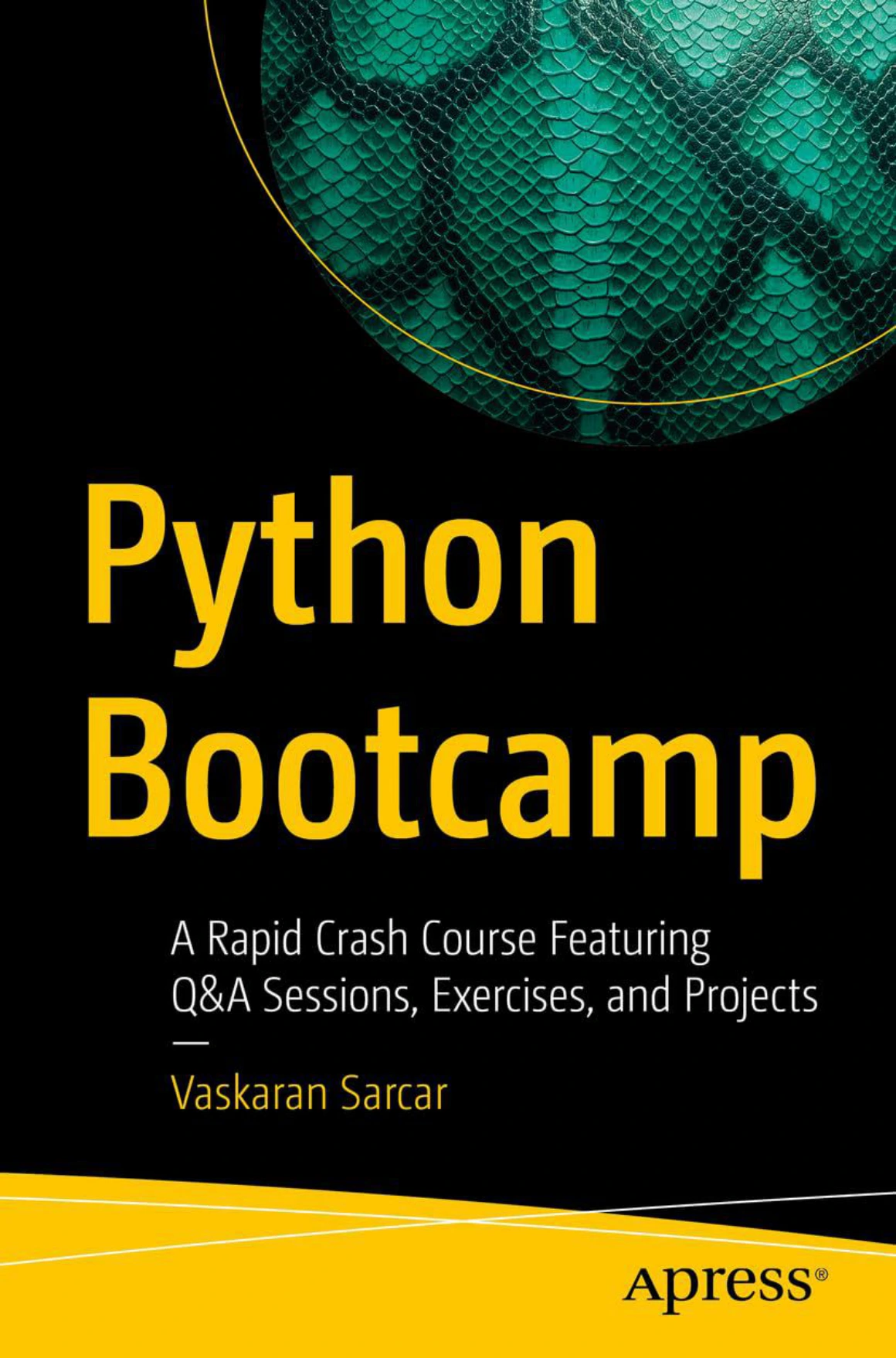
Python Bootcamp: A Rapid Crash Course Featuring Q&A Sessions, Exercises, and Projects by Vaskaran Sarcar is a candidate for readers who want explanations interspersed with questions and practical work.
Python Bootcamp: A Rapid Crash Course Featuring Q&A Sessions, Exercises, and Projects
New learners who prefer introductory explanations paired with questions, exercises, and projects.
The catalog describes a Python 3 introduction beginning with interpreter installation, version checks, and running code through the command prompt or IDLE. Its opening setup is Windows-focused. The supplied Apress publisher source provides a reference for the title.
- Consider it if: you prefer a short explanation followed by something to do.
- Check before choosing: whether the setup guidance matches your operating system and whether the available exercise feedback meets your needs.
- How to study it: answer each question before reading further, then reproduce the example without looking at the page.
“Rapid” describes the book’s positioning, not a guaranteed learning time. Let your ability to solve the exercises determine your pace.
Basics of Python Programming – 2nd Edition: textbook-style study
Basics of Python Programming – 2nd Edition by Pratiyush Guleria suits readers who want an organized route through the language with several kinds of knowledge checks.

Basics of Python Programming – 2nd Edition
Beginners seeking worked examples, exercises with solutions, and several kinds of knowledge checks.
The catalog describes fundamentals such as variables, conditions, loops, functions, and collections, followed by modules, files, exceptions, object-oriented programming, and introductions to NumPy and Tkinter. It also lists worked examples, exercises with solutions, multiple-choice questions, and true-or-false questions. A supplied BPB Publications source accompanies the catalog record.
- Consider it if: you like a course-text format and want to check both conceptual understanding and coding ability.
- Check before choosing: the edition details and sample material; the supplied date and edition metadata need reconciliation.
- How to study it: use the questions to identify weak topics, then write a program that applies each one.
You do not need to master every later topic before building useful beginner projects. Prioritize control flow, functions, collections, files, and basic error handling, then return to additional subjects as your projects require them.
Practice companions for learners who need more coding
1000 Python Examples: learn by examining and changing code
1000 Python Examples by Gábor Szabó is an example-led resource rather than a purely explanatory textbook. The catalog describes examples, exercises, and solutions covering foundations, strings, loops, files, dictionaries, exceptions, regular expressions, and more advanced topics. The supplied original source is the Leanpub book page.
By Gábor Szabó
Learners who want to practise concepts through code examples, exercises, and solution comparisons.
It can be useful when you understand a concept in principle but struggle to recognize how it appears in working code. Work on the topics you are currently studying rather than jumping immediately to decorators, multitasking, or GUI examples.
For each example, use this routine:
- Predict its output before running it.
- Explain the purpose of each important statement.
- Change an input or requirement.
- Attempt a related exercise before opening the solution.
The value comes from what you can explain and adapt, not the number of examples you have read.
Automate the Boring Stuff with Python Workbook: structured application
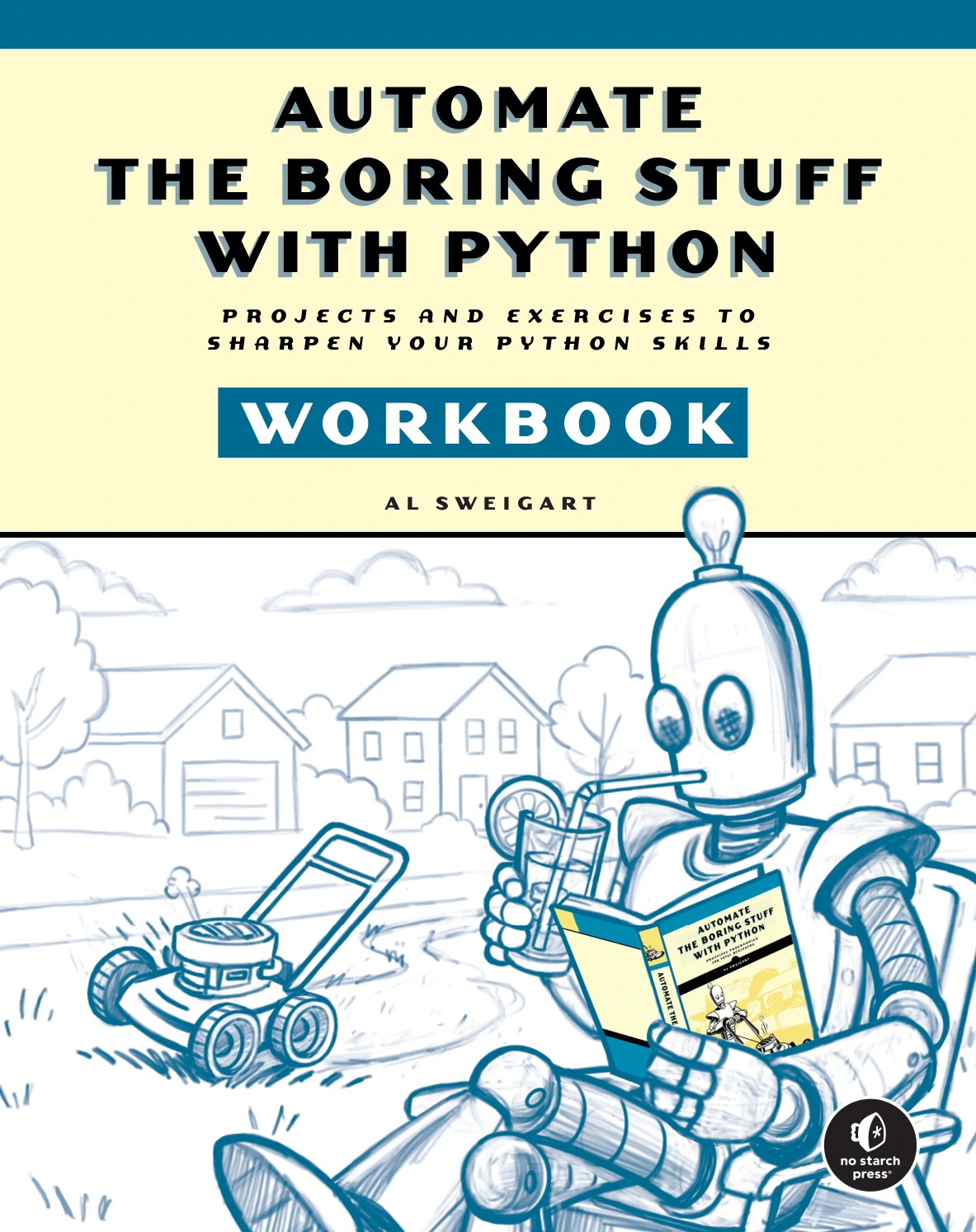
Automate the Boring Stuff with Python Workbook by Al Sweigart is specifically a workbook. Do not confuse it with the main Automate the Boring Stuff with Python textbook.
Automate the Boring Stuff with Python Workbook
By Al Sweigart
Beginners and returning learners seeking questions and mini-projects involving programming and automation tasks.
The catalog describes questions, exercises, mini-projects, and solutions at the back, with tasks involving core programming, files, web scraping, spreadsheets, and databases. The supplied publisher-distributor listing identifies the workbook separately.
This format is worth considering if you want organized practice rather than another explanation of the same fundamentals. However, the supplied material does not establish which edition of the main textbook it accompanies. Confirm that match before planning a chapter-by-chapter study schedule.
For exercises that manipulate files, practise in a temporary folder containing disposable copies. Check the proposed changes before allowing your program to modify anything important.
How to turn a Python book into a self-study plan
A book supplies structure. You still need a repeatable way to move from understanding someone else’s code to writing your own.
Use a read–run–change–solve cycle
- Read a short section. Stop when it introduces one usable idea, such as a loop or dictionary.
- Run the example. Type it yourself and compare the result with your prediction.
- Change it. Try different inputs, add a condition, or alter the output format.
- Solve without copying. Close the example and attempt an exercise from the requirement alone.
- Review the difference. Compare your approach with the solution and explain any changes you make.
Keep a brief learning log with three entries: what you learned, what failed, and what you will try next. Recording a specific error is more useful than writing “I do not understand functions.”
Choose projects that match the chapter
| Concepts studied | Small project | Next improvement |
|---|---|---|
| Input, conditions, and loops | A text-based quiz that counts correct answers | Allow another attempt and explain incorrect answers |
| Lists, dictionaries, and functions | An expense summary grouped by category | Handle empty input and separate calculation from display |
| Files and exceptions | A file-organizing script using disposable sample files | Add a preview mode that reports intended changes without moving files |
These are suggested practice projects, not claims about projects included in the books. Start with the smallest working version, then add one feature at a time.
Use readiness checks instead of a fixed deadline
Before moving beyond the fundamentals, check whether you can:
- Run a script and describe what it does.
- Use a loop and a condition to process a collection.
- Write a function with a clear input and result.
- Read an error message and investigate the relevant code.
- Build a small program from a written requirement rather than a copied solution.
If one item is difficult, return to that topic and practise it in a different context. You do not need to restart the whole book.
What to read after the fundamentals
Your next resource should answer a new need. For deeper language study, look for coverage of Python’s data model, iteration, generators, testing, and code organization. For web development or automation, choose material tied to the kind of application you want to build rather than another general beginner survey.
A statistics-focused path
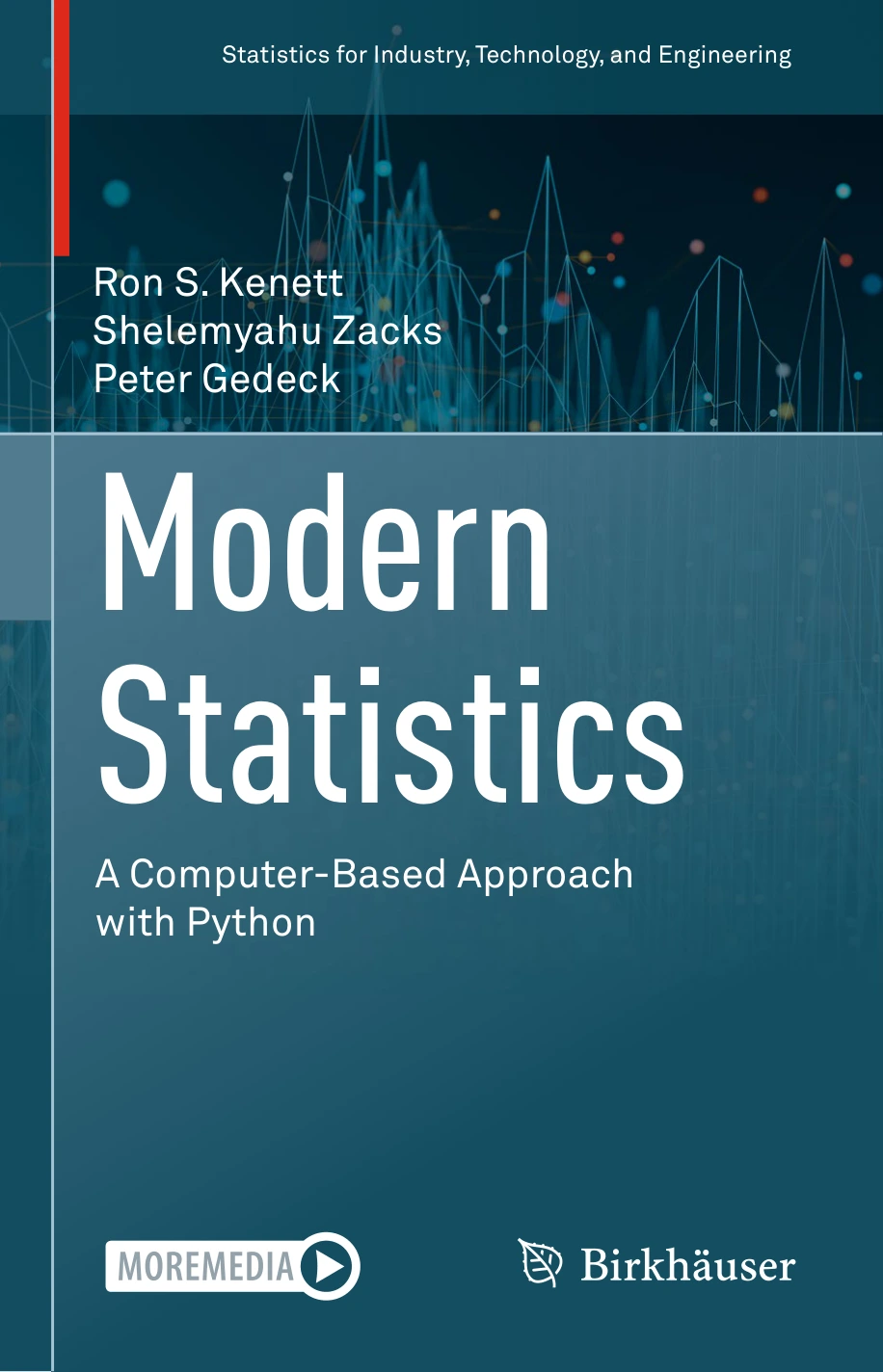
Modern Statistics: A Computer-Based Approach with Python by Ron S. Kenett, Shelemyahu Zacks, and Peter Gedeck is relevant when your goal becomes statistical analysis.
Modern Statistics: A Computer-Based Approach with Python
Learners moving beyond basic programming toward probability, inference, regression, and other statistical methods.
The catalog describes descriptive statistics, probability models, inference, bootstrapping, regression, sampling, and time series, with Python used to apply the methods. The supplied Springer book source identifies this specialist text.
Do not choose it simply because “Python” appears in the title. It asks you to study statistical ideas as well as code. A useful preparation check is whether you can work with functions and collections and identify the mathematical concepts you need to review.
Common mistakes when learning Python from books
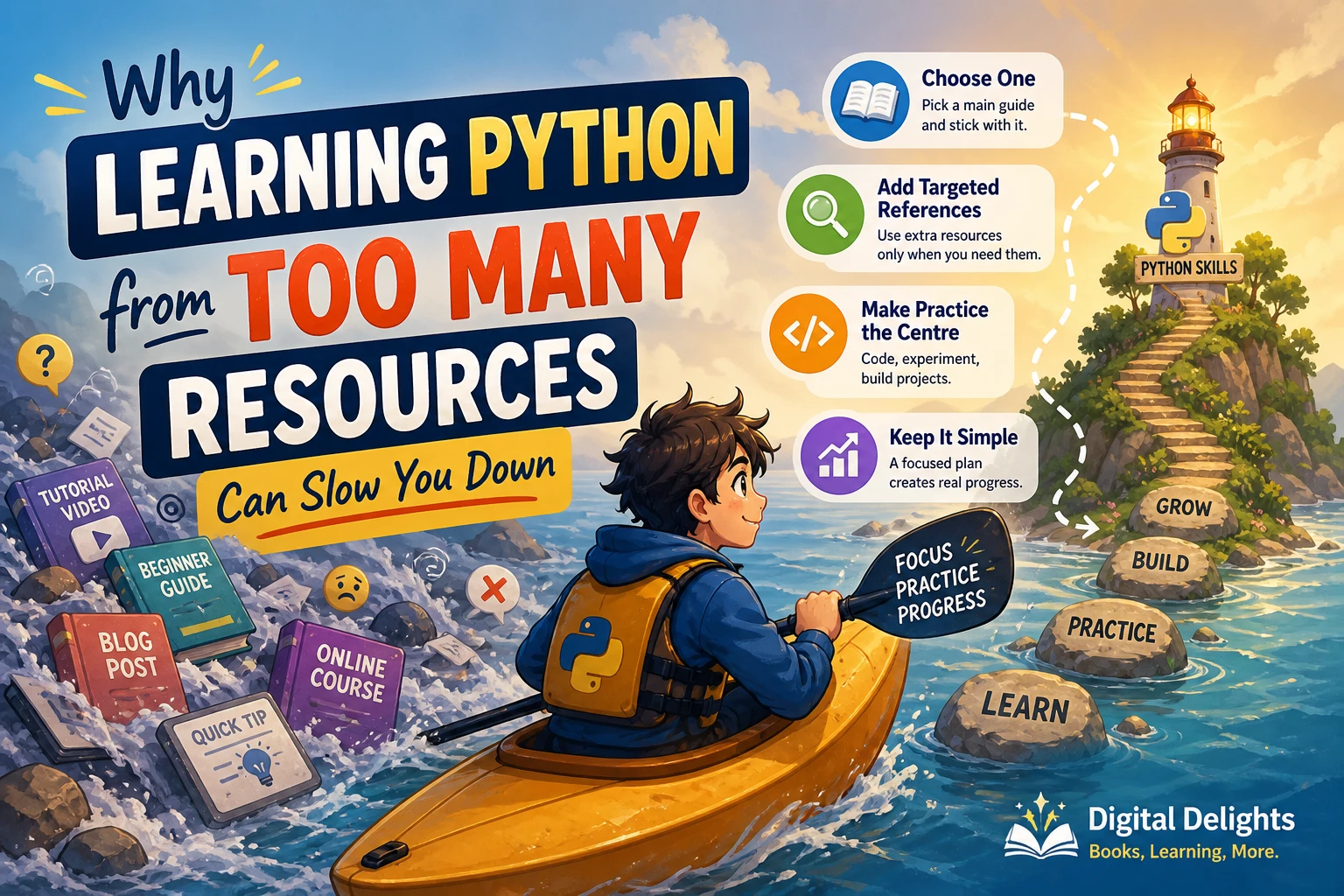
- Collecting overlapping introductions: choose one main explanation source and add practice only when it serves a clear purpose.
- Reading solutions too early: make an attempt first, even if it is incomplete.
- Equating page completion with skill: check whether you can solve a variation without the example.
- Skipping setup details: record the interpreter and packages used so failures are easier to investigate.
- Choosing a specialist book too soon: establish basic programming skills before adding a second demanding subject.
Frequently asked questions
Can I learn Python from books alone?
A book can be your main teaching resource, but reading alone is not enough. Run code, solve exercises, debug mistakes, and build small projects. Documentation and errata can help when the book does not explain an error or an environment difference.
Should I choose a textbook or a workbook?
Choose a textbook if you need explanations and a sequence of concepts. Choose a workbook when you already have an explanation source and need more practice. A companion workbook may assume access to a particular textbook, so check that relationship first.
Are older Python books still useful?
They can remain useful for foundational concepts, but inspect their language version, setup instructions, and external dependencies. Framework examples and installation steps need particular care. Publication year alone does not establish compatibility with your environment.
Is the official Python tutorial suitable for complete beginners?
Not as the default first resource. It assumes basic programming knowledge. Complete beginners can use it as a supplement once introductory concepts make sense; programmers learning Python can use it more directly.
How many Python books should I start with?
One foundation book is enough to begin. Add an exercise resource if you need more practice or a different explanation source if a specific topic remains unclear. You do not need to buy every title in this guide.
Choose one resource and start coding
For a practice-led start, consider Python Bootcamp. For textbook-style structure and varied knowledge checks, consider Basics of Python Programming – 2nd Edition. Use 1000 Python Examples or the Automate the Boring Stuff with Python Workbook when additional practice fits your study plan.
Use the Digital Delights resource descriptions to narrow your choice, check the edition and supporting materials, and begin with one small task. The most useful next step is not finding another reading list: it is writing a program, changing it, and understanding why it works.