

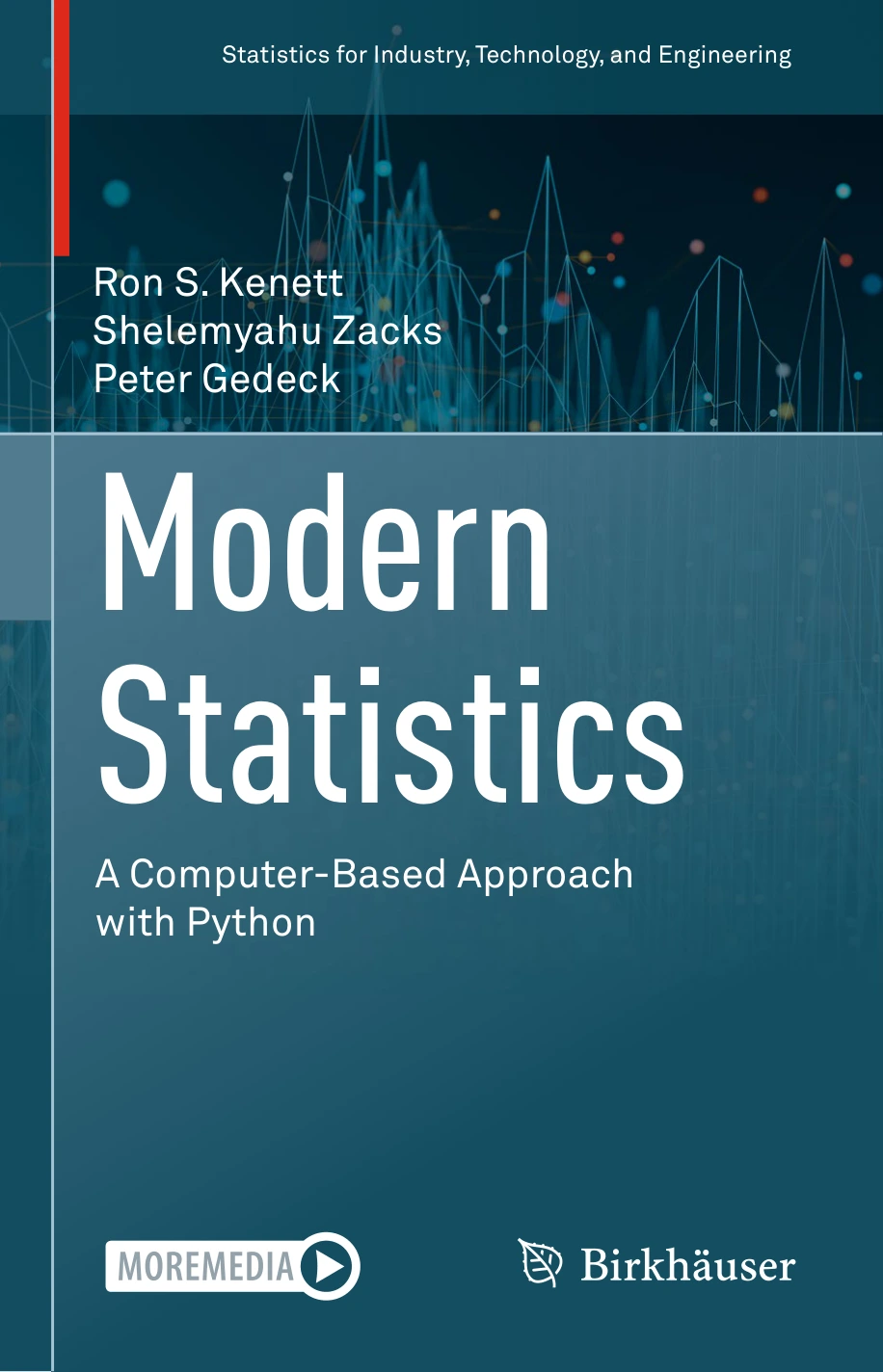
Modern Statistics: A Computer-Based Approach with Python
Original price was: $5.00.$2.50Current price is: $2.50.

Ron S. Kenett
Product Specs:
- File Type: PDF
- File Size: 7.4 MB
- Book Language: English
- Total Page Count: 453
- Instant Download
Modern Statistics, Meet Python 💻
Statistics has always been about turning data into insight. Modern Statistics: A Computer-Based Approach with Python brings that work directly into the Python ecosystem, pairing foundational statistical theory with code that shows how the ideas behave in practice. Written by Ron S. Kenett, Shelemyahu Zacks, and Peter Gedeck, this textbook is part of Springer’s Statistics for Industry, Technology, and Engineering series and is designed for a new generation of analysts, engineers, and students.
Instead of treating computation as an afterthought, the book treats Python as a working partner. Readers move through descriptive statistics, probability models, inference, regression, sampling, time series, and modern data analytic methods while applying each concept with Python tools and real data sets.
What the Book Covers
The material is organized into eight chapters that build a coherent path from basic variability to more advanced modeling:
- Analyzing variability with descriptive statistics, exploratory data analysis, and robust measures.
- Probability models and distribution functions, including conditional probability and Bayes’ theorem.
- Statistical inference and bootstrapping for drawing conclusions from samples.
- Regression models and variability in several dimensions.
- Sampling for estimating finite population quantities.
- Time series analysis and prediction.
- Modern data analytic methods that connect statistics to contemporary data science practice.
Each chapter includes exercises, data sets, and Python applications, making the book suitable for classroom use, self-study, or professional reference.
Case Studies That Anchor the Theory 📊
Across the book, more than 40 case studies show statistics at work. These examples are drawn from science, healthcare, business, defense, and industry, giving readers a sense of how the methods are used when real decisions depend on data. The companion mistat Python package provides the datasets and utilities needed to reproduce the analyses, so readers can follow along, modify the code, and test their own variations.
This combination of theory, code, and application is especially useful for anyone who learns best by doing. The book does not ask readers to accept formulas on faith; it encourages them to run the numbers and see the results.
Who Will Find It Useful
The technical level is designed for both undergraduate and graduate students. It can support a one-semester or two-semester course in modern statistics, as well as programs in data science, industrial statistics, engineering, physics, biology, chemistry, economics, psychology, and the social sciences. Practitioners who want a Python-based refresher or a structured reference will also find the book valuable.
Because the text is a foundational statistics book rather than a narrow guide to one library or framework, it can be combined with many different curricula. The exercises and case studies are built to support flipped classrooms, online learning, and independent study.
Why a Python-Based Approach Matters
Python has become a common language for data analysis, and learning statistics through Python helps close the gap between theory and everyday practice. Readers who work through this book gain experience with the same kind of workflow used in research, industry, and data science teams: load data, explore it, model it, check assumptions, and communicate what the numbers mean.
For those who want to continue further, the book is a companion to Industrial Statistics: A Computer-Based Approach with Python. The two books cross-reference each other but stand alone. Together they offer a deep, practical foundation in applied statistics with Python.
User Reviews
Be the first to review “Modern Statistics: A Computer-Based Approach with Python”
You must be logged in to post a review.
Original price was: $5.00.$2.50Current price is: $2.50.
There are no reviews yet.