Best Python Books for Learning Python Quickly
The best Python books for beginners help you move from reading an explanation to writing something that works. A short book is not automatically faster to learn from, and a large collection of examples is not a checklist you must complete. What matters is whether the resource matches your starting point, gives you enough practice, and supports the kind of program you want to build.
For a practice-led introduction, consider Python Bootcamp. For a compact guide to setup and fundamentals, consider Daniel O’Reilly’s Python for Beginners. Use 1000 Python Examples when you need additional exercises and worked solutions. If you want a broader route into frameworks and development tools, Unlocking Python is another option.
Here, “learning quickly” means making useful progress toward a specific goal—not mastering Python within a promised deadline.
Quick picks: Which Python book fits your goal?
These selections come from the supplied Digital Delights catalog. The comparisons reflect their described scope and format, not personal testing or measured learning outcomes.
| Book | Reader starting point | Learning format and goal | Main consideration |
|---|---|---|---|
| Python Bootcamp | New to programming | Python 3 introduction with Q&A sessions, exercises, and projects | The described setup guidance emphasizes Windows. |
| Python for Beginners | No technical background assumed | Compact route through setup, basic syntax, functions, collections, and files | Compact coverage is not evidence of faster learning; leave room for independent practice. |
| 1000 Python Examples | Beginners seeking practice or learners revisiting a topic | Examples, exercises, and solutions across core and more advanced subjects | Use selected topics rather than treating the whole collection as an introductory assignment. |
| Unlocking Python | New programmers wanting a longer learning path | Fundamentals followed by testing, databases, frameworks, and applied tools | Its breadth calls for a focused reading route, not an attempt to learn every tool at once. |
A practical starting choice: pick either a compact fundamentals guide or a practice-led introduction as your main book. Add an examples resource only when you encounter a specific practice gap.
Best Python books for beginners, organized by learning need
Python Bootcamp — for a practice-led introduction
Vaskaran Sarcar’s Python Bootcamp: A Rapid Crash Course Featuring Q&A Sessions, Exercises, and Projects is the most direct match here for readers who want explanations paired with opportunities to do something. The catalog describes a Python 3 introduction supported by questions, exercises, and projects.
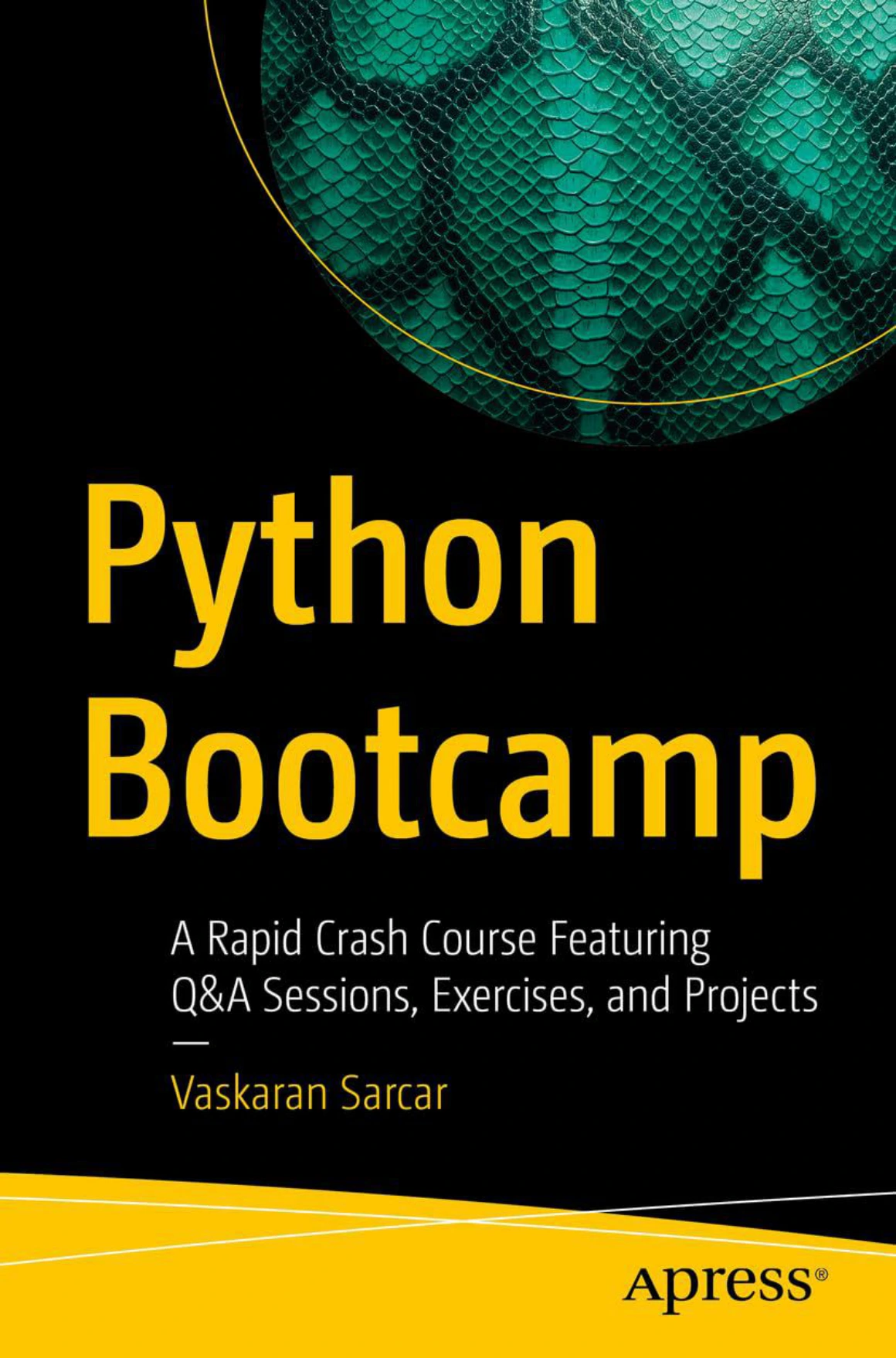
Python Bootcamp: A Rapid Crash Course Featuring Q&A Sessions, Exercises, and Projects
New programmers who want questions, exercises, and projects alongside introductory explanations.
The described opening material covers installing the interpreter on Windows, checking its version, and running code through the command prompt or IDLE. Questions also address early stumbling blocks, such as understanding what a shell is.
- Choose it if: you want a structured introduction with practice built into the learning format.
- Keep in mind: if you use macOS or Linux, check whether the available setup material covers your environment before relying on it.
- Suggested approach: answer each question before reading the explanation, and attempt each exercise before looking for help.
The word “rapid” describes the book’s positioning. It does not establish how long an individual reader will need.
Python for Beginners — for a compact starting point
Daniel O’Reilly’s Python for Beginners: A Complete Beginner’s Guide to Learning Python Quickly focuses on getting started without assuming a technical background. Its catalog description covers choosing an environment, installing Python, and progressing through variables, data types, operators, strings, conditions, and loops.
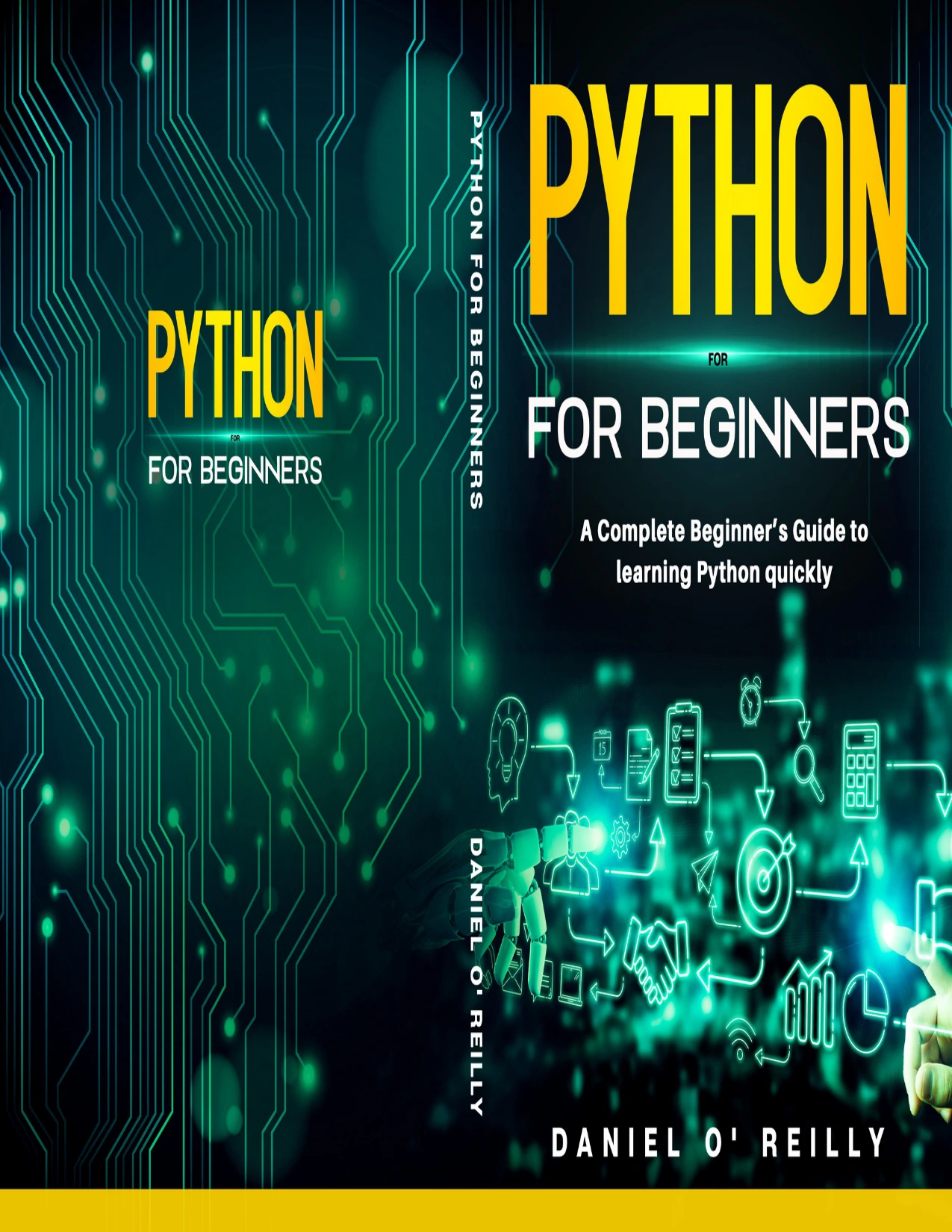
Python for Beginners: A Complete Beginner’s Guide to Learning Python Quickly
Readers without a technical background who need an initial route through setup, syntax, functions, and files.
Later material introduces functions, classes, dictionaries, and file handling. That makes it a reasonable option for someone who wants an initial map of the language before committing to a broader textbook.
- Choose it if: setup and unfamiliar programming vocabulary are your immediate obstacles.
- Keep in mind: finishing a concise explanation is different from being able to apply it independently.
- Suggested approach: create a small exercise of your own after each concept—for example, use a conditional to categorize an expense or a loop to total several purchases.
Do not judge progress by how many chapters you finish. Judge it by whether you can explain and reuse the ideas without copying the original example.
1000 Python Examples — for targeted exercises and solutions
Gábor Szabó’s 1000 Python Examples is described as an example-led resource with exercises and solutions. Its coverage ranges from installation, variables, conditions, and loops to strings, lists, dictionaries, files, exceptions, and more advanced subjects.
By Gábor Szabó
Learners who need additional exercises on specific Python concepts rather than another complete introductory sequence.
This is useful when a concept makes sense on the page but you still struggle to use it. Rather than starting another beginner book from the beginning, you can look for additional examples of the topic causing trouble.
- Choose it if: you learn through code examples or need more practice alongside a main guide.
- Keep in mind: advanced topics such as decorators, profiling, and GUI work do not need to be part of your first learning pass.
- Suggested approach: attempt an exercise, compare your result with the solution, and explain why the approaches differ.
A solution is most useful after an attempt. Reading it first can make an unfamiliar problem feel understood before you have actually solved it.
Unlocking Python — for a broader path beyond the basics
Ryan Mitchell’s Unlocking Python: A Comprehensive Guide for Beginners starts with programming fundamentals and expands into modules, packages, files, exceptions, logging, databases, and unit testing.
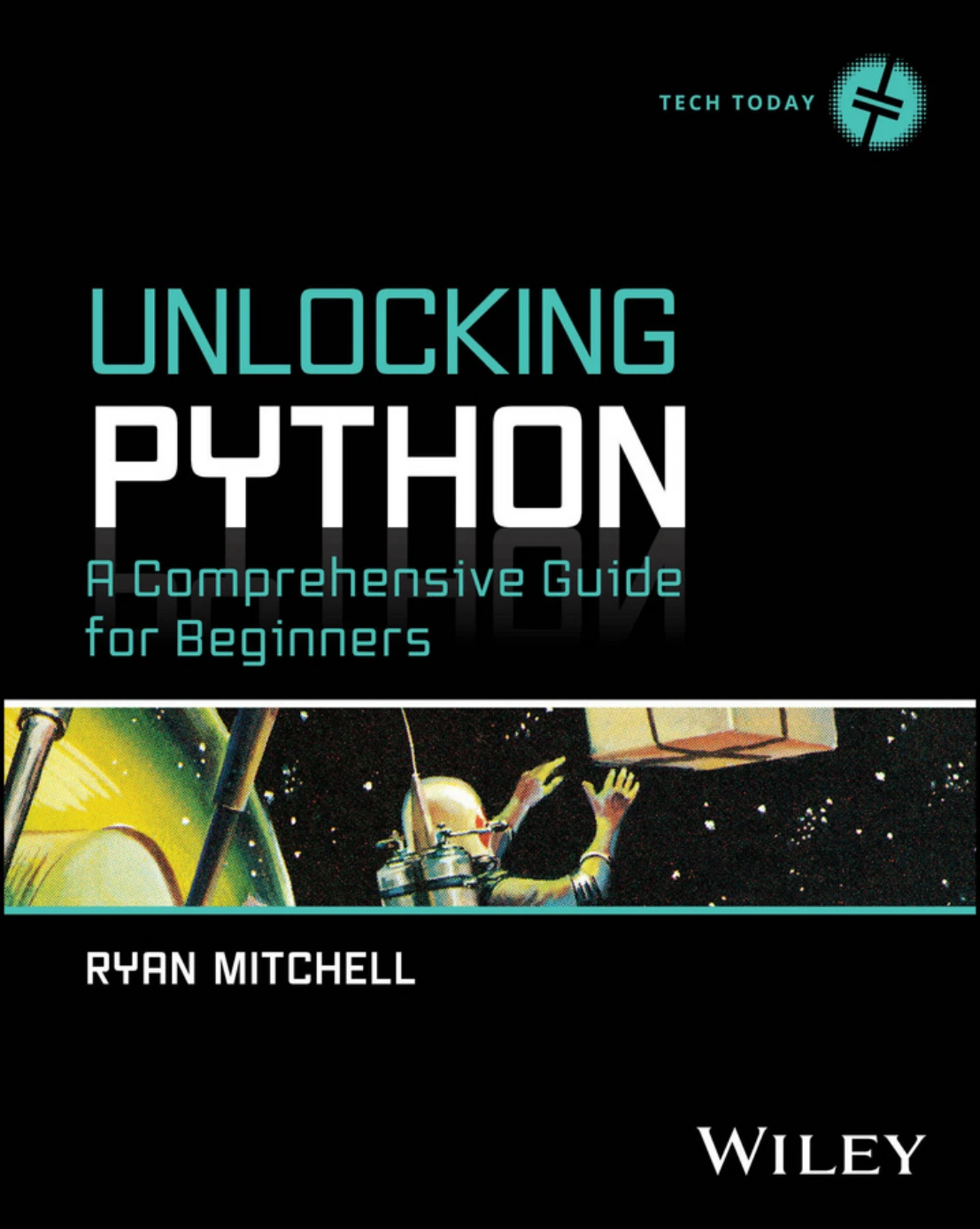
Unlocking Python: A Comprehensive Guide for Beginners
Beginners who want a longer progression beyond core syntax and can focus on one application area at a time.
The supplied description also identifies applied coverage involving Flask, Django, Scrapy, NumPy, Pandas, and Scikit-Learn. This gives it a different role from a compact starting guide: it offers a route into several areas where Python is used.
- Choose it if: you want a beginner resource that also introduces later development tools and applications.
- Keep in mind: breadth can become a distraction if your immediate goal is simply to write a useful script.
- Suggested approach: study the fundamentals first, then select one application area that matches your goal.
You do not need to learn web development, scraping, and machine learning together. A clear first project is a better guide to what to read next.
How to choose without collecting too many books
Before choosing a book, write down a concrete outcome: “I want to summarize a text file” is more actionable than “I want to learn all of Python.” Then evaluate the resource against that outcome.
- Prerequisites: does it teach programming itself, or assume you already understand functions and control flow?
- Explanations: can you follow a sample section without constantly searching for definitions?
- Practice: are there tasks that require you to make decisions rather than reproduce code?
- Feedback: are solutions, expected outputs, or tests available to help you check your work?
- Project relevance: does the material lead toward something you genuinely want to build?
- Support: can you find setup instructions, corrections, or guidance for the tools used?
Where sample chapters or contents pages are available, inspect them before deciding. The catalog summaries establish subject coverage, but they cannot show whether a particular explanation will suit your learning style.
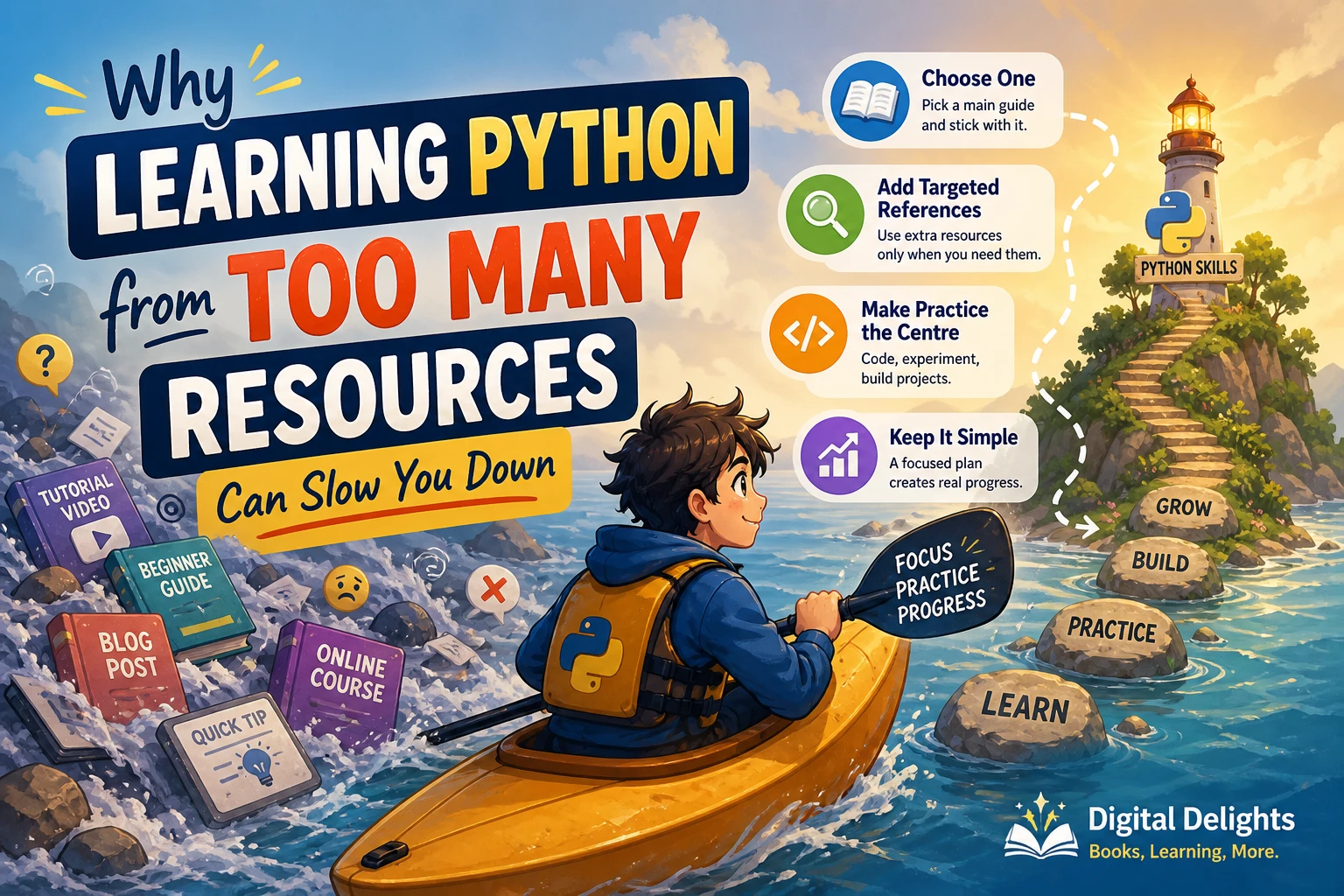
Use one main guide and, if needed, one practice companion. Switch only when you can identify a concrete mismatch, such as assumed knowledge you do not have or projects unrelated to your goals.
If you already know another programming language
You may not need extended explanations of what variables and loops are. Instead, use a focused route through Python syntax, collections, functions, modules, exceptions, and file handling.
The official Python Tutorial explicitly expects a basic understanding of programming. That makes it a useful companion for language-switchers, but not an equivalent substitute for a guide that teaches complete beginners.
A focused reading-to-coding plan
Use the following sequence as a flexible study route. Advance when you can perform the task independently, not when a calendar says you should.
- Set up and run a script. Learn how to save a file, execute it, and recognize where its output appears. Follow the book’s environment instructions before changing tools unnecessarily.
- Work with values and collections. Practise strings, numbers, lists, and dictionaries. Store several expenses or words and inspect individual entries.
- Add decisions and repetition. Use conditions to categorize data and loops to process multiple items.
- Organize code with functions. Give a repeated operation a name, supply inputs, and return a result.
- Read files and handle expected failures. Work with a small sample file and decide what should happen when an input is missing or invalid.
- Build one small project. Combine familiar concepts before adding new frameworks or libraries.
Use the run, modify, rebuild method
For each important example, follow three steps:
- Run: execute the example and predict its output before looking at the result.
- Modify: change an input, condition, or data structure and predict what will change.
- Rebuild: close the example and recreate the idea in a new context.
If a chapter counts items in a list, your rebuild exercise might count expenses above a chosen amount. The aim is to transfer the concept, not memorize the original variable names.
First-project option: a text-based expense tracker
Start with a program that stores expense names and amounts, calculates a total, and prints a summary. Once that works, extend it to group expenses by category, move calculations into functions, and save records to a file.
Check ordinary and awkward cases: an empty list, a zero amount, a decimal amount, and an invalid entry. These checks give you specific questions to take back to your book.
First-project option: a word-count script
Begin with a short string and count its whitespace-separated parts. Then read text from a file and report the most frequent words. Decide how your program should treat capitalization and punctuation, and document those choices.
A small program with a clearly stated limitation is a useful learning result. You can improve it after you understand why the first version behaves as it does.
Common mistakes that slow useful progress
- Reading without running code: turn explanations into a task you can execute and inspect.
- Switching books repeatedly: identify the actual obstacle before restarting another introduction.
- Skipping exercises: attempt them, even if your first answer is incomplete.
- Choosing by title alone: “quick,” “complete,” and “beginner” do not establish suitability or outcomes.
- Starting specialist AI material too early: become comfortable with functions, collections, imports, files, and errors before adding model frameworks.
- Changing the environment while learning: avoid adding an editor, package manager, or library unless it solves a clear problem.
If an example fails, distinguish a conceptual mistake from a setup problem. Note the error message, the step that produced it, and the environment you are using. That is more useful than assuming the entire book is unsuitable.
Frequently asked questions
Can I learn Python from a book alone?
A book can provide the structure, but you still need to write and run programs. Use documentation when an explanation leaves a question unanswered, and build small variations of the examples. Reading alone does not demonstrate that you can solve a new problem.
Should I finish every chapter?
Not necessarily. Follow the foundational sequence, then choose later chapters according to your goal. Do not skip a prerequisite merely because it seems less exciting, but you can defer unrelated specialist topics.
Which resources suit someone who already codes?
Look for material that lets you focus on Python-specific features rather than introductory programming concepts. The official tutorial assumes basic programming knowledge, while an examples collection can provide targeted practice. Check prerequisites rather than relying on the word “beginner.”
Does an older Python book still help?
It can still be useful for core concepts, but check its interpreter and dependency instructions. Setup screens and third-party APIs may differ from your environment. Do not assume every example works unchanged with newer tools; look for corrections and version guidance.
How quickly can I learn Python?
There is no supported completion-time estimate for these selections. Your starting knowledge, practice opportunities, and target project all matter. Set a capability milestone, such as writing a script that reads a file and summarizes its contents, instead of treating a deadline as proof of proficiency.
Do I need several Python books?
No. Start with one suitable guide. Add another resource only to address a specific need, such as more exercises on dictionaries or a deeper explanation of file handling.
Choose the book that helps you write your next program
For a practice-led beginning, consider Python Bootcamp. For a compact introduction, consider Python for Beginners. Use 1000 Python Examples for targeted practice, and consider Unlocking Python if you want a broader path into development tools and applications.
These Digital Delights resources serve different learning needs; none is established as the universally fastest option. Choose one, define a small project, and make your next study session include code you have written—not just pages you have read.
Sources and selection basis
Book coverage and format descriptions are based on the supplied Digital_Delights_product_1008_1235.xlsx catalog and the linked product pages. The official Python Tutorial supports the distinction between learning Python and learning programming from scratch. These sources do not establish comparative learning speed, completion times, or instructional quality through independent testing.