Best Python Books for Students
The best Python books for students are the ones that help you do your next piece of programming independently. A complete beginner may need careful setup instructions and small examples. A student preparing for assessments may need exercises with solutions. Someone studying physics may benefit more from a scientific-computing textbook than from a general introduction.
For structured coursework, start by considering Basics of Python Programming – 2nd Edition. For visual explanations, consider Python Illustrated. For a faster introduction built around questions and practice, consider Python Bootcamp. These are different starting points, not a universal ranking.
This guide compares relevant Digital Delights catalog titles by learning need, explains their limitations, and gives you a practical way to turn reading into usable coding skills. You do not need a collection of overlapping beginner books: choose one suitable core text, then add a companion only when it solves a specific problem.
Quick picks: Which Python book fits your needs?
Use the table to identify a likely fit before reading the detailed recommendations. The descriptions reflect the supplied catalog information; the suitability judgments are editorial guidance, not results from personal testing.
| Book | Intended reader | Learning focus | Selection caveat |
|---|---|---|---|
| Basics of Python Programming – 2nd Edition | Students wanting a structured introduction and revision material | Fundamentals, worked examples, exercises with solutions, and review questions | Check its topic sequence against your syllabus rather than assuming every chapter is required. |
| Python Illustrated | Beginners who prefer explanations supported by illustrations | Visual instruction, setup, terminal basics, and introductory coding | Preview a sample to decide whether its presentation suits you. |
| Python Bootcamp: A Rapid Crash Course Featuring Q&A Sessions, Exercises, and Projects | New programmers seeking a faster, practice-led route | Python 3 setup, questions, exercises, and projects | The catalog highlights Windows setup; check guidance for your own operating system. |
| Python for the Greenhorns Book-1 | Learners taking their very first steps | Thonny setup, variables, constants, and simple exercises with answers | A narrow introduction, not a replacement for a complete programming course. |
| Unlocking Python: A Comprehensive Guide for Beginners | Beginners wanting a broader path into applications | Core Python followed by testing, files, databases, and applied tools | Its breadth is not a reason to tackle every framework immediately. |
| Problem Solving with Python: Using Computational Thinking in Everyday Life | Problem Solving with Python | Students who want to connect code with problem-solving methods | Problem decomposition, text processing, functions, APIs, and debugging | Later networking and API topics introduce more moving parts than basic scripts. |
| How to Write Good Programs: A Guide for Students | Students who need better programming and coursework habits | Testing, debugging, clarity, version control, and refactoring | A programming-practice companion using Python, Java, and Haskell—not a Python-only introduction. |
| Introduction to Scientific Computation: A First Course for Physics, Mathematics and Engineering Majors | Science, mathematics, and engineering students | Python foundations, numerical methods, plotting, and numerical error | Choose it for a scientific-computing goal, not simply because you want to learn general Python. |
Best Python books for students, explained by learning goal
For structured coursework: Basics of Python Programming – 2nd Edition
Basics of Python Programming – 2nd Edition is a useful candidate when you want a textbook-style route through the language. The catalog describes coverage of variables, data types, operators, conditions, loops, functions, collections, modules, file handling, and object-oriented programming. It also lists exercises with solutions, multiple-choice questions, and true/false questions.

Basics of Python Programming – 2nd Edition
Students wanting fundamentals, worked examples, exercises with solutions, and review questions.
That combination makes it worth considering for students who need both explanations and revision prompts. Later topics include databases, regular expressions, exceptions, NumPy, and Tkinter. The supplied BPB publisher reference page provides an additional place to check the book information before choosing an edition.
How to use it: Make a chapter-to-syllabus map. If your course currently covers loops and functions, practise those topics first instead of reading ahead into graphical interfaces. Use review questions to identify gaps, but also write programs without looking at the examples.
Watch for: The availability of solutions does not establish that every task has a complete worked answer. Check the sample and contents if solution coverage is important to you.
For visual explanations: Python Illustrated
Python Illustrated, written by Maaike van Putten and illustrated by Imke van Putten, combines beginner instruction with visual explanations. Its catalog description includes terminal orientation, checking a Python installation, running a first program, and getting started with Visual Studio Code.
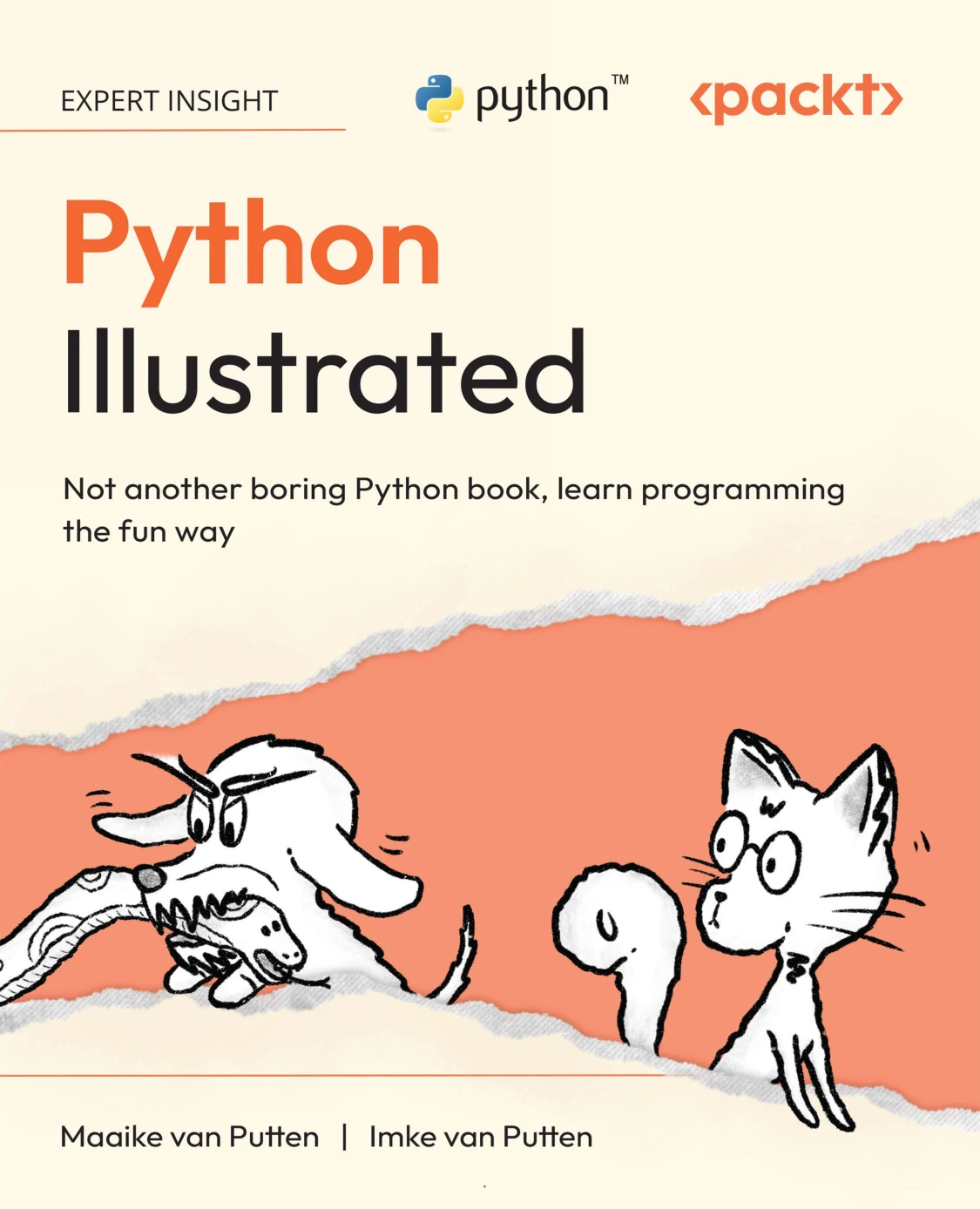
New programmers interested in visual explanations and practical setup guidance.
Consider it if dense pages of syntax make it difficult to see what a program is doing. Illustrations offer another way to represent an idea, but the useful question is whether a sample explanation helps you understand it—not whether a visual book is automatically better.
How to use it: After reading an illustrated explanation, redraw the idea in your own way. For a conditional, sketch the two possible paths, then write a small program that follows them.
Watch for: An approachable presentation still needs active coding alongside it. Recognizing an explanation on the page is different from creating a working solution.
For a rapid, practice-led start: Python Bootcamp
Python Bootcamp: A Rapid Crash Course Featuring Q&A Sessions, Exercises, and Projects by Vaskaran Sarcar is aimed at readers who want to begin using Python through explanation and immediate practice.
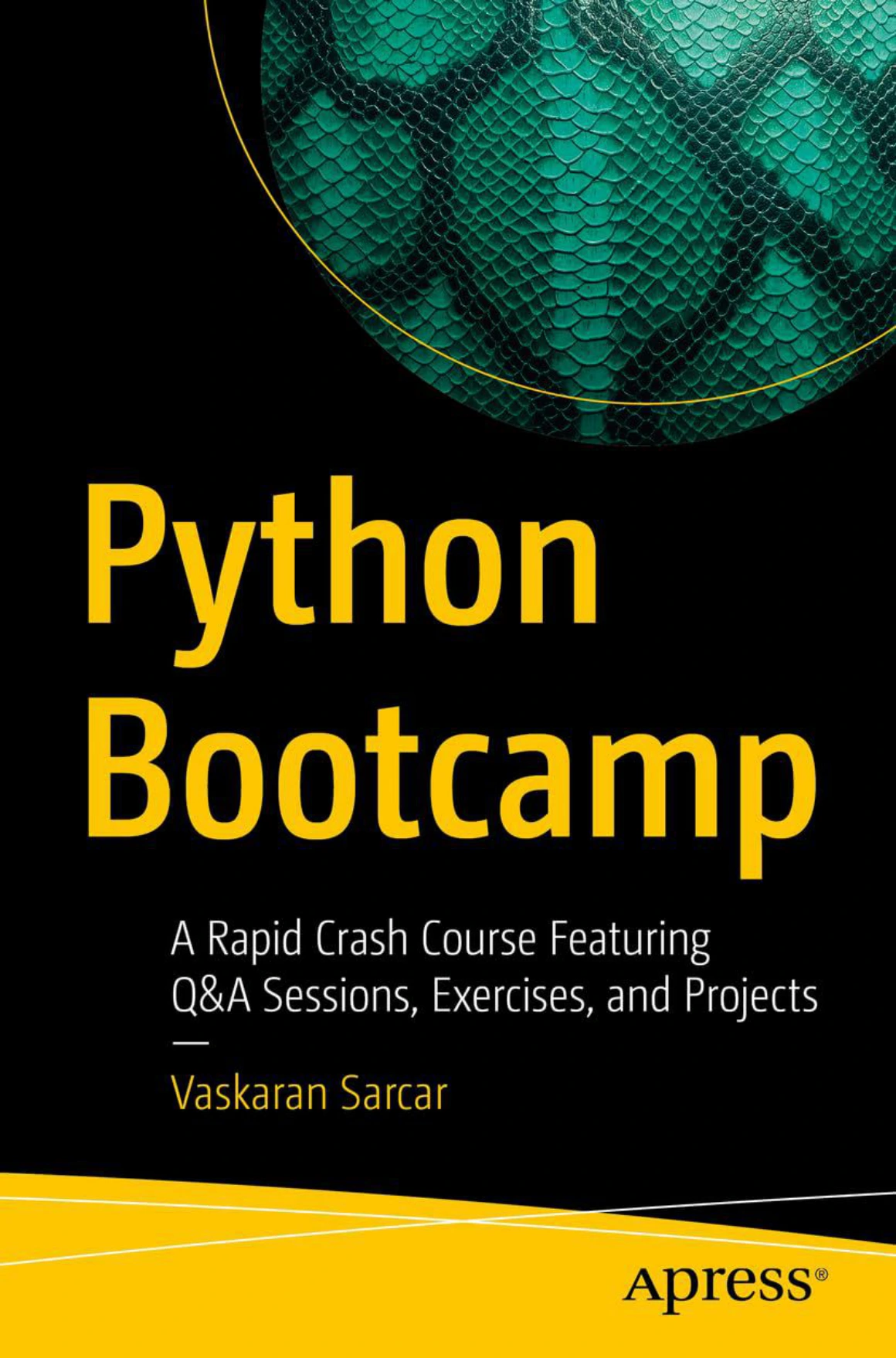
Python Bootcamp: A Rapid Crash Course Featuring Q&A Sessions, Exercises, and Projects
Beginners who prefer Python 3 setup guidance, Q&A segments, exercises, and projects.
The catalog describes Python 3 installation on Windows, checking the interpreter version, running code from the command prompt or IDLE, and Q&A segments that clarify concepts such as the shell. Exercises and projects are part of its stated approach. The supplied Apress publisher reference page identifies the corresponding title.
This is a candidate for students who prefer a compact explanation followed by something to do. However, “rapid” should describe the organization of the material, not a deadline you impose on yourself.
How to use it: Turn each Q&A into a self-check. Try answering before reading the explanation, then write an example that demonstrates your answer.
Watch for: Students using macOS, Linux, or a managed university environment should check whether the setup instructions match their situation.
For a gentle first step: Python for the Greenhorns Book-1
Python for the Greenhorns Book-1 by Monty is designed for learners with no coding experience. Its catalog description introduces Thonny, explains basic ideas about variables and constants, and includes simple exercises with answers.
Python for the Greenhorns Book-1
By Monty
Absolute beginners needing orientation to Thonny, variables, constants, and simple exercises.
Its role is orientation: helping you get comfortable writing and running small pieces of code. That can be useful when even the editor, interpreter, and terminology feel unfamiliar.
How to use it: Treat it as a starting bridge. Once you can run code and explain how values are stored and changed, move to a fuller introduction that covers decisions, loops, functions, and larger programs.
Watch for: Do not choose it as your only resource for a course requiring a much wider range of programming topics.
For a broader route into applications: Unlocking Python
Unlocking Python: A Comprehensive Guide for Beginners by Ryan Mitchell begins with setup and core structures, including strings, lists, dictionaries, sets, tuples, functions, and classes.
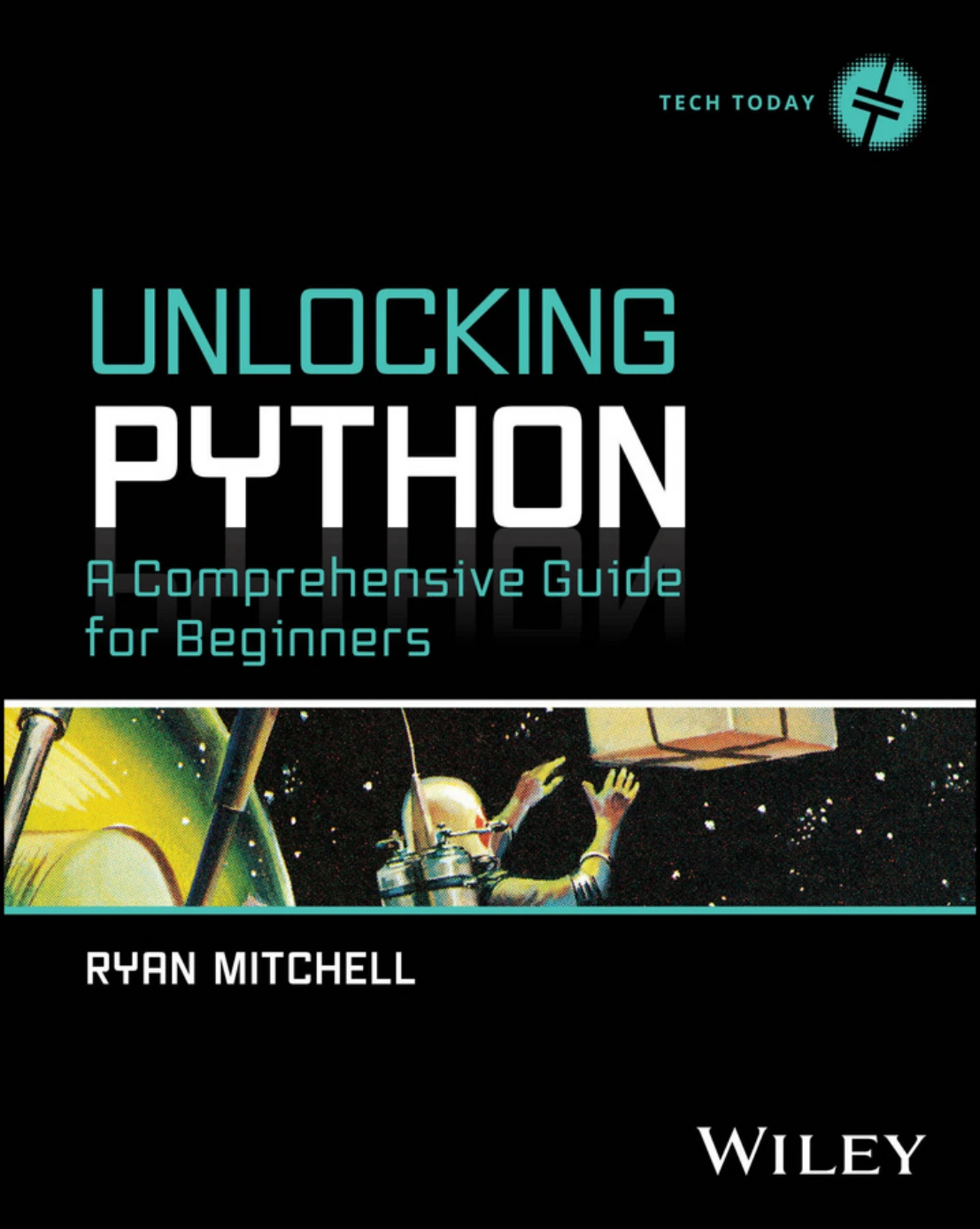
Unlocking Python: A Comprehensive Guide for Beginners
Beginners who want foundations followed by introductions to testing, databases, web tools, and data work.
The catalog then describes files, exceptions, modules, logging, databases, concurrency, and unit testing, followed by introductions to tools such as Flask, Django, Scrapy, NumPy, pandas, and scikit-learn.
Consider it when you want a core introduction with room to explore possible next steps. The advantage is breadth of direction: you can see whether web applications, data work, or another area interests you.
How to use it: Finish enough of the language foundation to write small programs independently, then choose one applied branch. A student interested in data analysis does not need to study several web frameworks at the same time.
Watch for: Introducing a tool is not the same as providing a specialist course in it. The available catalog description does not establish the depth of every later topic.
For learning how to approach problems: Problem Solving with Python
Problem Solving with Python: Using Computational Thinking in Everyday Life | Problem Solving with Python by Michael D. Smith uses practical challenges to connect computational thinking with code.
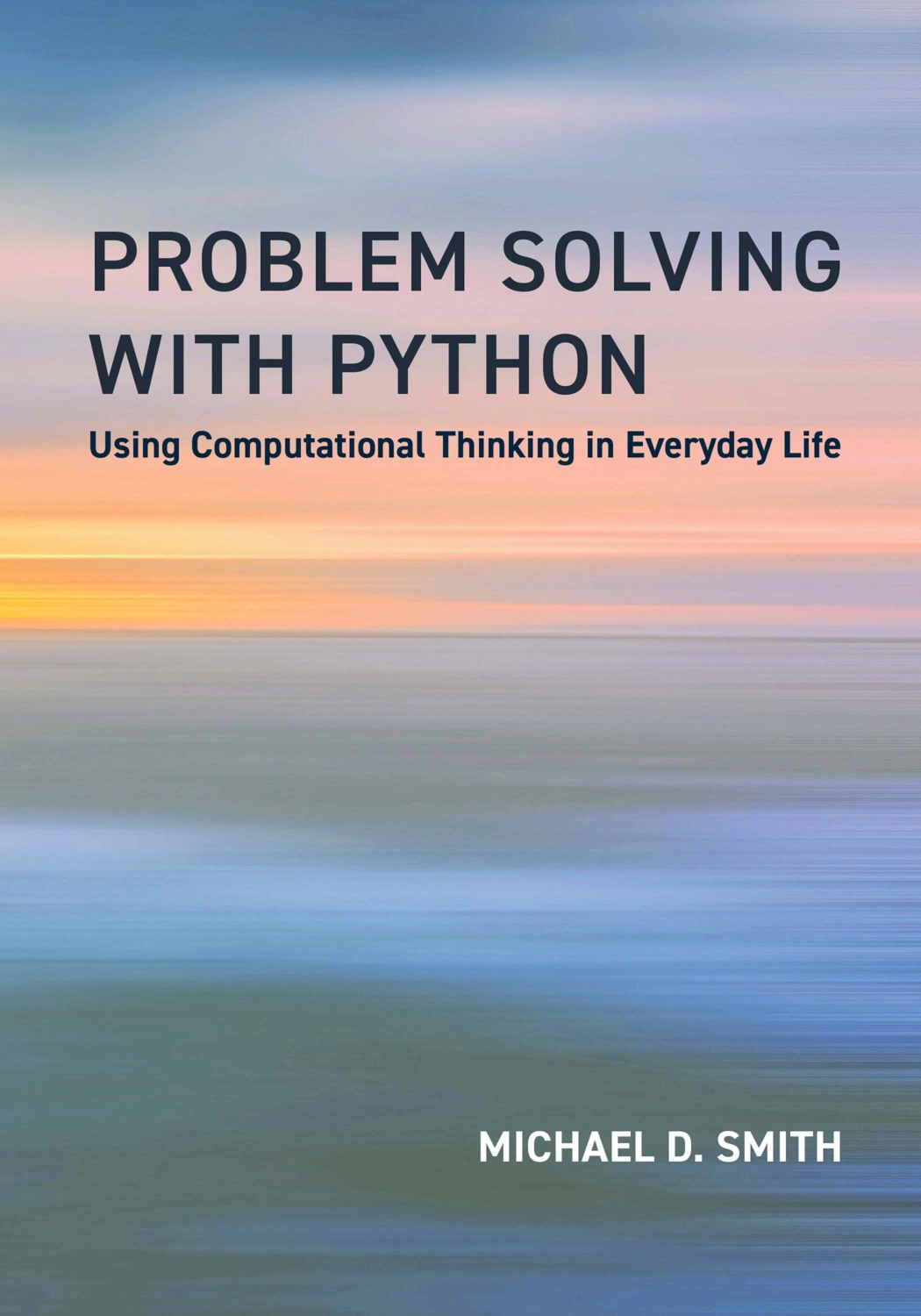
Students interested in practical problems involving text, reusable code, APIs, and debugging.
The catalog describes working with text, breaking problems into smaller parts, recognizing patterns, designing algorithms, and writing reusable functions and modules. Later examples include JSON responses from web APIs and a networked guessing game.
This is a useful direction to consider when you can follow a worked example but struggle with a blank editor. Instead of asking only, “Which syntax do I need?”, ask, “What are the inputs, what should the output be, and what smaller tasks connect them?”
How to use it: Before each programming task, write a plain-language plan and a tiny example of the expected result. Then implement one piece at a time.
Watch for: API and networking work involves setup and external behavior beyond basic language syntax. Begin with the simpler problems rather than treating the most elaborate example as your first project.
Useful companions and subject-specific next steps
For debugging and coursework habits: How to Write Good Programs
How to Write Good Programs: A Guide for Students by Perdita Stevens addresses the work surrounding syntax: understanding assignments, testing, debugging, clear naming, backups, version control, efficiency, and refactoring.
The catalog also describes guidance on asking for help without cheating, working in teams, and preparing for programming exams. It uses examples in Python, Java, and Haskell. The supplied Cambridge University Press reference page is an additional source for the title.
Choose it as a companion if your main obstacle is not understanding a loop, but figuring out why your program fails or how to make it understandable. It complements a language introduction rather than replacing one.
For science and engineering: Introduction to Scientific Computation
Introduction to Scientific Computation: A First Course for Physics, Mathematics and Engineering Majors by J David Brown connects introductory Python with scientific problems.
Its catalog description includes control structures, functions, libraries, arrays, plotting, and symbolic computation with SymPy, followed by numerical topics such as root finding, interpolation, integration, and linear algebra. Numerical error is part of the emphasis.
This is a more targeted choice for a student whose goal is computational physics, applied mathematics, or engineering. Compare its mathematical content with your course prerequisites: no previous programming experience does not necessarily mean no mathematical preparation is needed.
How to choose a Python book for your course
Before selecting a book, work through this checklist:
- Match the syllabus. List the topics your course actually assesses. Look for those topics in the contents rather than relying on “complete” in the title.
- Check the starting level. Distinguish “new to programming” from “new to Python.” If you already program, preview how much of the book repeats familiar concepts.
- Check the environment. Match the Python version, editor, and package requirements to your instructor’s setup. Do not assume compatibility with every newer interpreter.
- Preview an explanation. Choose one concept you find difficult. Read a sample if available, then see whether you can explain or apply it.
- Inspect the practice material. Look for tasks you must solve independently, not only examples you can copy. Check whether hints, answers, or worked solutions are provided.
- Check supporting resources. Find out whether companion code, corrections, and installation guidance are available for the exact edition.
- Consider access before purchasing. Check your course reading list and library options. Confirm digital-format features if accessibility, device compatibility, or offline reading matters to you.
When the prescribed course text differs from your preferred learning style, keep the prescribed book for syllabus alignment and use a companion to clarify difficult concepts. Replacing it entirely can leave gaps in the terminology or methods your instructor expects.
Turn reading into programming practice
A useful study cycle is read → reproduce → change → solve → test → explain. Apply it to one concept at a time:
- Read: Identify the idea being taught, such as a dictionary or a loop.
- Reproduce: Run the example and check that you understand its output.
- Change: Alter an input or condition. Predict the result before running it.
- Solve: Write a related program without copying the original structure line by line.
- Test: Try ordinary cases and relevant edge cases.
- Explain: Describe why the program works and what its current limitations are.
Mini-project: Build a study-session tracker
This original exercise combines collections, loops, conditions, and functions. Start with a small list of study sessions and calculate the total number of minutes:
def total_minutes(sessions):
    total = 0
    for session in sessions:
        total += session["minutes"]
    return total

sessions = [
    {"subject": "Python", "minutes": 25},
    {"subject": "Mathematics", "minutes": 40},
    {"subject": "Python", "minutes": 20},
]

print(total_minutes(sessions))

assert total_minutes(sessions) == 85
assert total_minutes([]) == 0
The expected printed result is 85. The function currently assumes every session contains a numeric minutes value; it does not validate the records.
Extend the project in stages:
- Calculate the total for a chosen subject.
- Reject negative study durations.
- Handle an empty list without an error.
- Read sessions from a file once you have studied file handling.
- Add tests for missing fields and invalid values when you reach error handling.
The point is not to build a polished application immediately. It is to connect each new chapter with a change you can make, test, and explain.
Common mistakes when choosing and using Python books
- Choosing the widest scope instead of the right scope. A book covering web development and machine learning may be less useful for next week’s functions assessment than a focused introduction.
- Collecting overlapping introductions. Try identifying your specific difficulty before buying another book that starts with variables.
- Reading solutions too soon. Write an attempt first. If you need help, look for a hint or isolate the part you cannot solve.
- Confusing recognition with understanding. Close the book and recreate a small example. That reveals gaps a familiar-looking page can hide.
- Jumping into libraries before understanding the code. Learn enough functions, collections, imports, and errors to follow what a library example is doing.
- Ignoring setup differences. An installation or package problem is not necessarily a misunderstanding of Python. Record the error and compare your environment with the instructions.
Frequently asked questions
Can I learn Python from a book without prior coding experience?
Yes, a beginner-oriented book can provide the structure you need. Choose one that explains setup and basic concepts, then practise alongside the reading. A gentle resource such as Python for the Greenhorns Book-1 can help with orientation, while a fuller introduction supports the topics that follow.
Do I need more than one Python book?
Not initially. Begin with one core text. Add a companion when you can name the gap it fills—for example, debugging habits, problem-solving methods, or scientific applications. Two books with different roles are more useful than several nearly identical introductions.
Should I choose a textbook or a project-based guide?
Choose a structured textbook when syllabus coverage and revision are the priority. Choose a problem- or project-led approach when applying concepts helps you stay engaged. In either case, check that the fundamentals your course requires are covered.
Which book should I choose if I already know another language?
Preview the fundamentals before choosing an absolute-beginner title. You may benefit more from selected chapters on Python’s collections, modules, exceptions, and application tools than from reading every introductory explanation. The supplied catalog descriptions do not establish a dedicated transition guide, so check samples carefully.
Does an older edition still match my course?
It may, but verify the exact topics, interpreter expectations, and supporting files. Basic language instruction and package-dependent projects have different compatibility concerns. Follow your instructor’s edition requirements where specified, and check corrections rather than assuming an older or newer edition will work unchanged.
How can I tell whether a book has enough exercises?
Inspect a sample chapter and the exercise structure. Look for opportunities to write original code, not just run completed examples. Also check the support provided: short answers, hints, and detailed solutions serve different purposes. The catalog confirms solutions for some titles, but not complete solution coverage for every recommended book.
Choose one core book, then build something
For a coursework-focused starting point, consider Basics of Python Programming – 2nd Edition. If illustrated explanations suit you better, preview Python Illustrated. If you prefer a faster question-and-practice format, consider Python Bootcamp.
Then give the book a clear job: use it to support your next set of programming tasks. Write code, change examples, test your assumptions, and keep notes on the errors you resolve. Add specialist material only when your course or interests require it.
You can browse the Python learning resources at Digital Delights for related titles, but the most useful next step is not building a larger reading list. It is choosing a suitable resource and using it to finish a small program independently.
Sources and recommendation limits
Book coverage and intended audiences in this guide are based on the supplied Digital Delights catalog descriptions. Publisher reference links supplied with the catalog are included where relevant. Some descriptions are partial, so readers should check contents, samples, and edition-specific support before selecting a book.
The recommendations are judgments about fit, not a tested ranking. The available evidence does not establish comparative learning outcomes, improved grades, or a universally best Python book.