

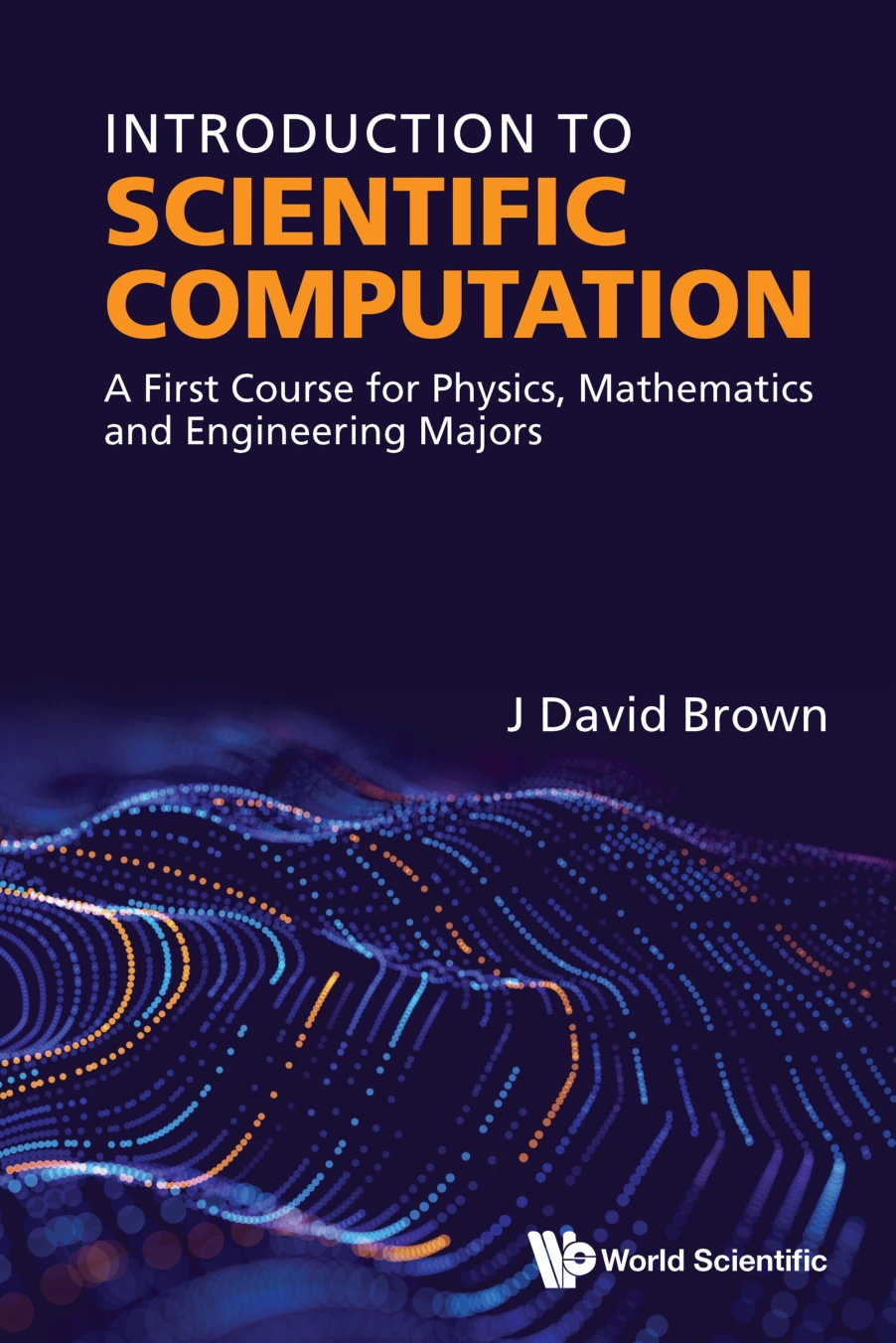
Introduction to Scientific Computation: A First Course for Physics, Mathematics and Engineering Majors
Original price was: $36.34.$18.17Current price is: $18.17.

J David Brown
Product Specs:
- File Type: PDF
- File Size: 8.1 MB
- Book Language: English
- Total Page Count: 331
- Instant Download
Scientific computation becomes much easier to reason about when you can see what a program is doing—and where its answers might go wrong. Introduction to Scientific Computation builds that understanding step by step, pairing Python foundations with numerical methods and examples drawn from science, mathematics, and engineering.
J David Brown begins with the tools and programming concepts students need, then moves toward computational techniques for problems such as integration, linear algebra, and differential equations. Throughout, the focus is not simply on getting a result: it is on understanding the method behind it and paying attention to numerical error.
Build a working foundation in Python
The early chapters introduce Python programming, control structures, functions, libraries, arrays, and plotting. The book also treats symbolic computation with SymPy. Together, these topics establish a practical base for the numerical work that follows, without requiring previous programming experience.
Understand the numerical methods, not just the button
Rather than relying on built-in routines as opaque shortcuts, Brown gives attention to how numerical algorithms work and to the errors that can arise in computation. That emphasis helps readers approach computational results with a more informed eye: a calculated answer is useful, but knowing how it was produced matters too.
From familiar problems to richer models
The subject matter ranges across root finding, curve fitting, interpolation, numerical integration, linear algebra, numerical differentiation, ordinary and partial differential equations, and Fourier analysis. Examples and exercises put computational ideas in context, drawing on problems such as cellular automata, the driven damped pendulum, and Euler–Bernoulli beam theory.
A first course for science, math, and engineering students
Designed for university students in physics, mathematics, and engineering, this scientific computing textbook assumes a solid understanding of calculus but no prior programming experience. Its interactive exercises are intended to be worked through alongside the material, making the book suited to readers who want to learn by testing ideas as they go.
For students beginning computational science—or looking to connect introductory programming with scientific modeling—Brown offers a route from Python fundamentals to the numerical tools used across quantitative disciplines. 💻
User Reviews
Be the first to review “Introduction to Scientific Computation: A First Course for Physics, Mathematics and Engineering Majors”
You must be logged in to post a review.
Original price was: $36.34.$18.17Current price is: $18.17.
There are no reviews yet.