

Best Python Books for Experienced Programmers
An experienced programmer does not necessarily need an advanced Python book. If you already write Java, C++, JavaScript, or another language, your immediate challenge may be learning Python’s conventions—not revisiting what a loop does. If you already use Python comfortably, the more useful book may explain its object model, challenge your coding habits, or help you design a better application.
The best Python books for experienced programmers therefore depend on the gap you want to close. Python Distilled is the most useful starting point in this catalog-based shortlist for consolidating core language knowledge. Python in a Nutshell serves a different purpose: broad, repeated reference. Practice and design companions become valuable when you know the syntax but want to use it more deliberately.
This guide compares six relevant Digital Delights titles by purpose. These are editorial fit recommendations, not a tested ranking or a claim that one book is best for everyone.
Quick picks: the best Python books for experienced programmers by goal
Start with the row that describes your next task. You probably need one main book and, at most, one complementary resource—not every title below.
Choose a Python resource by the skill you want to develop
| Reader goal | Book | Why it fits | Important caveat |
|---|---|---|---|
| Learn Python after another language, or consolidate its core | Python Distilled | Focused treatment of language fundamentals and features such as generators, decorators, context managers, and the object model | Not an exhaustive guide to frameworks or third-party libraries |
| Keep a broad reference beside your editor | Python in a Nutshell: A Desktop Quick Reference, Fourth Edition | Language, standard-library, and selected third-party coverage in a reference format | The catalog identifies Python 3.10 coverage with Python 3.11 updates; check later changes separately |
| Turn familiar syntax into stronger problem-solving habits | Python Workout, Second Edition (MEAP V03) | Exercises across collections, files, functions, and comprehensions | The supplied product is an early-access manuscript, not the final second edition |
| Explore techniques through worked code | 1000 Python Examples | Examples, exercises, and solutions spanning fundamentals and applied topics | Includes introductory material; experienced readers should select relevant sections |
| Study implementation and software-design decisions | 500 Lines or Less: Experienced Programmers Solve Interesting Problems | Compact case studies that expose how working systems are organized | Not exclusively a Python book or a Python language tutorial |
| Move from scripts to desktop applications | Python for Desktop Applications: How to Develop, Pack and Deliver Python Applications with TkInter and Kivy, 1st Edition | Project-based GUI development and Windows packaging | Verify toolkit and packaging instructions against the versions you use |
How to choose a Python book at your level
Separate programming experience from Python fluency
If you know another language, you can usually move quickly through familiar programming concepts. What deserves closer attention is how Python expresses those concepts: collection operations, iteration, function arguments, exceptions, modules, and object behavior.
If you already maintain Python applications, choose a book around recurring friction. Do you struggle to explain a decorator? Reach for a language guide. Do you repeatedly search for library behavior? A reference may help more. Do you understand examples but hesitate when writing your own solution? Choose exercises.
A useful self-check is to ask whether you can explain your code as well as run it. Knowing that a generator works is different from knowing when its behavior is appropriate for your application.
Match the format to how you will use it
- Language guide: useful for building a connected understanding of Python.
- Desk reference: useful when you know the question and need a precise explanation.
- Exercise collection: useful when your main need is independent implementation.
- Design case studies: useful when you want to understand boundaries, abstractions, and tradeoffs.
- Application guide: useful when you have a specific delivery goal, such as a desktop tool.
Do not judge an advanced Python book by the number of unfamiliar terms in its contents. A book that helps you simplify a troublesome module can be more valuable than one covering mechanisms you will not use.
Check the exact edition and manuscript status
Before choosing, confirm the edition, intended Python environment, and whether the download is a finished book or an early-access version. Those details affect expectations, particularly for references and books built around external tools.
A newer edition is not automatically the better fit. Equally, an older book should not be treated as a complete description of your current interpreter and dependencies.
Recommended books by purpose
Python Distilled: a focused core-language choice
David M. Beazley’s Python Distilled is the clearest default choice here for a programmer who wants a concentrated understanding of Python rather than a tour of its entire ecosystem. The supplied catalog describes coverage of functions, exceptions, modules, object-oriented programming, generators, decorators, context managers, asynchronous functions, and the object model. The publisher listing for Python Distilled provides a further bibliographic reference.
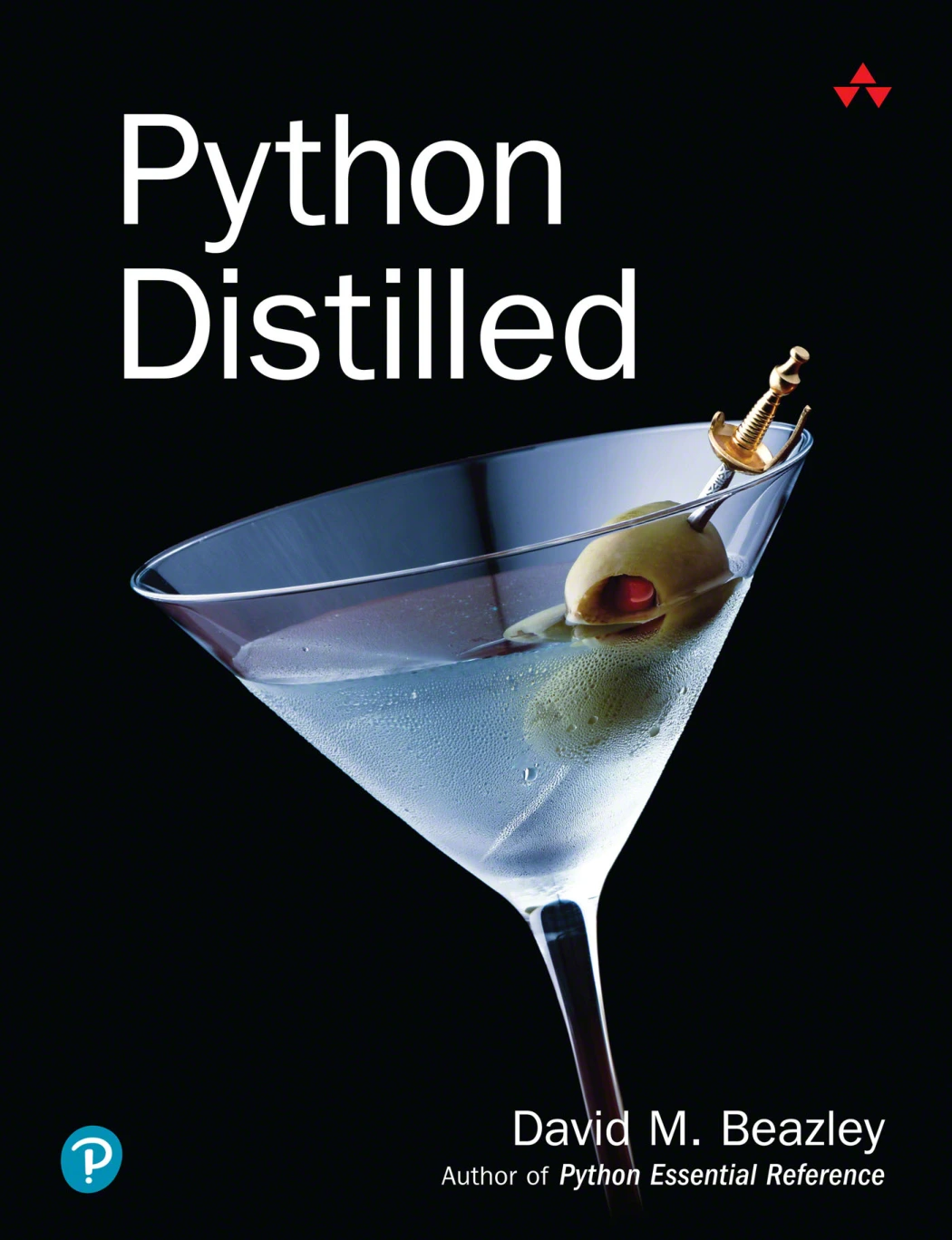
Programmers transitioning into Python or consolidating their understanding of its functions, objects, and advanced language features.
Choose it if: you are moving into Python from another language, or you use Python already but want to connect scattered knowledge into a more coherent model.
Use it this way: read the fundamentals selectively, then slow down at topics whose behavior you cannot confidently explain. After a chapter, return to an existing script and identify one place where the idea improves clarity.
Choose something else if: your immediate problem is framework-specific deployment, a specialist data stack, or detailed library lookup. Its core-language focus is a strength, but it is also a boundary.
Python in a Nutshell: a broad working reference
Python in a Nutshell: A Desktop Quick Reference, Fourth Edition suits readers who want to consult topics as questions arise. The catalog covers the language and object model alongside areas such as exceptions, modules, packages, type annotations, file handling, databases, and concurrency.
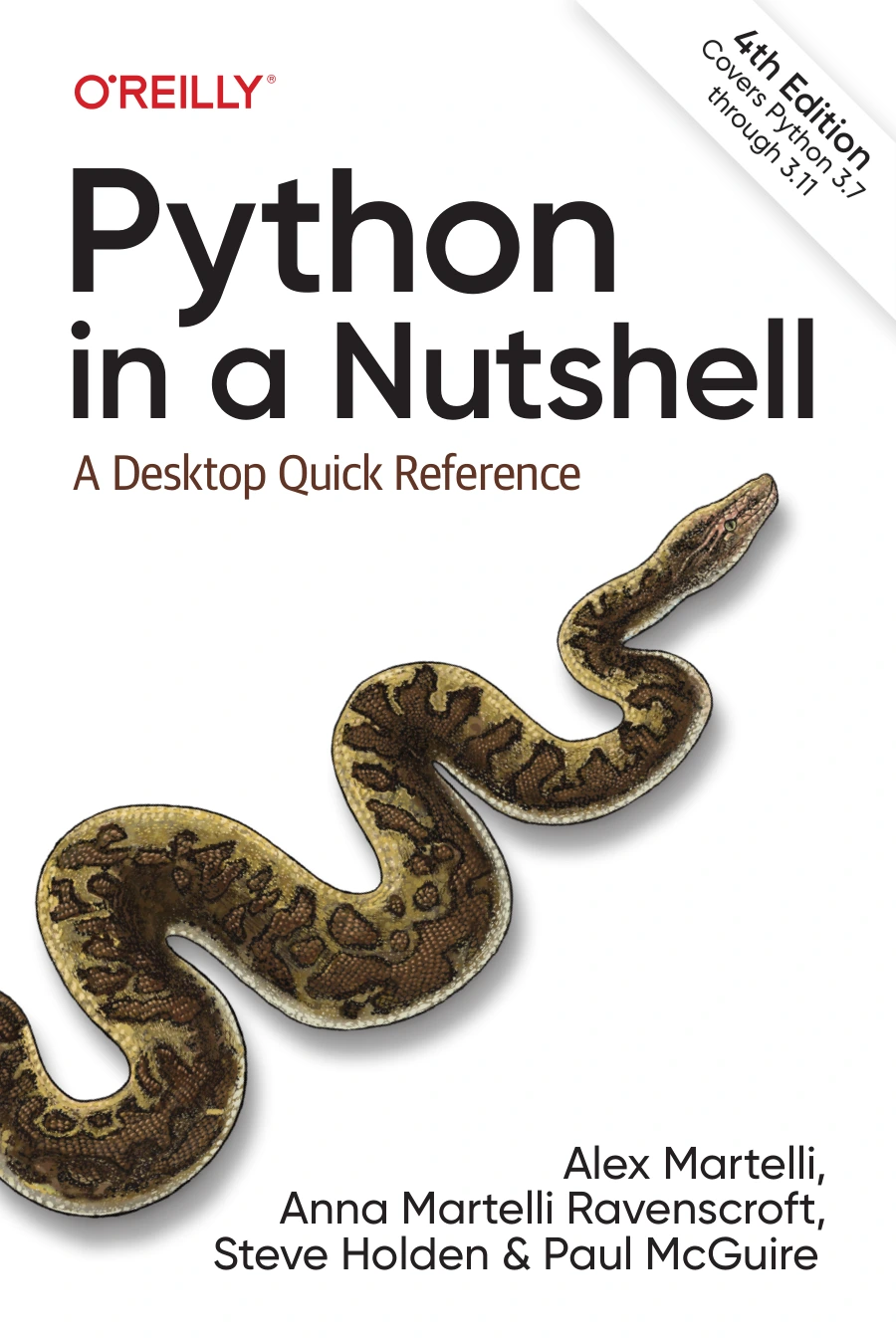
Python in a Nutshell: A Desktop Quick Reference, Fourth Edition
Developers who prefer topic-by-topic consultation across the language, standard library, and selected tools.
Choose it if: you regularly work across different parts of Python and want a substantial reference rather than a short introduction.
Use it this way: begin with a concrete question from your code. Read the relevant section, create a small example that isolates the behavior, and record any version assumptions that matter.
The catalog describes this edition as focused on Python 3.10 with coverage of Python 3.11. That makes its version scope an important consideration rather than a reason to assume it describes every subsequent change.
How it differs from Python Distilled: choose Distilled when you want a focused path through the language; choose Nutshell when breadth and repeated consultation are the priority. Owning both makes most sense when those are genuinely separate needs.
Python Workout: deliberate practice rather than more passive reading
Reuven M. Lerner’s Python Workout, Second Edition (MEAP V03) is an optional companion for programmers who understand explanations but want more practice applying them. The supplied description includes numeric types, strings, lists, tuples, dictionaries, sets, files, functions, and comprehensions.
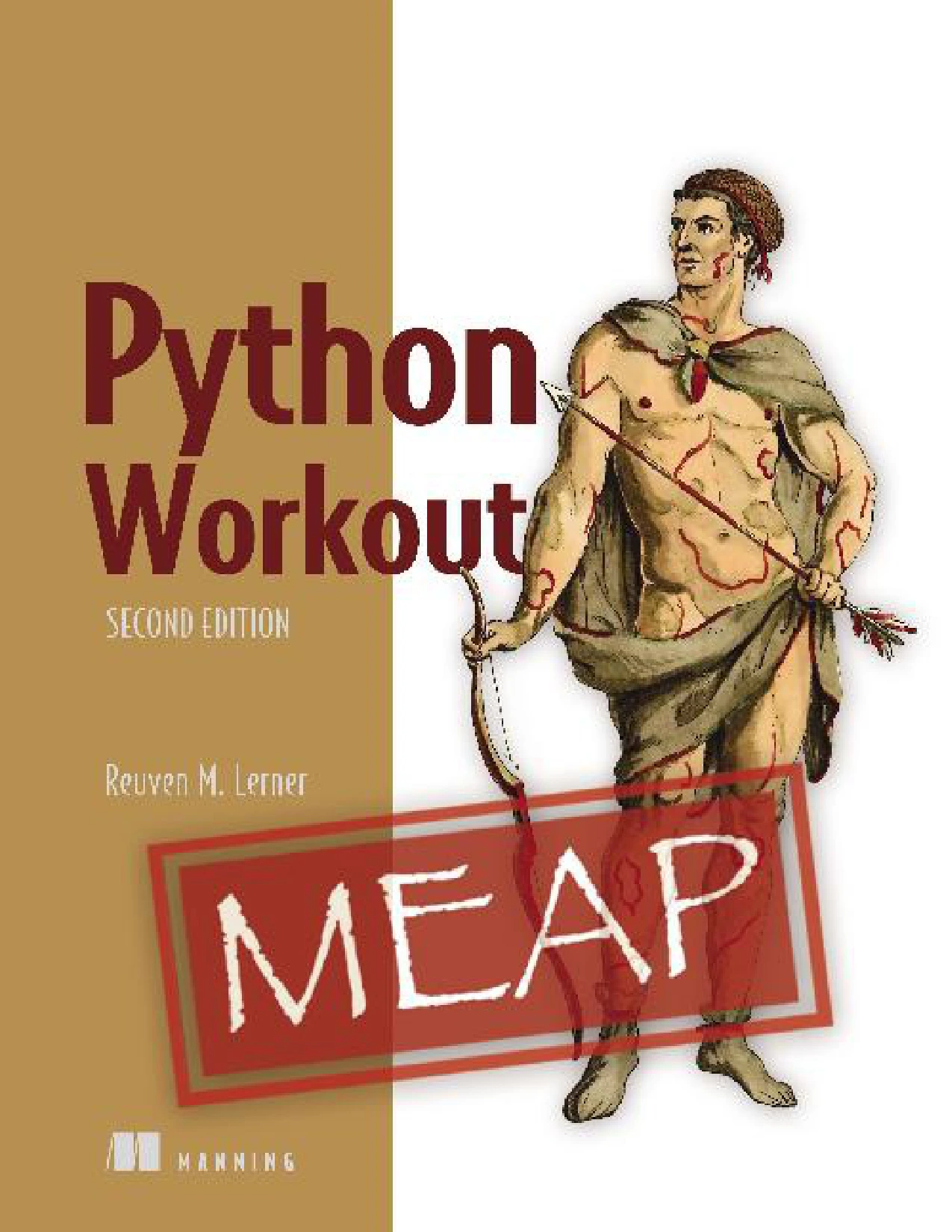
Python Workout, Second Edition (MEAP V03)
Readers who know Python concepts but want to practise independent solutions involving collections, files, functions, and comprehensions.
Choose it if: your difficulty is turning knowledge into an independent solution, especially with everyday data transformations.
Use it this way: attempt a problem before reading its solution. Compare the approaches afterward, looking at correctness, naming, intermediate state, and how easily another person could follow the code.
Edition warning: this product is explicitly MEAP V03, an early-access version. Do not assume that its contents, corrections, or organization match the final published second edition. The supplied material does not establish that purchasing it includes later revisions.
1000 Python Examples: a selective code companion
Gábor Szabó’s 1000 Python Examples is useful when you prefer to explore code alongside explanations. The catalog describes examples, exercises, and solutions covering everyday Python as well as regular expressions, decorators, profiling, multitasking, and Tk GUI work. Its supplied original source is the Leanpub listing for 1000 Python Examples.
By Gábor Szabó
Programmers who learn by inspecting and adapting code and can selectively navigate introductory and applied topics.
Choose it if: you want a broad source of code to inspect, modify, and compare with your own implementations.
Use it this way: select a topic connected to current work. Predict what an example will do, run it, then change the inputs or constraints. Finally, recreate the underlying technique without looking at the original.
Keep expectations realistic: the collection also includes installation, variables, conditionals, and loops. It is not exclusively advanced material. Its value for experienced programmers comes from selective use, not necessarily reading every section in order.
500 Lines or Less: learn from design decisions
500 Lines or Less: Experienced Programmers Solve Interesting Problems shifts the question from “What does this Python feature do?” to “How should this system be organized?” The supplied catalog identifies case studies including a web crawler, graph database, Python interpreter, static analysis, and a simple web server.
500 Lines or Less: Experienced Programmers Solve Interesting Problems
Comfortable code readers interested in system decomposition and tradeoffs rather than a Python-only tutorial.
The original 500 Lines or Less introduction explains the collection’s educational emphasis on examining implementation choices. That makes it a useful design companion rather than a substitute for a Python language guide.
Choose it if: you are comfortable reading code and want to study decomposition, abstraction, and the reasoning behind a small working system.
Use it this way: before studying an implementation, sketch your own approach. Identify the components, their responsibilities, and the data they exchange. Compare that sketch with the chapter’s decisions afterward.
Important limitation: this is a multi-project programming collection, not exclusively a Python book. Choose it for transferable design lessons, not comprehensive coverage of modern Python.
Python for Desktop Applications: a specialist project choice
Tran Duc Loi’s Python for Desktop Applications: How to Develop, Pack and Deliver Python Applications with TkInter and Kivy, 1st Edition addresses a specific next step: turning scripts into desktop software.
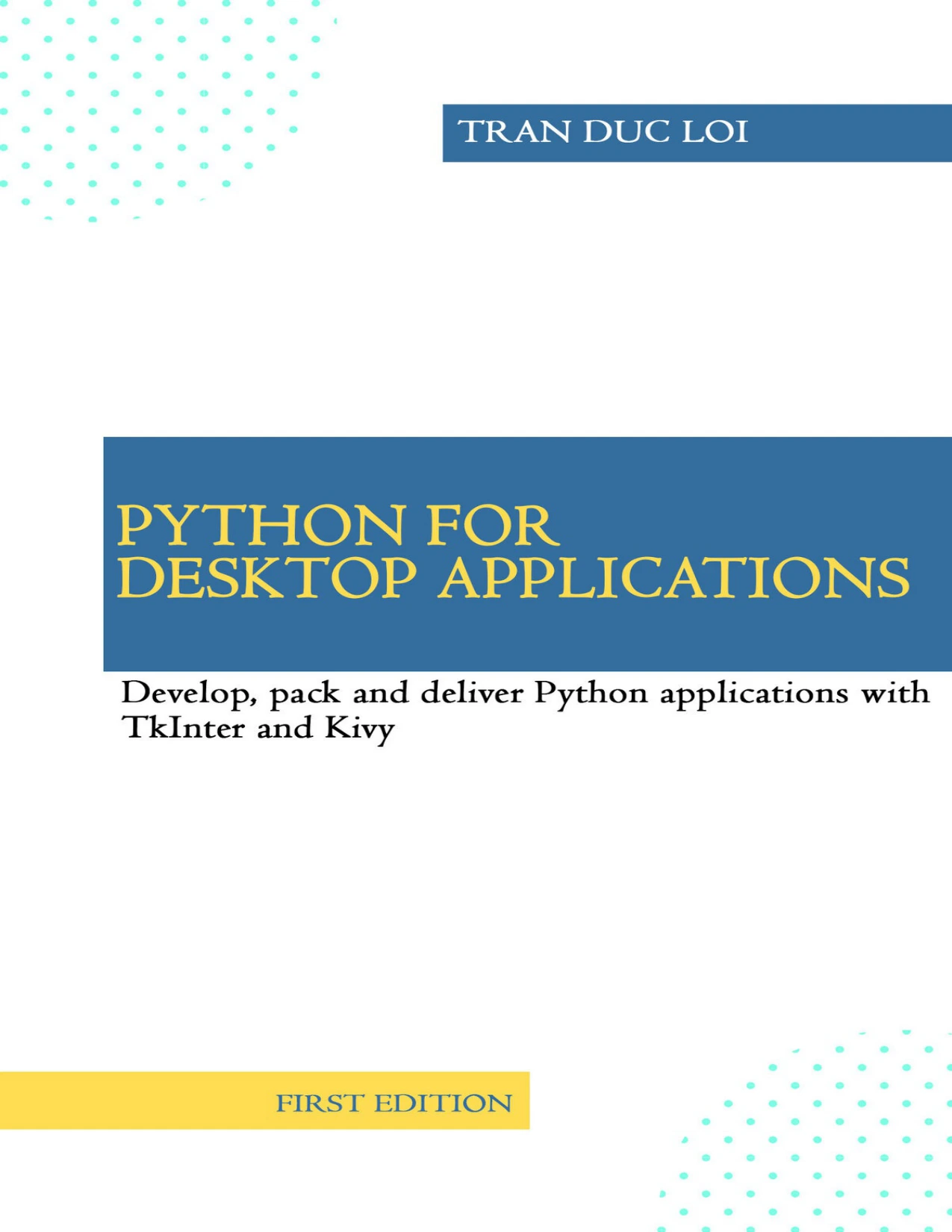
By Tran Duc Loi
Python programmers pursuing Tkinter or Kivy interfaces and Windows packaging, with tool-version checks.
The catalog describes a console downloader that becomes a Tkinter application, a Kivy music-player project, and Windows packaging and installer work. These are concrete reasons to consider the book if application delivery—not general language depth—is your goal.
Choose it if: you already write useful scripts and want to add a graphical interface and distribute an application.
Use it this way: keep your program’s core logic separate from the interface, then test packaging in a clean environment rather than only on your development machine.
Important limitation: toolkit and packaging instructions need checking against your installed versions. This is a focused application guide, not the default recommendation for every experienced Python programmer.
Turn reading into better code
The following exercises are editorial suggestions, not claims about projects included in the books.
- Identify one observable gap. Replace “learn advanced Python” with something specific, such as “make this file-processing function easier to test.”
- Read a relevant section. Keep the scope narrow enough that you can apply the idea immediately.
- Write a small independent example. Do not begin by copying a complete solution.
- Add tests. Include ordinary inputs, empty inputs, and the failure cases relevant to your task.
- Compare alternatives. Explain why your preferred approach is clearer or better suited to the constraints.
- Check version-sensitive details. Confirm behavior in the environment where the code will run.
Three useful practice tasks
- Refactor a data-processing script: separate input handling, transformation, and output so each responsibility can be examined independently.
- Build a generator pipeline: process records in stages, then compare it with a straightforward list-based implementation. Explain the tradeoff rather than assuming one is always better.
- Explore a bounded asynchronous workload: use a controlled test setup to examine concurrency limits, errors, cancellation, and cleanup. Do not treat a successful demonstration as proof that a production service is robust.
Keep a short decision log. “This shortened the function” is less useful than “This removed duplicated parsing while keeping error handling explicit.” The goal is better judgment, not simply more compact code.
What older Python books can—and cannot—tell you
Older books can still provide useful explanations and design exercises. Their publication age alone does not establish that their examples are incompatible. However, you should distinguish durable ideas from version-dependent behavior.
For example, the official What’s New in Python 3.14 documentation describes changes involving annotation evaluation, free-threaded Python, multiple interpreters, and asyncio introspection. These are relevant checkpoints when reading older discussions of typing, runtime behavior, and concurrency.
Use the book’s intended environment to understand an example when practical. Before transferring it into production, compare its assumptions with your target interpreter and dependency versions. Neither “recent edition” nor “classic book” is a compatibility guarantee.
Common book-selection mistakes
- Choosing advanced material before learning Python conventions. Experience in another language does not eliminate the need to understand Python’s own behavior.
- Buying overlapping introductions. Several books explaining the same basics may add less value than one guide paired with exercises.
- Confusing a reference with a course. A comprehensive lookup resource may not provide the study sequence you need.
- Ignoring early-access labels. A manuscript should not be presented or evaluated as an unchanged final edition.
- Choosing a specialist book without a specialist goal. GUI, performance, and AI resources are useful when they match actual work, not merely because their subjects sound advanced.
- Reading without implementation. Recognizing an explanation is not the same as using it independently.
Frequently asked questions
Which Python book suits an experienced developer new to Python?
Among the supplied catalog titles, Python Distilled is the strongest starting choice for a focused core-language path. Move quickly through familiar concepts, but give Python-specific behavior and conventions proper attention. Add exercises if you need practice rather than another explanation-heavy resource.
Should I choose Python Distilled or Python in a Nutshell?
Choose Python Distilled for a concentrated understanding of the language. Choose Python in a Nutshell when you want broader reference coverage while working. Your reading workflow matters more than which book has the larger scope.
Are exercise books useful for experienced programmers?
Yes, when the exercises address a real weakness. Python Workout offers a practice-centered option, while 1000 Python Examples provides a broader example-led companion. Skip routine material you can already explain and solve, but do not skip a topic merely because its name sounds basic.
Are older editions still useful?
They can be, particularly for core explanations and design reasoning. Check version-sensitive syntax, annotations, concurrency behavior, libraries, and packaging instructions separately. The supplied evidence does not establish compatibility of every example with current environments.
Do I need a specialist concurrency book?
Only if concurrency is part of your next development goal. General coverage can introduce the concepts, but detailed application work may require a dedicated resource and current documentation. None of the six recommendations here should be treated as a comprehensive specialist asyncio course.
Is Python Workout MEAP V03 the final second edition?
No. The supplied catalog identifies it as an early-access version. Check the available manuscript and any revision arrangements before choosing it; final-edition completeness and future updates are not established by the supplied listing.
Choose the book that changes your next piece of code
For most experienced programmers considering this shortlist, the decision begins with a simple distinction: understand the language, consult a reference, practise independently, or build a particular kind of application.
- Start with Python Distilled for focused language study.
- Choose Python in a Nutshell for broad reference use.
- Add Python Workout or 1000 Python Examples when implementation practice is the missing piece.
- Use 500 Lines or Less to examine design choices.
- Select Python for Desktop Applications when desktop delivery is your actual goal.
You can explore the Python book collection at Digital Delights for related resources. Before adding another title, decide what you want your next program to do better. That question is a more useful selection tool than an undifferentiated list of advanced books.
Sources and recommendation basis
Book scope and edition notes are based on the supplied Digital Delights catalog descriptions and metadata, with original publisher or project references linked where available. Current-version context comes from the official Python documentation linked above. These sources support coverage and version statements; they do not establish comparative learning outcomes, personal testing, or a universal ranking.