Best Python Books for Absolute Beginners
A book can be suitable for someone new to Python and still be frustrating for someone who has never programmed. If terms such as variable, terminal, and function are unfamiliar, your first book needs to explain both the language and the process of writing code—not just present syntax.
The best Python books for beginners depend on the obstacle you want help with. For a broad introduction, start by considering Beginning Programming with Python For Dummies, 3rd Edition. For visual explanations and short exercises, consider Python Illustrated. If you need a smaller first step, Python for the Greenhorns Book-1 has a deliberately limited scope.
This guide compares beginner-relevant titles in the supplied Digital Delights catalog. It is a goal-based shortlist, not a market-wide ranking or a claim that any book has been personally tested.
Quick picks: Which beginner Python book should you choose?
Choose one main teaching book. Add a workbook only if you want extra practice; you do not need several overlapping introductions to get started.
| Book and author | Suitable reader | Teaching approach | Main consideration |
|---|---|---|---|
| Beginning Programming with Python For Dummies, 3rd Edition — John Paul Mueller | Someone seeking a broad first introduction | Programming fundamentals, Google Colab, and everyday coding tasks | Its wider scope requires sustained study rather than a quick read |
| Python Illustrated — Maaike van Putten, illustrated by Imke van Putten | Someone who prefers visual explanations | Illustrations, step-by-step setup, and short exercises | Check sample pages, if available, to judge whether the presentation suits you |
| Python for the Greenhorns Book-1 — Monty | Someone intimidated by a full programming textbook | Thonny setup, variables, constants, and exercises with answers | A short primer, not a complete Python course |
| Python Crash Course: A Comprehensive and Fast-Paced Introduction to Python Programming for Beginners and Experienced Developers Alike — Tyron B. Rodriguez | Someone motivated by applying fundamentals to projects | Core syntax, data structures, functions, and project chapters | The fast-paced framing may not suit readers who need slower explanations |
| Unlocking Python: A Comprehensive Guide for Beginners — Ryan Mitchell | Someone wanting foundations and a map of later applications | Core Python followed by testing, databases, frameworks, and data tools | Later topics should be treated as follow-on study |
| Python Workbook for Absolute Beginners [Part 1] — Koding Success | Someone who needs extra checks on their understanding | Questions, answers, and explanations of foundational topics | A practice companion rather than a main teaching book |
The distinctions above come from the catalog descriptions and listed contents. They describe likely fit, not measured learning outcomes. Detailed profiles and product links follow below.
What makes a Python book suitable for an absolute beginner?
A reassuring title is not enough. Before choosing a book, look for evidence that it explains what you need to do at each stage.
- No assumed programming background: The opening material should explain what a program is and how to run one.
- A clear setup route: Look for instructions for your operating system or a clearly introduced notebook environment.
- A gradual sequence: Variables, decisions, loops, collections, and functions should become understandable before specialized frameworks dominate.
- Opportunities to practise: Examples should lead to questions, modifications, or independent tasks—not just more reading.
- Help with mistakes: Explanations of errors and debugging matter because incorrect code is part of learning.
- Software guidance: Check which Python version and libraries the examples use, and whether correction or support resources are identified.
If sample pages are available, read an explanation of a topic you do not already know. Can you follow the example? Can you tell where to type it? Does the author explain the result? Those checks are more useful than choosing by page count alone.
Recommended Python books by learning approach
For a broad first introduction: Beginning Programming with Python For Dummies, 3rd Edition
Beginning Programming with Python For Dummies, 3rd Edition by John Paul Mueller is a reasonable starting candidate if you want one book that introduces programming and then develops a wider foundation.
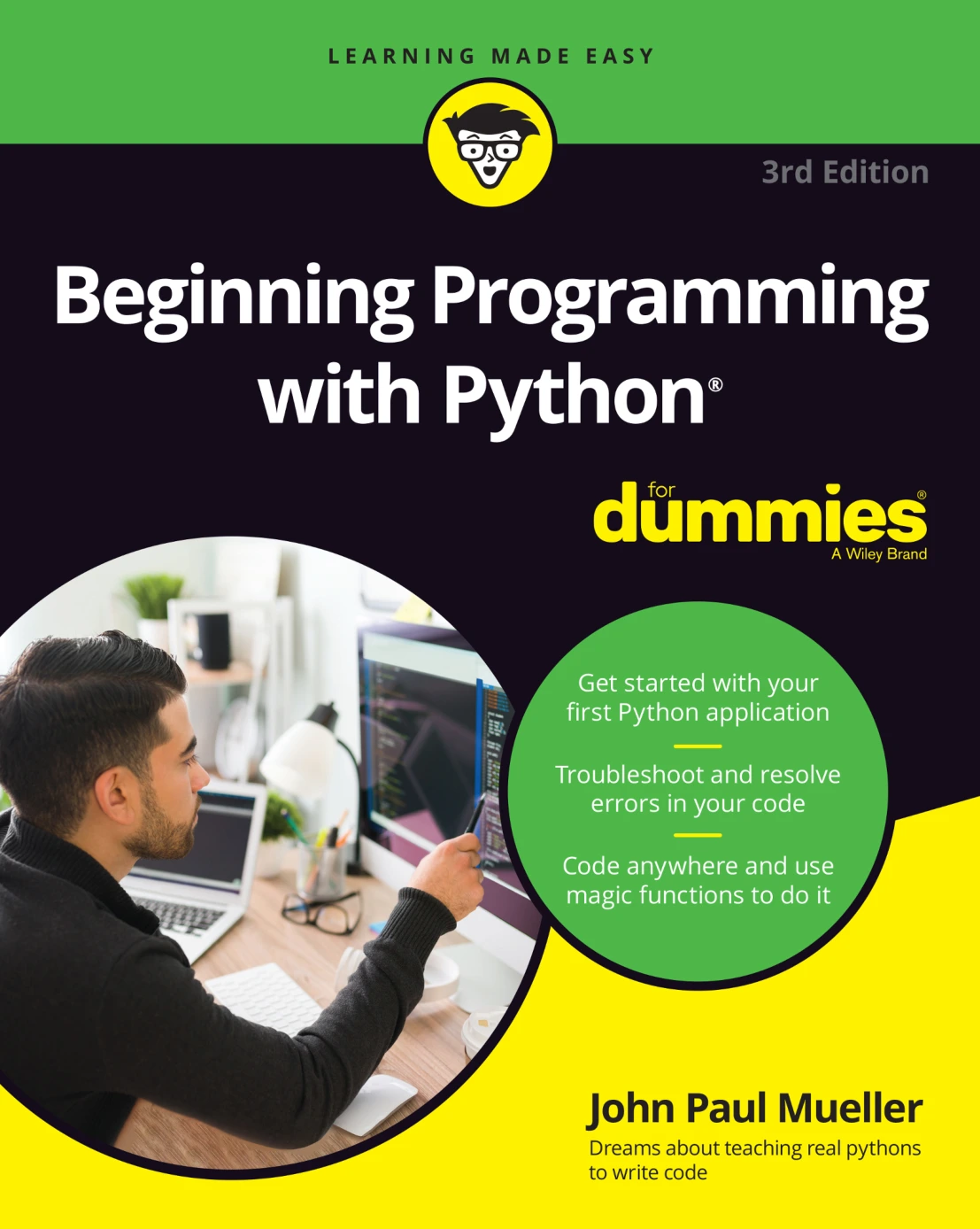
Beginning Programming with Python For Dummies, 3rd Edition
New programmers who want fundamentals followed by files, classes, packages, and everyday coding tasks.
The catalog describes coverage of Google Colab, storing and changing information, decisions, repetition, error handling, packages, strings, lists, classes, and files. It also includes practical topics such as sending email.
Why it may suit you: Its scope gives you room to move beyond first commands without immediately switching resources. The Google Colab coverage also offers a learning workflow to consider if local setup feels like an early obstacle.
What to consider: A broad introduction is still a substantial learning commitment. Work through the foundational chapters actively, and avoid treating every later topic as something you must master before writing a small useful program.
For visual explanations: Python Illustrated
Python Illustrated by Maaike van Putten, with illustrations by Imke van Putten, combines visual explanations with beginner-oriented instruction.
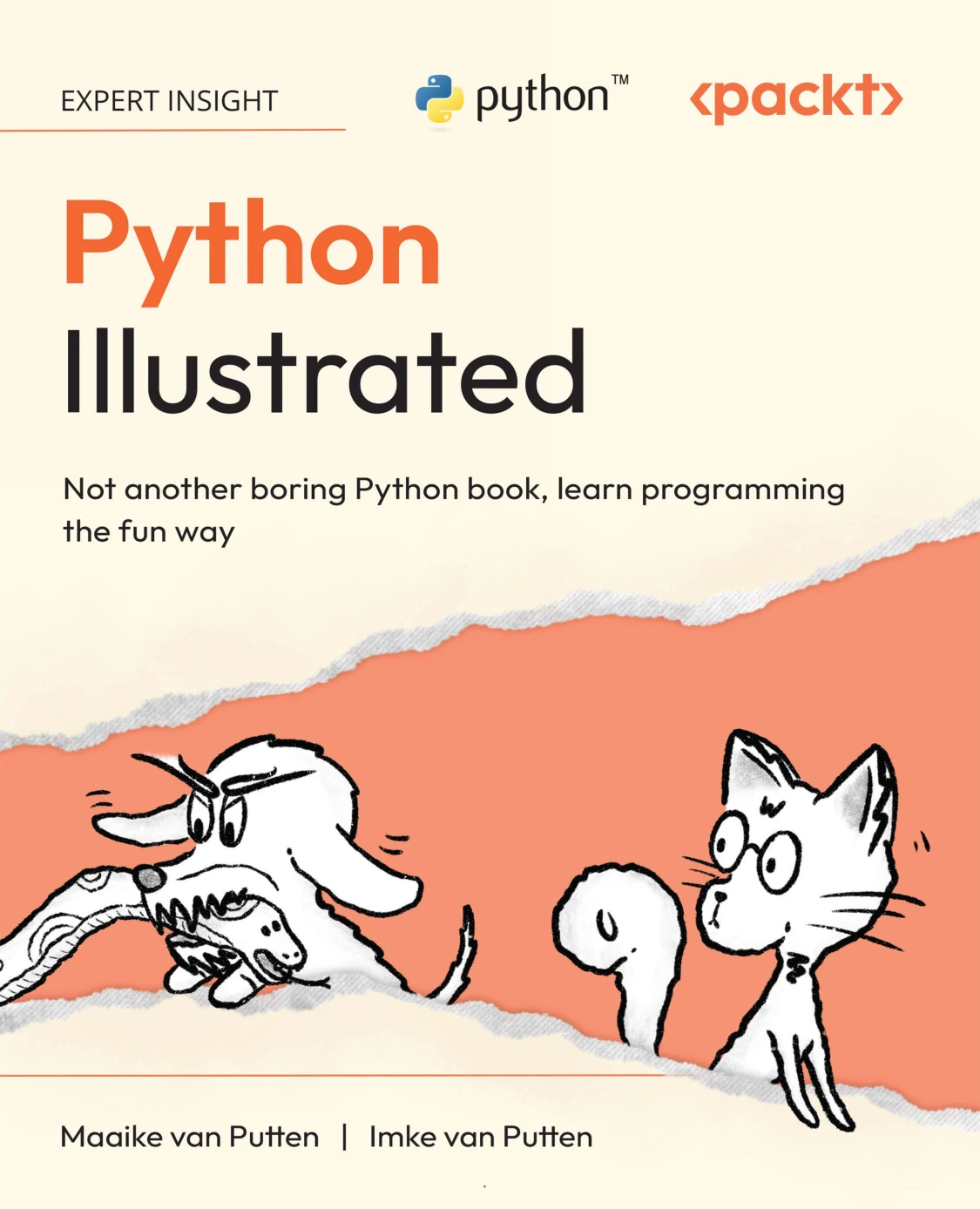
Beginners interested in visual explanations alongside foundational code examples.
Its listed material begins with setup, the terminal, running a first program, and Visual Studio Code. Core topics include variables, numbers, strings, comparison and logical operators, conditional statements, lists, tuples, and dictionaries. The description also identifies short exercises and common mistakes involving indentation, colons, and assignment versus comparison.
Why it may suit you: If dense prose makes an abstract idea harder to understand, an illustrated presentation is worth considering. The short exercises provide opportunities to apply individual concepts before tackling larger programs.
What to consider: Illustrations do not establish that a book will teach you better than a text-focused alternative. Inspect sample pages where available, especially the balance between explanation, diagrams, and code.
For a gentle first step: Python for the Greenhorns Book-1
Python for the Greenhorns Book-1 by Monty is the narrowest starting resource in this shortlist. The catalog describes an introduction for readers who have never written code, including Thonny installation on Windows, Mac, or Linux.
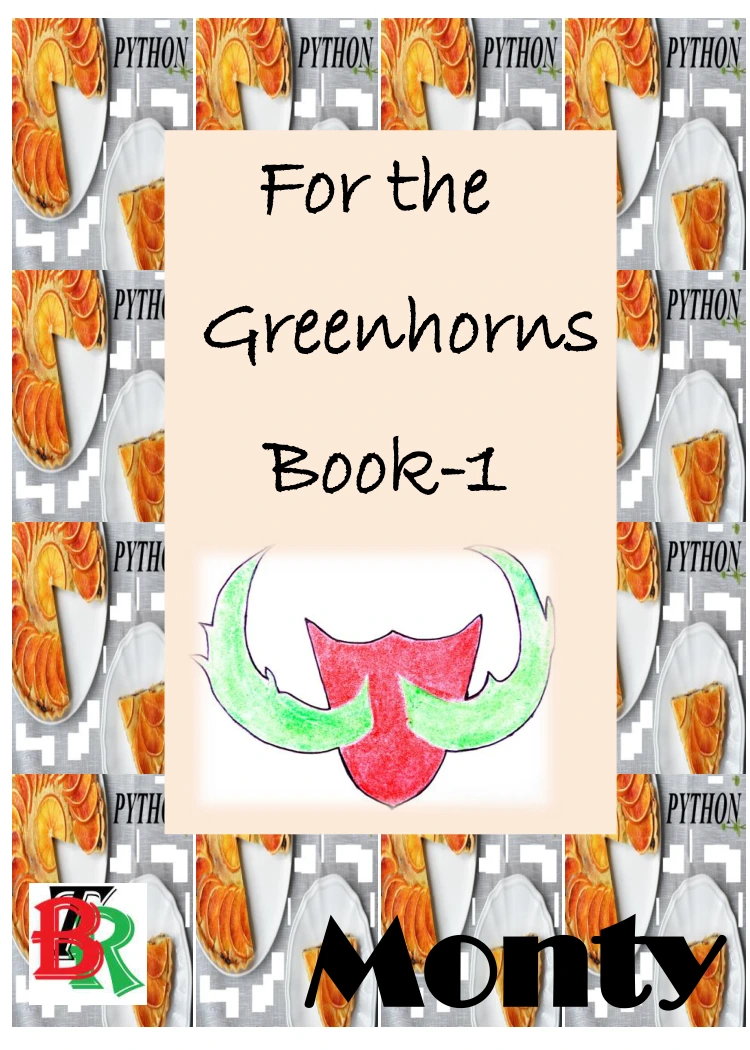
Python for the Greenhorns Book-1
By Monty
Readers who need help starting with Thonny, variables, and basic exercises before a broader introduction.
Its focus is on basic orientation, changing and unchanging values, variables, constants, exercises with answers, and a closing review.
Why it may suit you: A small primer can make the first task manageable: open the coding environment, type a few expressions, and understand how values are stored.
What to consider: This is not a substitute for a full introduction. Choose it as an on-ramp if that limited scope solves a real problem for you. Afterward, continue with a resource that develops decisions, loops, collections, and functions.
For project-motivated learners: Python Crash Course by Tyron B. Rodriguez
Python Crash Course: A Comprehensive and Fast-Paced Introduction to Python Programming for Beginners and Experienced Developers Alike by Tyron B. Rodriguez moves from setup and first programs into variables, operators, conditions, loops, strings, collections, functions, and modules.
Learners motivated by games and practical projects who are comfortable with a faster introductory pace.
The catalog identifies project chapters involving games, automation, task management, and data analysis, including a number-guessing game.
Why it may suit you: Project chapters can give you a reason to revisit earlier concepts. Instead of studying a loop only as a definition, you can connect it to repeated guesses or repeated processing of information.
What to consider: The title explicitly describes a fast-paced approach. If you are completely new to computing tools as well as programming, allow time for additional practice between chapters.
Check the author before choosing: This catalog listing is by Tyron B. Rodriguez. It is not Eric Matthes’s similarly titled Python Crash Course; their contents and editions should not be treated as interchangeable.
For foundations plus a longer learning path: Unlocking Python
Unlocking Python: A Comprehensive Guide for Beginners by Ryan Mitchell starts with installation, first scripts, and core language topics, then extends into a much wider range of applications.
Unlocking Python: A Comprehensive Guide for Beginners
Self-directed beginners who want core Python followed by exposure to testing, databases, web tools, and data analysis.
The catalog lists collections, functions, classes, exceptions, modules, packages, file handling, logging, databases, and unit testing. Later material introduces tools associated with web development, web scraping, and data analysis.
Why it may suit you: It offers a way to learn the basics while seeing possible directions for later study. That can help if you know you want to use Python but have not yet chosen an application area.
What to consider: Breadth can become distracting if you try to study everything at once. Treat the fundamentals as your first course and the application chapters as a menu to revisit after you can write and debug small programs.
For additional practice: Python Workbook for Absolute Beginners [Part 1]
Python Workbook for Absolute Beginners [Part 1] by Koding Success uses questions, answers, and explanations to review foundational Python topics.
![cover of python workbook for absolute beginners [part 1]](https://cdn.digitaldelights.co/wp-media-folder-digital-delights/wp-content/uploads/2026/09/Python-Workbook-for-Absolute-Beginners-Part-1.webp "best python books for absolute beginners")
Python Workbook for Absolute Beginners [Part 1]
Beginners studying from a main resource who want additional questions with answers and explanations.
The catalog describes more than 70 questions covering material such as variables, strings, lists, tuples, dictionaries, sets, operators, conditions, loops, and functions.
Why it may suit you: It gives you a separate opportunity to check understanding after reading an explanation elsewhere. Attempt each question before revealing the answer, then explain why your answer was right or wrong.
What to consider: Correctly recognizing an answer is different from writing a working program. Use the workbook alongside a teaching resource and hands-on coding, rather than as your only learning method.
What if your main goal is automating everyday tasks?
If your motivation is organizing files or reducing repetitive digital work, an automation-focused resource may be more relevant than a broad application-building guide.
The catalog-listed Python Automation Crash Course: 3 Books in 1 – The Ultimate Guide to Mastering Python Automation from Beginner to Advanced. Learn it Well & Fast by Mark Reed begins with setup, variables, loops, and conditions before introducing file management, email automation, scheduling, web scraping, and APIs.
This is a goal-specific option rather than another book every beginner needs. Start with its foundational material before approaching the later automation tasks. When practising file operations, use copies in a separate test folder; do not begin by moving or renaming important originals.
How to learn with your first Python book
Your first objective is not to finish the book quickly. It is to turn explanations into code you can understand, change, and recreate.
- Read one concept: Identify the problem it solves, such as storing a value or repeating an operation.
- Run the example: Type it into the environment the book introduces and check the output.
- Predict a change: Before changing a value or condition, write down what you expect to happen.
- Test your prediction: Run the modified code and explain any difference.
- Attempt an exercise: Make a genuine attempt before looking at an answer.
- Rebuild something small: Close the example and write a similar program from a short description.
Keep a brief learning log with three entries: what you learned, what confused you, and what you want to try next. A specific note such as “I do not understand why this condition is false” is easier to act on than “I am bad at Python.”
A small example to practise
The following independent example combines a collection of numbers with repetition and a running total. It is not presented as an excerpt from any recommended book.
expenses = [12.50, 8.00, 4.25]
total = 0

for expense in expenses:
    total = total + expense

print(total)
Read the code as a set of instructions: start with no accumulated spending, add each expense, and display the result. Before running it, calculate the expected total yourself.
- Add another expense and predict the new result.
- Try an empty list and explain what happens.
- After learning functions, put the calculation inside a function that accepts a list.
This kind of modification helps reveal whether you understand the example or only recognize its appearance.
Choose an independent project that matches your current skills
- Unit converter: Practise input, numbers, arithmetic, and output.
- Number-guessing game: Practise decisions and repetition after learning those concepts.
- Simple expense tracker: Begin with a list of values; add user input or file storage later.
These are suggested practice projects, not a claim that every shortlisted book includes them. Keep the first version small enough that you can explain each part.
Common buying and learning mistakes
Choosing a reference when you need a course
A reference helps you look up a feature. A teaching book introduces ideas in a deliberate sequence. For a first programming book, prioritize progression, setup guidance, and practice over an exhaustive list of features.
Starting with machine learning before understanding the language
If your eventual goal is machine learning, you still need to understand the Python code you are running. Learn to work with collections, conditions, loops, functions, and errors before expecting a specialist book to make sense of everything at once.
Collecting overlapping beginner books
Switching resources whenever a chapter becomes difficult can leave you repeatedly studying the same opening material. First identify the problem: an unfamiliar term, a setup error, a skipped concept, or too little practice. A second book is useful when it addresses that specific gap.
Copying code without checking understanding
After an example runs, change it. Ask what would happen with different input and which line controls the behavior. If you cannot explain the result, return to the relevant concept before adding more code.
Assuming all setup instructions remain interchangeable
Software interfaces and library requirements can differ from the instructions in a particular edition. Record the Python version and package versions you use. When an example fails, check the book’s support material, if available, rather than assuming that either you or the entire book is wrong.
Frequently asked questions
Can I learn Python without previous coding experience?
Yes. Choose a resource explicitly intended for people new to programming, and practise alongside the explanations. You do not need to understand advanced topics before writing your first small program.
Should I choose a textbook or a workbook?
Start with a teaching book if you need concepts explained and a sequence to follow. Add a workbook when you want more questions to check understanding. A workbook is most useful when you attempt answers independently and also practise writing code.
Are older Python books still useful?
They can be useful for foundational concepts, but examine their setup instructions, Python version, and dependencies. Distinguish an explanation of a basic idea from instructions tied to a particular software release. Do not assume every example will run unchanged in a different environment.
Can the official Python tutorial replace a beginner book?
Not necessarily for someone who has never programmed. The official Python tutorial states that it expects a basic understanding of programming. It can be a useful reference or follow-on resource, but that audience assumption matters when choosing your first structured introduction.
Which book should I choose if programming feels intimidating?
Consider Python for the Greenhorns Book-1 for a limited first step, or inspect Python Illustrated if visual explanations appeal to you. Choose based on an explanation you can follow, not on the most ambitious subtitle.
How will I know when I am ready to move beyond a beginner book?
Look for practical signs: you can write a small program from a description, explain its variables and control flow, and investigate a simple error. You do not need to memorize every feature. Move into a specialization when it serves a project you want to build.
Final recommendation: Choose for your next step
For a broad first teaching book, begin by comparing Beginning Programming with Python For Dummies, 3rd Edition with Python Illustrated. Choose the former if its structured, wide-ranging introduction appeals to you; consider the latter if you prefer visual presentation and short exercises.
If a full course feels like too much at first, use Python for the Greenhorns Book-1 as an on-ramp. If projects motivate you, consider Rodriguez’s Python Crash Course. Use Unlocking Python for a broader path, or add the Python Workbook for Absolute Beginners [Part 1] when extra practice addresses a real need.
You can browse the Python learning resources at Digital Delights for related options. The useful next step, however, is simple: choose one resource, open a coding environment, and work through a concept actively.
Sources and selection basis
Book coverage and audience descriptions in this guide are based on the supplied Digital Delights catalog, with the relevant listings linked in each profile. The shortlist distinguishes teaching books, short primers, and practice companions; it does not establish comparative teaching quality.
The audience caveat for the official tutorial is supported by The Python Tutorial. Software compatibility and the availability of support files should be checked for the particular edition and environment you plan to use.