
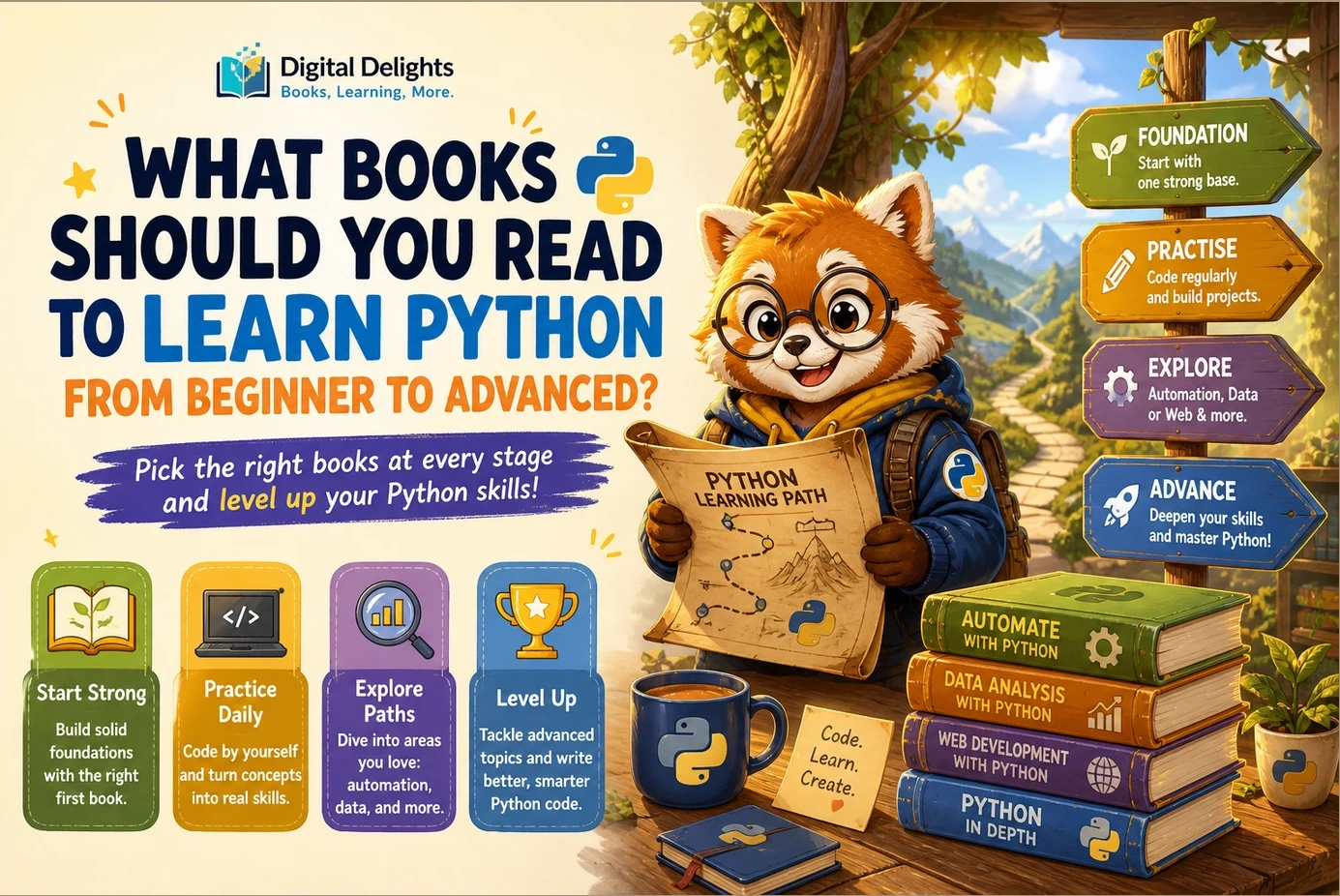
What Books Should You Read to Learn Python from Beginner to Advanced?
The most useful Python reading path is not a stack of increasingly intimidating books. It is a sequence of skills: learn the fundamentals, write small programs without following a tutorial, improve those programs, and then explore the language features your projects actually need.
When choosing Python books from beginner to advanced, start with one foundation resource rather than several overlapping introductions. Add an exercise or example companion when you need practice. Move to advanced material only after you can organize code into functions and modules, handle errors, and explain your own solutions.
Below is a practical route through relevant books in the supplied Digital Delights catalog, with alternatives for automation and business data work. You do not need to buy or finish every title. The aim is to choose the next resource that addresses a specific gap in your ability.
Quick answer: a practical Python reading path
For a general route, use Paul Richard’s beginner guide → Chamsseddine Rebbaj’s practice-focused first part → independent projects → selected advanced chapters. Monty’s introduction is an optional gentler starting point, while Gábor Szabó’s example collection can serve as a companion at several stages.
The table uses short labels for scanning; full linked catalog titles appear in the relevant sections. The readiness checkpoints are editorial suggestions, not publisher-certified prerequisites.
| Stage | Book or resource | Intended reader | Documented coverage | Checkpoint before moving on |
|---|---|---|---|---|
| Optional first step | Python for the Greenhorns Book-1 — Monty | Someone who has never written code | Thonny setup, variables, constants, introductory exercises | Run and modify a short program independently |
| Foundation | Python for Beginners — Paul Richard | A beginner seeking broader language coverage | Collections, control flow, functions, modules, files, classes, exceptions | Build a small program using functions and stored data |
| Structured practice | Python Programming with Practice from Beginner to Advanced: 1st Part — Chamsseddine Rebbaj | A learner who wants exercises alongside explanations | Core syntax, data structures, scripts, functions, introductory algorithms | Solve a new problem without copying a worked answer |
| Example companion | 1000 Python Examples — Gábor Szabó | A learner seeking examples and topic-based reference | Fundamentals, files, exceptions, regular expressions, decorators, profiling | Adapt an example to different requirements |
| Advanced software skills | Python Advanced Programming — Kevin Lioy | A reader already comfortable writing and debugging programs | Generators, decorators, context managers, testing, profiling, processes and threading | Explain and evaluate a technique in an existing project |
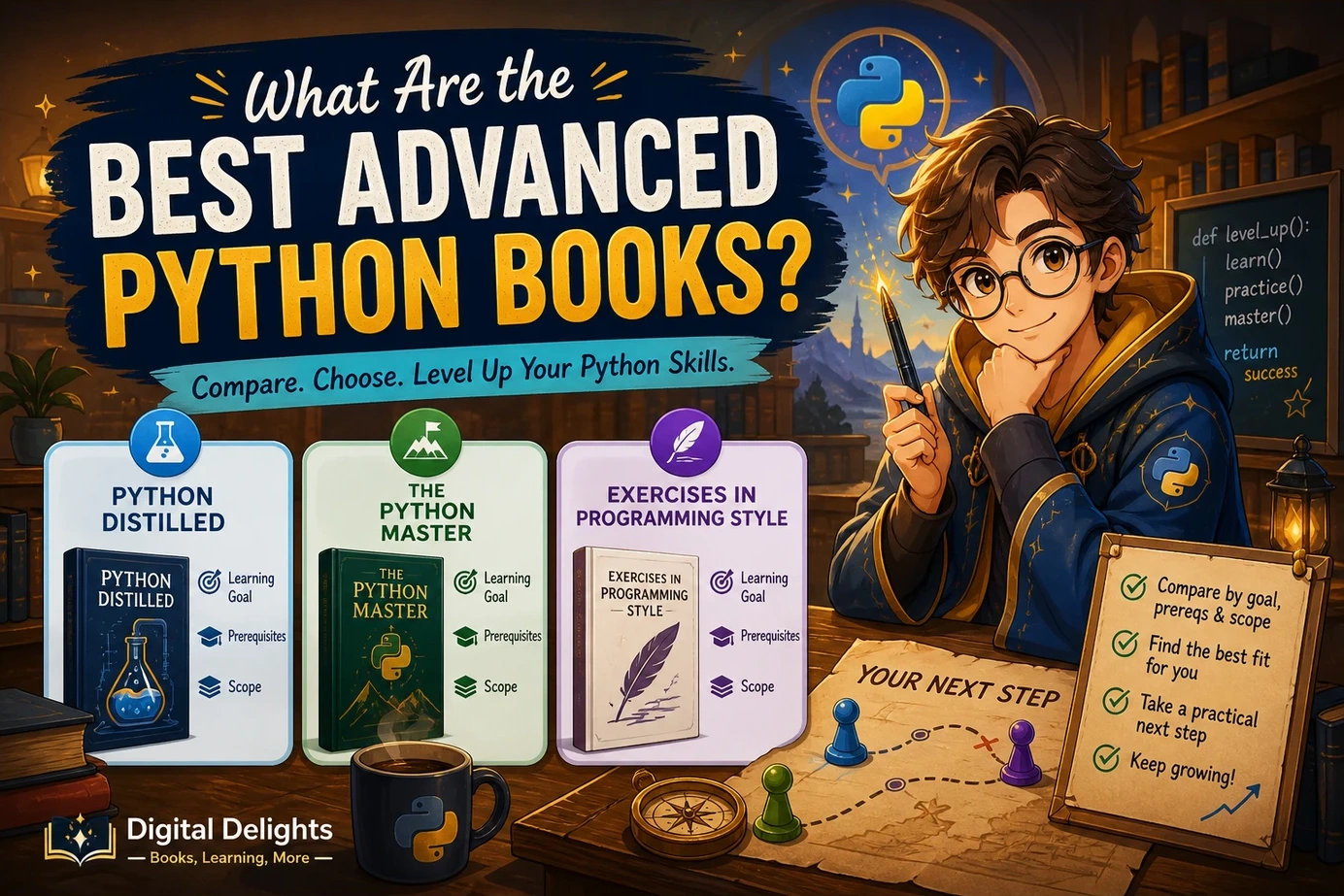
| Language internals | The Python Master — Robert Smallshire and Austin Bingham | An experienced learner seeking deeper language understanding | Descriptors, object internals, metaclasses, byte-oriented programming | Identify when an advanced mechanism is justified |
Choose by your current bottleneck. If setup is confusing, begin gently. If syntax makes sense but a blank editor does not, prioritize practice. If you already build useful programs, choose a resource that helps you improve their design or understand their behavior.
Beginner Python books: choose one starting point
A gentle introduction for your first experience with code
Python for the Greenhorns Book-1 by Monty is aimed at readers with no coding experience. Its catalog description introduces Python, getting started with Thonny, variables, constants, and simple exercises with answers.
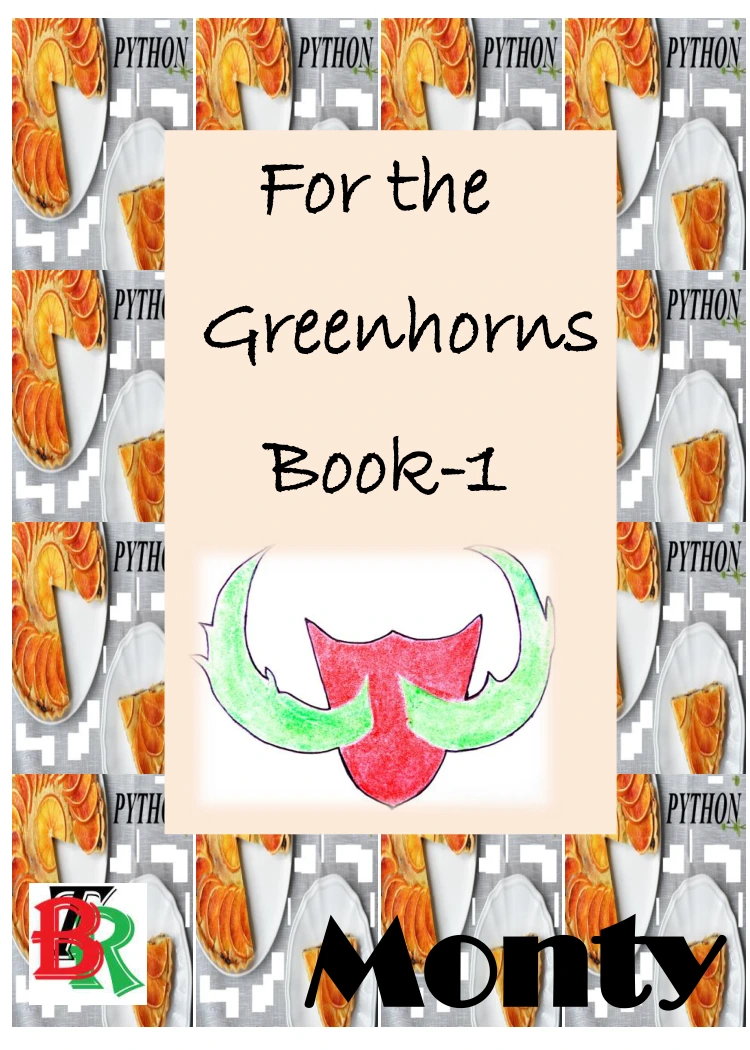
Python for the Greenhorns Book-1
By Monty
First-time coders who need help with Thonny setup, variables, and introductory exercises.
This makes it a possible starting point if you need help getting comfortable with the basic act of writing and running code. Its documented scope is limited, however: do not treat it as a complete foundation covering functions, file handling, exceptions, and program design.
After working through an introductory example, change a stored value, rename a variable consistently, and predict what the program will print. Being able to explain those changes matters more than finishing the pages quickly.
A broader foundation for general programming
Python for Beginners: A Crash Course Guide to Learn Coding and Programming With Python in 7 Days by Paul Richard has wider documented coverage. The catalog lists data types, collections, control flow, functions, modules, file handling, classes, inheritance, and exceptions.
Python for Beginners: A Crash Course Guide to Learn Coding and Programming With Python in 7 Days
By Paul Richard
Beginners seeking coverage of collections, functions, modules, files, classes, and exceptions.
That breadth makes it a more suitable candidate for a main introductory resource than a book focused only on setup and variables. Treat the time claim in the title as part of the title, not as a promise that you will become proficient within that period.
A useful beginner sequence is:
- Values and collections: strings, numbers, lists, and dictionaries.
- Decisions and repetition: conditionals and loops.
- Reusable logic: functions, arguments, and returned values.
- Working programs: modules, files, and exception handling.
- Basic organization: classes where they help represent the problem.
Do not wait until the final chapter to build something. A small calculator, quiz, or contact list gives the early concepts a purpose.
Move from following examples to writing programs
Recognizing code and producing it are different tasks. If you can follow a chapter but cannot solve a similar problem alone, another introductory book may simply repeat what you already recognize. What you need next is an opportunity to make decisions.
Use a practice-focused resource
Python Programming with Practice from Beginner to Advanced: 1st Part by Chamsseddine Rebbaj combines explanations with exercises. Its supplied description covers numbers, strings, conditionals, loops, built-in data structures, scripts, modules, functions, and introductory searching and sorting algorithms.
Python Programming with Practice from Beginner to Advanced: 1st Part
Learners who want exercises alongside foundational syntax, data structures, functions, and introductory algorithms.
Despite the wording in its title, the available description does not establish that this first part is a complete advanced Python curriculum. Its clearer role in this roadmap is structured practice across foundational topics, with some introduction to algorithms.
The catalog identifies Python 3.7 in its setup material. Check installation instructions and package requirements against the environment you plan to use rather than copying every setup step unquestioningly.
A repeatable practice routine
- State the task: write down the input, expected output, and any constraints.
- Try before reading the answer: make a first attempt, even if it is incomplete.
- Debug deliberately: inspect the error and isolate the smallest failing example.
- Compare approaches: explain the differences between your solution and the worked one.
- Change a requirement: handle empty input, accept several records, or save the result.
For example, after writing a function that totals a list of expenses, modify it to total expenses by category. Then decide what should happen if a record has no category or an invalid amount. Those decisions turn a syntax exercise into program design.
Project checkpoint: a command-line expense tracker
Before advancing, try building a small expense tracker without following a complete tutorial. Keep the first version modest:
- Add an expense with an amount, category, and description.
- List the saved expenses.
- Calculate totals by category.
- Save and reload the records from a file.
- Handle invalid input without losing existing data.
Start with a list of dictionaries and a few functions. You do not need a database, graphical interface, or elaborate class hierarchy. The checkpoint is whether you can connect several basic ideas into one working program.
Intermediate learning: improve code you can already write
The intermediate stage is less about collecting new syntax and more about making working code easier to understand, change, and verify.
Use examples selectively rather than reading everything in order
1000 Python Examples by Gábor Szabó is described in the catalog as an example-driven resource containing exercises and solutions. Its coverage ranges from installation and control flow to files, exceptions, regular expressions, decorators, profiling, multitasking, and Tk GUI examples.
By Gábor Szabó
Readers who learn through examples and want material spanning basics, files, exceptions, decorators, and profiling.
Use it as a topic-based companion. If your expense tracker struggles with file handling, study the relevant examples and adapt the ideas. If you need text matching, investigate regular expressions. A large example collection does not have to become another cover-to-cover assignment.
Refactor one existing project
Choose a project you already understand and make one focused improvement at a time:
- Separate user input and output from calculation logic.
- Replace repeated blocks with a clearly named function.
- Add tests for empty input and invalid records.
- Move related functions into a module.
- Explain which parts modify data and which only calculate results.
A useful test of understanding is whether you can explain why the revised version is better. Shorter code is not automatically clearer code, and a newly learned technique does not belong in every function.
Advanced Python books: choose depth with a purpose
Advanced learning can follow two complementary directions: building more dependable software and understanding the mechanisms underneath the language. Choose the direction that answers your current questions.
Testing, debugging, profiling, and concurrency
Python Advanced Programming: The Guide to Learn Python Programming. Reference with Exercises and Samples about Dynamical Programming, Multithreading, Multiprocessing, Debugging, Testing and More by Kevin Lioy covers generator expressions, decorators, context managers, functional-style tools, debugging, unit testing, profiling, multiprocessing, and threading according to the supplied catalog description.
By Kevin Lioy
Readers comfortable with basic programs who want to study testing, debugging, profiling, generators, and concurrency.
Its documented coverage makes it a candidate for readers moving beyond small scripts. The supplied row does not establish its edition or compatibility with every current environment, so check those details before relying on version-sensitive examples.
Begin with a practical question: how can you test a function, investigate a failure, or measure a slow operation? Study concurrency when you have a task that could benefit from it, not merely because it sounds advanced.
Object internals, descriptors, and metaprogramming
The Python Master by Robert Smallshire and Austin Bingham focuses on advanced language features. The catalog identifies object internals, attribute access, descriptors, instance creation, metaclasses, class decorators, abstract base classes, and byte-oriented programming.
Experienced learners interested in descriptors, metaclasses, attribute access, and byte-oriented programming.
It belongs later in the learning path, after functions, modules, exceptions, and basic classes are familiar. A good reason to study descriptors is that you want to understand controlled attribute access. A good reason to study metaclasses is that you have a concrete question about class creation.
Understanding these mechanisms is useful even when you decide not to use them. An ordinary function, property, or straightforward class may be the more readable solution to a particular problem.
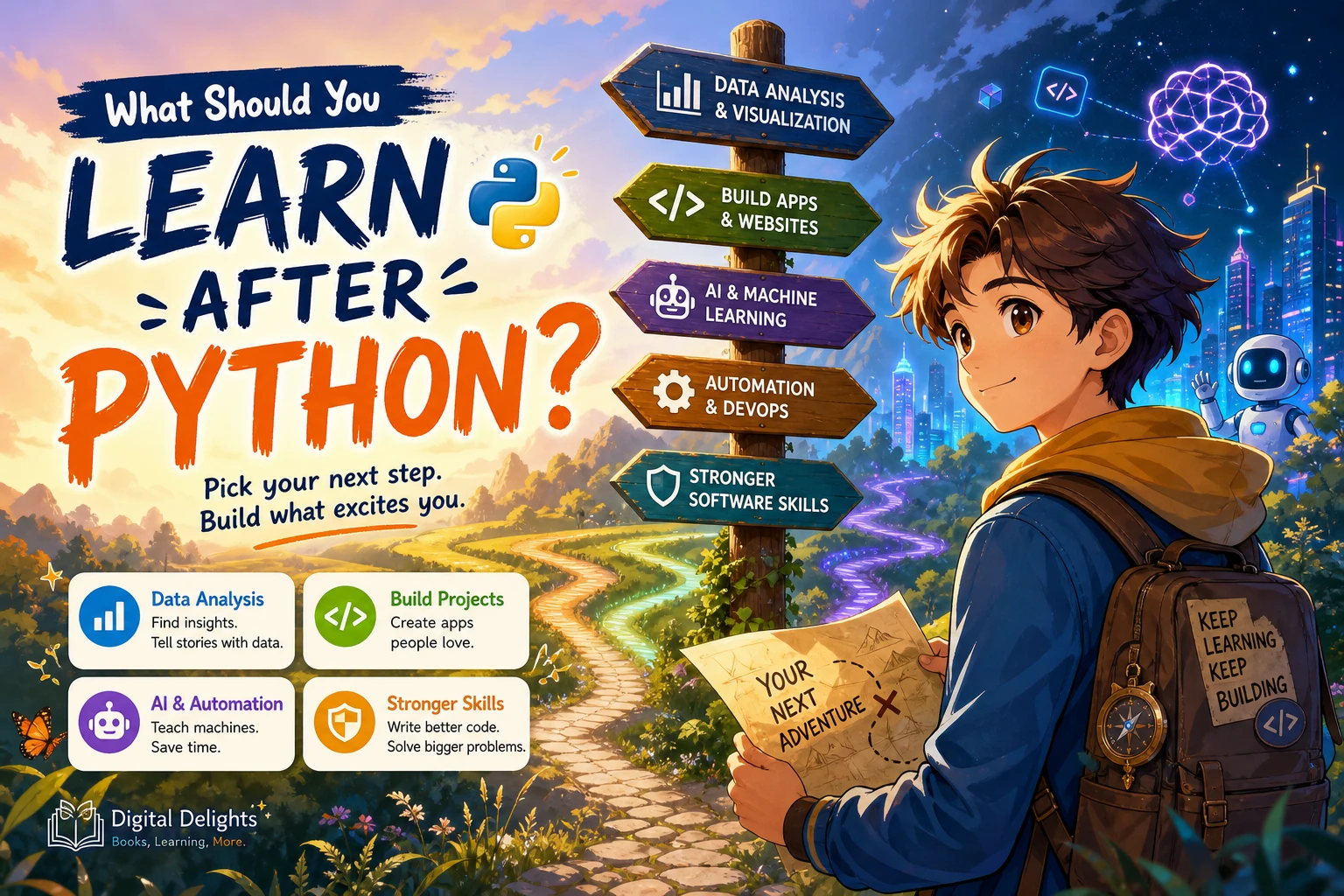
Optional branches: automation or business data work
Specialization is not a compulsory stage after advanced Python. You can pursue a motivating application once your foundations are sufficient, then deepen your general skills alongside it.
Automation for repetitive computer tasks
Python Automation Crash Course: 3 Books in 1 – The Ultimate Guide to Mastering Python Automation from Beginner to Advanced. Learn it Well & Fast by Mark Reed is a catalog option for an automation-led route. Its description includes file management, web scraping, email automation, task scheduling, REST APIs, and projects such as a file organizer and reminder system.
This is an alternative main route if practical computer tasks provide your motivation; it need not be added to several other beginner courses. For an initial project, organize copies of sample files in a temporary folder. Add a preview mode before allowing a script to move or rename anything important.
For online tasks, check service terms and access permissions. Keep credentials out of source code, and test scheduled jobs before allowing them to run unattended.
Python for business-oriented data tasks
Python for Non-Pythonians by Francesco Grossetti and Gaia Rubera is aimed at business-oriented readers and professionals with little or no coding experience. The supplied catalog material describes core Python, exercises, functions, common development environments, pandas, and data handling.
It is a possible starting route when your goal is working with business data rather than general application development. A sensible practice project is to summarize a sample sales file by category and explain the handling of missing or invalid records.
Learning a library and understanding the data are separate responsibilities. You should be able to explain what the records represent, which values were excluded, and why the summary answers the original question.
How to choose and use your next Python book
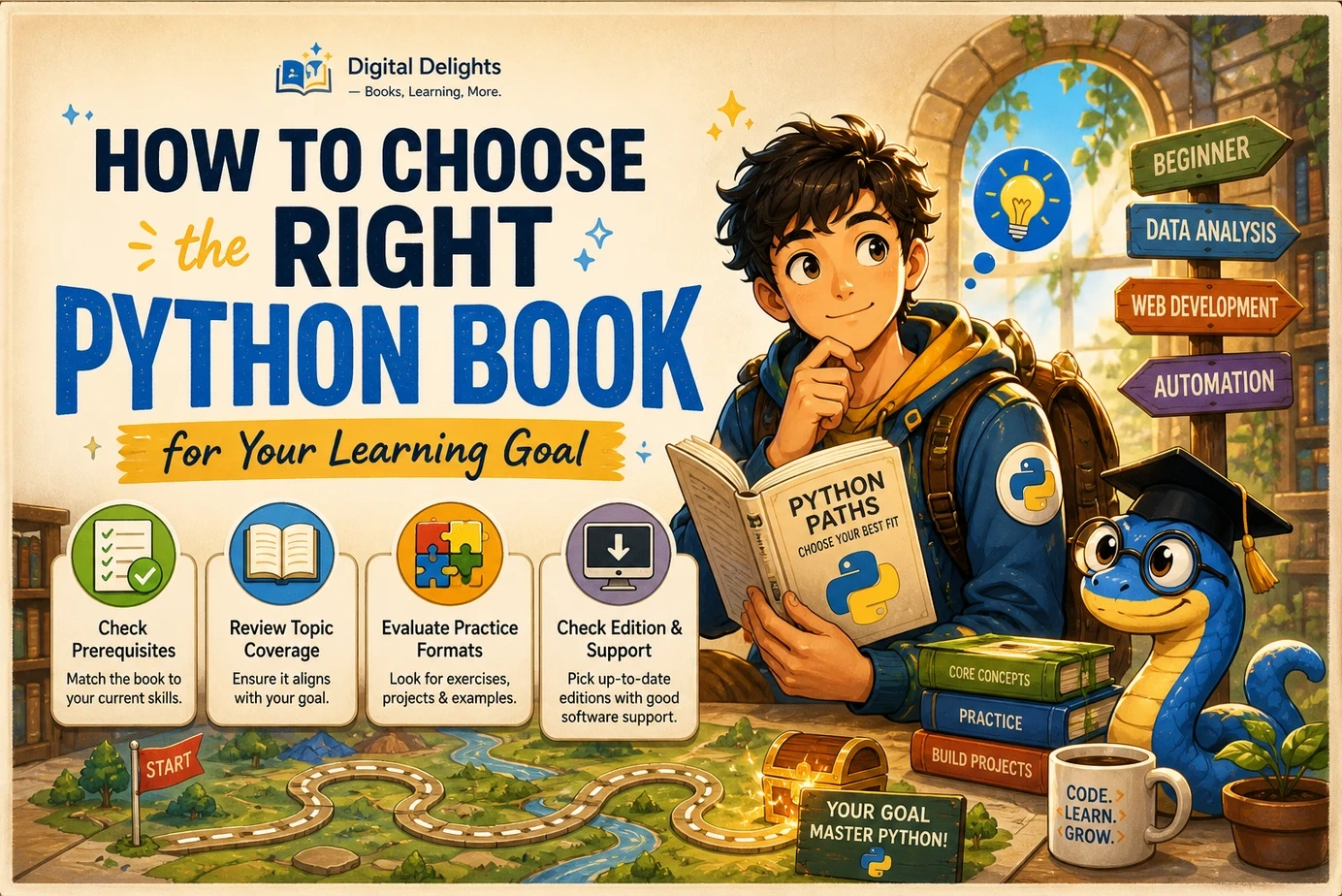
Check fit before choosing another resource
- Prerequisites: can you understand a sample explanation without looking up every term?
- Coverage: does the contents list address a gap you can name?
- Practice: are there exercises, projects, solutions, or code you can work with?
- Versions: which interpreter, packages, operating system, or external services do the examples assume?
- Overlap: are you paying for substantially the same introduction again?
- Scope: does the actual coverage support the broad claims suggested by the title?
Check version-sensitive guidance
Older material can still explain useful concepts, but setup instructions and some advanced behavior deserve extra attention. For a concrete example, the official Python 3.14 release notes document deferred evaluation of annotations and officially supported free-threaded Python. These changes make annotation and concurrency discussions particularly worth checking against the version and build you use.
This does not establish that an older book’s examples are broken. It means compatibility should be checked at the example and environment level, rather than inferred from a publication date alone.
Frequently asked questions
Can you learn Python from books alone?
A book can provide the structure, but you still need to run code, solve unfamiliar problems, and investigate errors. Use reading as preparation for practice, not as a substitute for it. Documentation is also useful when an example depends on a particular version or library.
How many Python books do you need?
Begin with one foundation resource. Add a practice companion if you need more problems, then select a deeper resource when a specific gap appears. Owning several introductions is less useful than completing meaningful exercises from one.
When should you start an advanced Python book?
Start when you can build and debug a small program using functions, collections, modules, exceptions, and basic classes. You should also be able to explain your design choices. You can read an individual advanced chapter earlier when it answers a concrete question.
Are older Python books still useful?
They can be, particularly for foundational concepts. Check installation steps, dependencies, and version-sensitive behavior separately. Do not assume either complete compatibility or complete obsolescence based solely on age.
Does “beginner to advanced” mean one book covers everything?
No. The phrase does not establish the depth of coverage. Examine the contents, examples, and prerequisites. A resource may introduce advanced vocabulary without providing sustained practice in advanced program design.
Choose the next skill, not the biggest stack
The most practical reading path starts with a manageable foundation, moves into independent work, and uses deeper books to answer questions that arise from that work. Selective reading is appropriate once you have enough experience to recognize your gaps.
For your next step, choose one resource and pair it with a small project. You can explore the Python book collection at Digital Delights with a specific purpose in mind: first steps, practice, automation, data handling, or language internals.
Sources and recommendation basis
Book coverage and audience descriptions are based on the supplied Digital Delights catalog entries, linked where each title is discussed. The learning sequence, checkpoints, and project ideas are editorial guidance, not comparative testing results. Version-sensitive context is supported by the official Python 3.14 release information.