
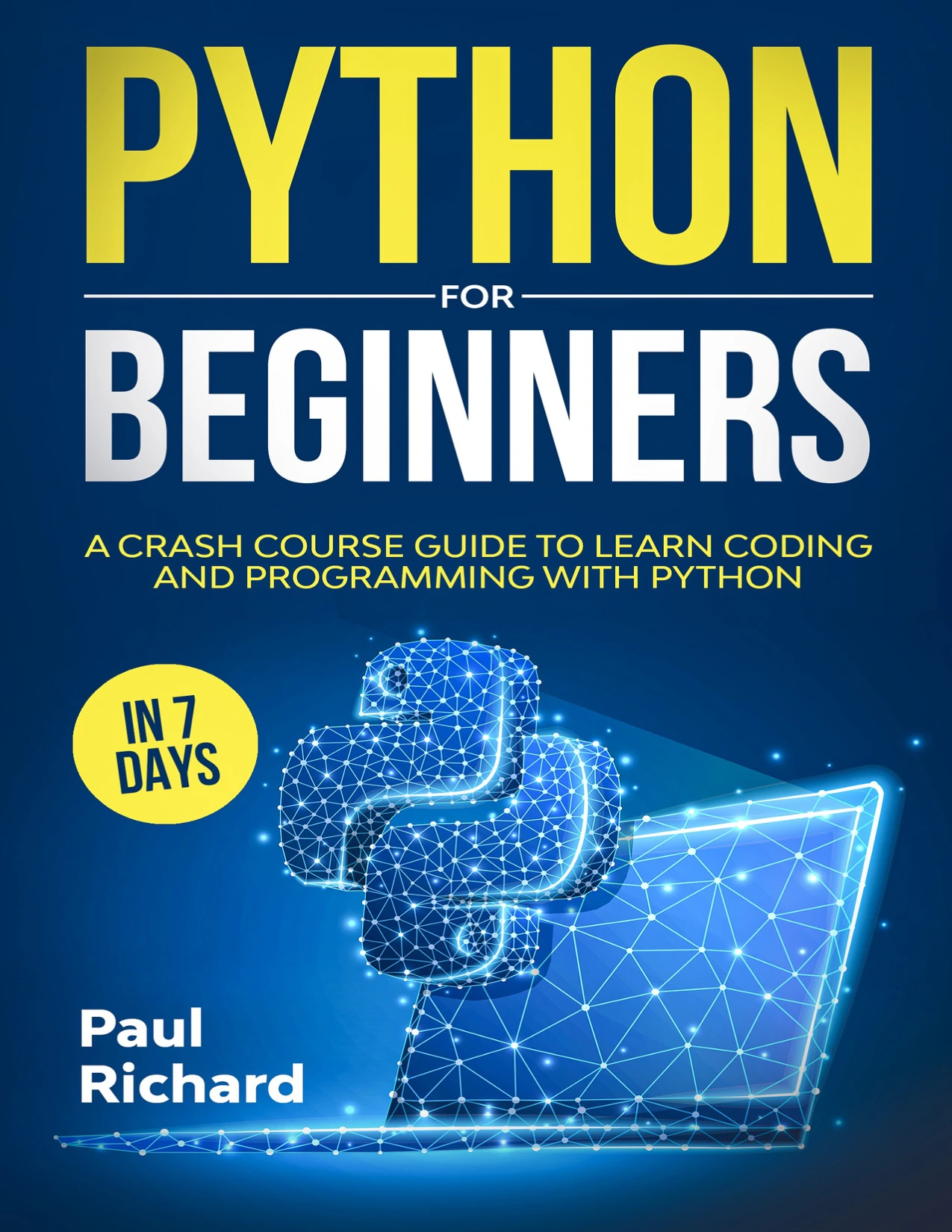
Python for Beginners: A Crash Course Guide to Learn Coding and Programming With Python in 7 Days
Original price was: $5.00.$2.50Current price is: $2.50.

Paul Richard
Product Specs:
- File Type: PDF
- File Size: 3.3 MB
- Book Language: English
- Total Page Count: 136
- Instant Download
Start Programming with Python 💻
Python is often recommended as a first programming language because its syntax is readable and its uses are broad. This guide by Paul Richard leans into that beginner-friendly reputation. It is structured as a crash course: start with the essentials, build vocabulary around how Python works, then move toward the parts of the language that make real programs possible.
The material is compact rather than exhaustive. That makes it a reasonable starting point for readers who want a broad orientation before choosing a deeper specialization.
What the Book Covers
- What Python is and who it suits
- Beginning with Python and using the interpreter
- Variables, assignment, object references, and fundamental data types
- Strings, booleans, lists, tuples, and dictionaries
- Control flow with if, while, and for statements
- Functions, arguments, return values, and modular code
- Modules, imports, and the module search path
- File handling, paths, encodings, reading, and writing
- Classes, objects, constructors, inheritance, and method overriding
- Exceptions, built-in errors, and custom exceptions
From Language Basics to Practical Python
The table of contents moves in a logical progression. Early chapters explain what Python is, how it compares with web languages such as HTML, CSS, and JavaScript, and how the interpreter executes code. From there, readers encounter the data structures and control-flow tools that appear in almost every Python program. Later chapters connect those pieces to functions, modules, files, and classes, which is where the language starts to feel less like isolated syntax and more like a way to organize working code.
Error Handling and Object-Oriented Thinking
Dedicated chapters address exceptions and error handling, including syntax errors, type errors, zero division errors, and a range of built-in exceptions. That focus matters for beginners, because learning to read errors is part of learning to program. The book also introduces object-oriented concepts such as classes, objects, constructors, inheritance, and method overriding, giving readers a foundation for understanding how larger Python programs are structured.
Advanced Topics and Wider Context
Toward the end, the guide reaches beyond the fundamentals. It discusses Unicode and character encodings, generators and the yield statement, advanced generator methods, and an introduction to Alexa skill development. A later chapter compares Python with Java, JavaScript, Perl, Tcl, Smalltalk, C++, and Lisp/Scheme, then outlines reasons to use Python, its advantages and limitations, and companies that rely on the language. These sections help place Python in a broader programming landscape.
Who May Find This Python Guide Useful
The book is aimed at beginners and self-learners. If you are new to coding and want a single-volume overview of Python’s core ideas, the sequence from definitions to data types, functions, files, and classes may suit you. Readers who already program in another language may also use it as a fast refresher, though experienced Python developers will likely want a more specialized reference for advanced work.
A Compact Starting Point 🐍
Python for Beginners works best as a first map of the language. It introduces the vocabulary, shows the major building blocks, and points toward topics that can be explored in more depth later. For a reader who wants to begin coding without committing to a massive textbook, this crash-course approach keeps the scope focused and the path forward clear.
User Reviews
Be the first to review “Python for Beginners: A Crash Course Guide to Learn Coding and Programming With Python in 7 Days”
You must be logged in to post a review.
Original price was: $5.00.$2.50Current price is: $2.50.
There are no reviews yet.