
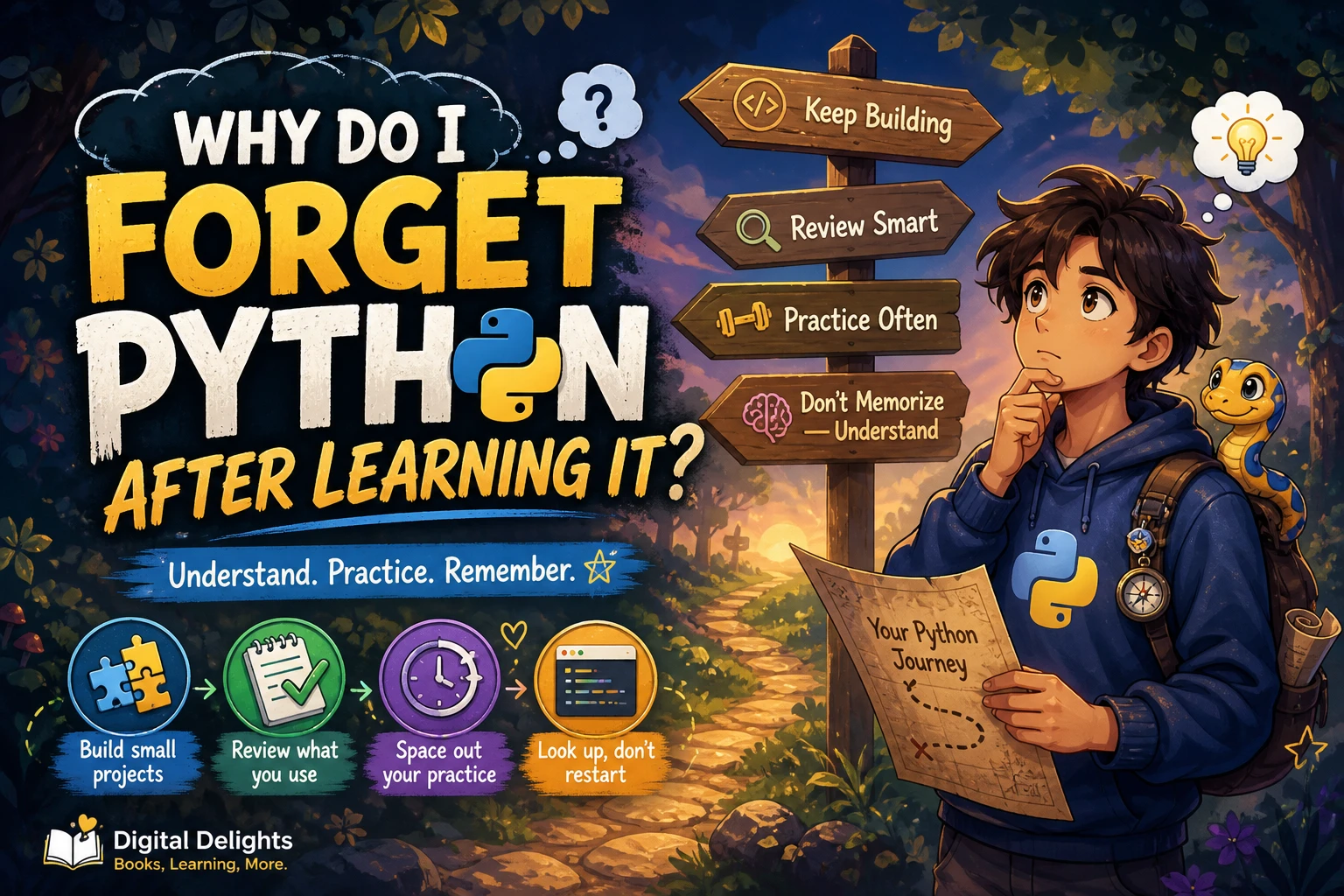
Why Do I Forget Python After Learning It?
You finish a Python lesson, understand the examples, and feel ready to code. Then you open a blank editor and struggle to remember how to begin. That experience can be frustrating, but it does not necessarily mean you learned nothing or that programming is not for you.
A useful distinction is the difference between recognizing code when you see it and recalling how to write or adapt it on your own. Reading a familiar example can feel easy; producing a solution without prompts asks you to retrieve ideas and make decisions. This guide explains why Python can feel hard to recall, what is worth practising, and how to review without starting your course over.
Why do I forget Python after learning it?
There is no single, Python-specific explanation established by the research available here. In everyday learning, though, several things can contribute: you may have followed examples more than you practised producing code, you may not have used the language for a while, or you may be unsure how to turn a problem into steps. These are different challenges, and each calls for a different response.
It also helps to remember that understanding a concept does not require keeping every piece of syntax or every library detail in memory. Programmers routinely consult documentation. The important skill is being able to reason about a problem, recognize the concepts that apply, and find reliable details when needed.
Why Python can feel familiar but hard to recall
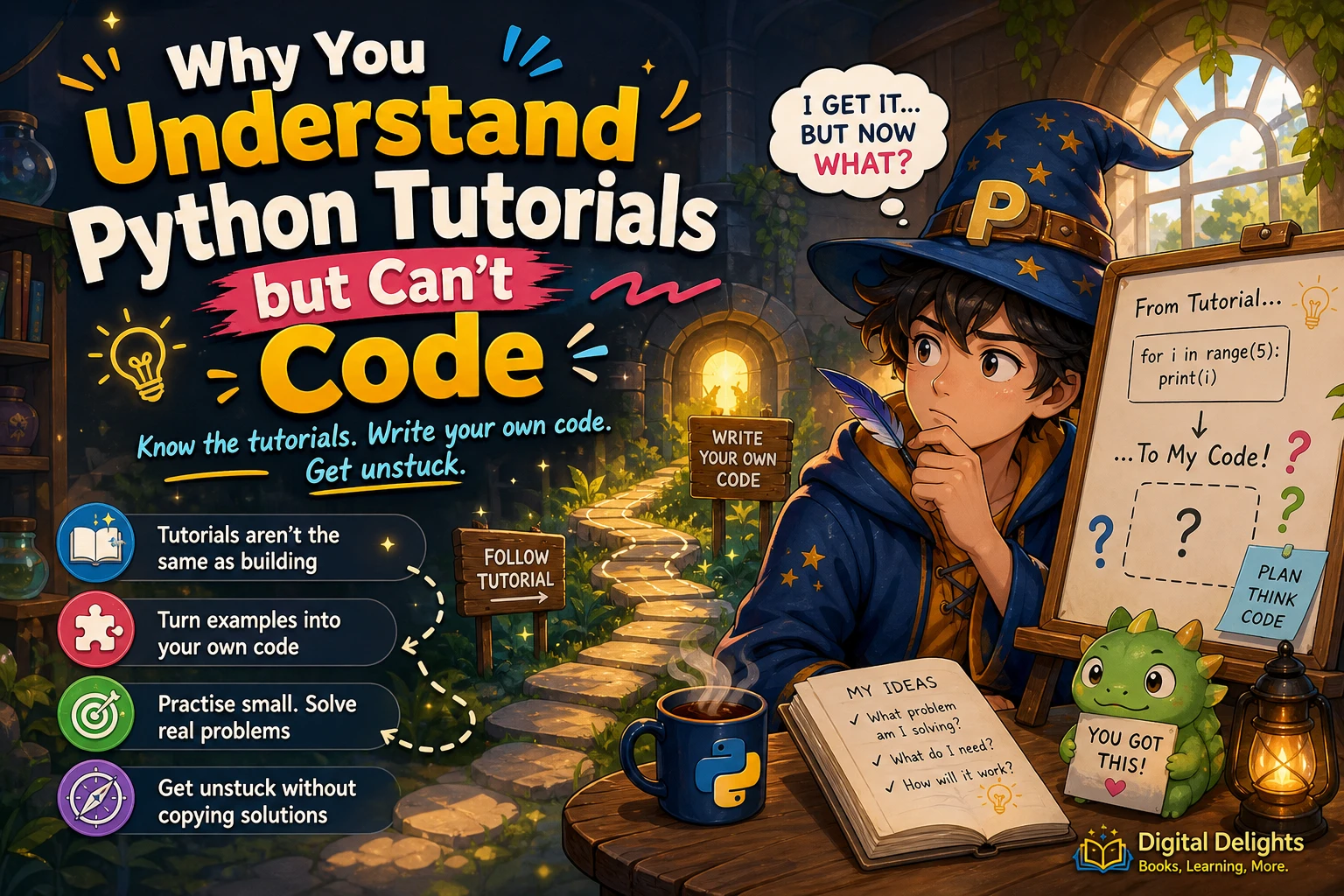
Following a solution is not the same as producing one
When a tutorial supplies the next line of code, you can focus on understanding that line. When you start from a blank file, you have to decide what the program should do, which concepts to use, and how to express them. Those are related but distinct activities.
For example, you might understand a demonstration that loops through a list and prints each item. A new task—such as counting how many values exceed a threshold—requires you to decide what to track, how to compare each value, and when to update the result. If you get stuck, that may point to a need for more independent problem-solving practice, not a total loss of Python knowledge.
Time away from coding can make details less accessible
If you have not written Python recently, recalling a particular construct or method may take longer. That does not mean you must memorize every detail before returning to a project. Try a small task first, notice what you can retrieve, and use a reference for the parts you cannot.
Remembering syntax and planning a program are different skills
Sometimes the challenge is not remembering whether a loop uses for or while. It is deciding how to break a task into manageable steps. Before coding, write a short plain-language plan: what information goes in, what needs to happen, and what result should come out. Then match those steps to Python concepts.
You do not need to memorize every method
It is reasonable to look up less-familiar syntax, library functions, and method names. Put more practice into core ideas you use to build solutions: variables, conditionals, loops, functions, and basic data structures such as lists and dictionaries. Documentation can fill in details while you work.
The official Python tutorial recommends working with an interpreter as you learn and describes itself as an introduction rather than a comprehensive reference. In other words, reading and running code belong together, and consulting documentation is part of the process.
What should I review—and what should I look up?
Use this simple division to choose what to practise:
- Practise recalling: how to assign values, make a decision with a conditional, repeat work with a loop, define and call a function, and work with familiar collections.
- Practise reasoning: how to divide a problem into steps, choose an approach, test a result, and respond to an error message.
- Look up when needed: unfamiliar library APIs, rarely used methods, detailed function arguments, and version-specific behavior.
This is not a rule that you must recite syntax from memory. It is a way to focus review on reusable understanding while keeping references available for details.
A practical Python review routine
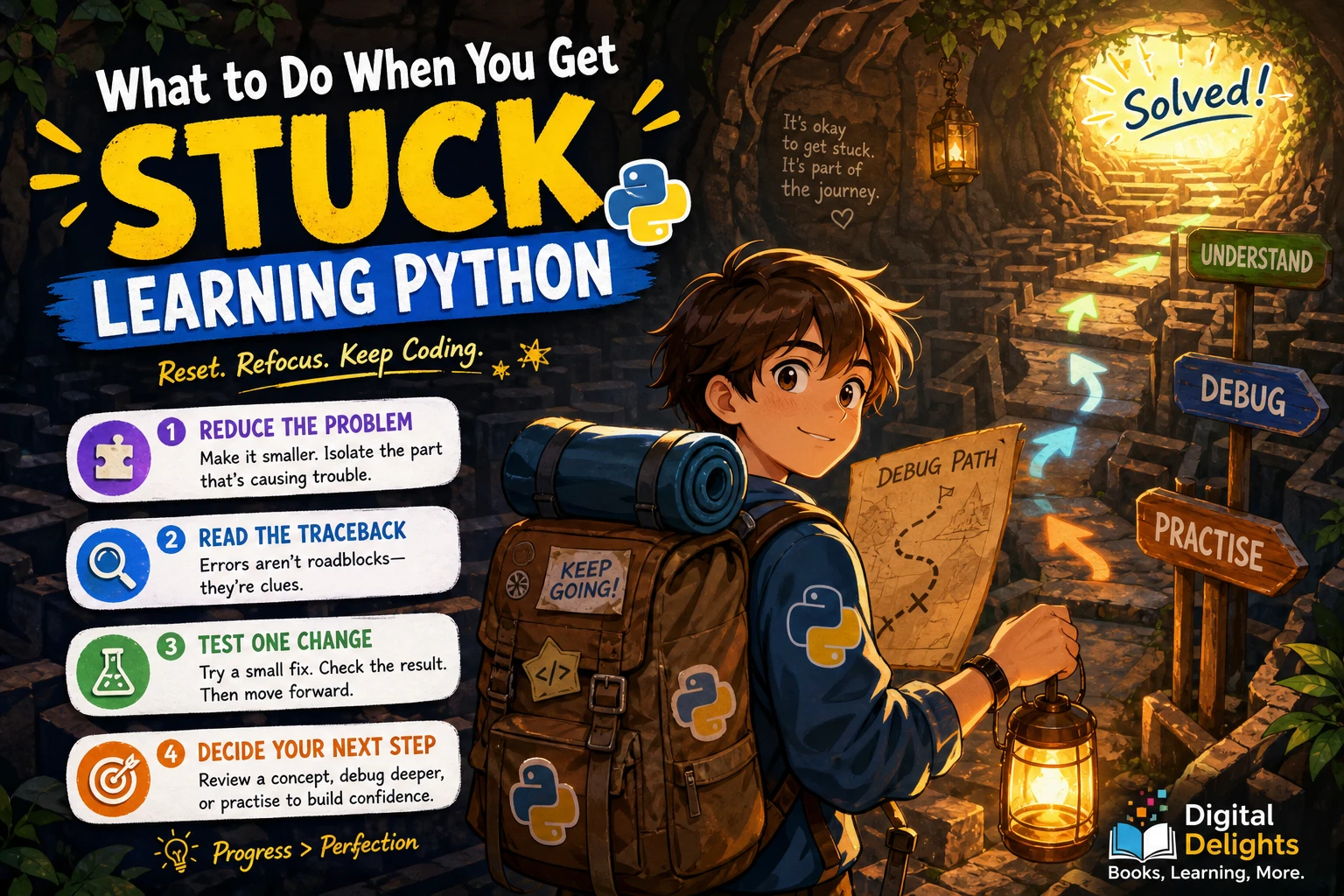
Use a short cycle that asks you to attempt, check, and revise. The point is not to get every answer right on the first try; it is to find out what you can currently retrieve and use that information to guide your next attempt.
- Choose a small task. Pick something limited, such as finding the largest number in a list or counting matching words in a sentence.
- Try it before rereading. Start with a blank file or a short written plan. Give yourself a little time to recall what you know.
- Check a reference when you need one. Look up syntax or a method rather than guessing indefinitely. If you use a worked example, make sure you understand how it applies to your task.
- Run and inspect the code. Test a normal case and at least one case that might expose a mistake, such as an empty list or an unexpected input.
- Explain the fix. In a comment or a note, describe what was wrong and why the change works. This makes the correction more meaningful than copying a replacement line without context.
- Return to the task later. After some time has passed, try it again before looking at your earlier solution. Adjust the gap to fit your schedule and how challenging the task feels.
Coming back to material after a gap is a reasonable review strategy, but the available research does not establish a universal schedule for Python learners. Findings on spaced retrieval in introductory STEM courses are mixed, and a calculus study cannot prove that the same effect applies to programming. If a later attempt feels harder, treat that as useful information about what to review—not proof that the approach has failed. See the research section below for the studies and their limits.
How can I practise without repeating tutorials?
Keep the task small, but change something so you must make a decision. Replaying a tutorial can help when you need an explanation; it is less useful as your only form of practice if you simply copy each line as it appears.
- Modify an example: Change its input, add a condition, or make it return a value instead of printing one.
- Solve a small problem: Write a short program that filters a list, counts items, or formats a simple report.
- Build a modest project: Make a quiz, a basic expense summary, or a command-line to-do list using concepts you have already met.
- Reconstruct from a description: Read what a program should do, close the sample solution, and draft your own version before comparing.
- Keep an error note: Record the error, the cause you discovered, and what helped you fix it. Review the pattern rather than memorizing an isolated traceback.
If you want structured prompts for this kind of hands-on review, Python Bookcamp: Exercises and Projects is described in the Digital Delights catalog as covering Python fundamentals through exercises, case studies, and projects. It may suit learners who want practice tasks alongside their review; it is not a guarantee against forgetting.
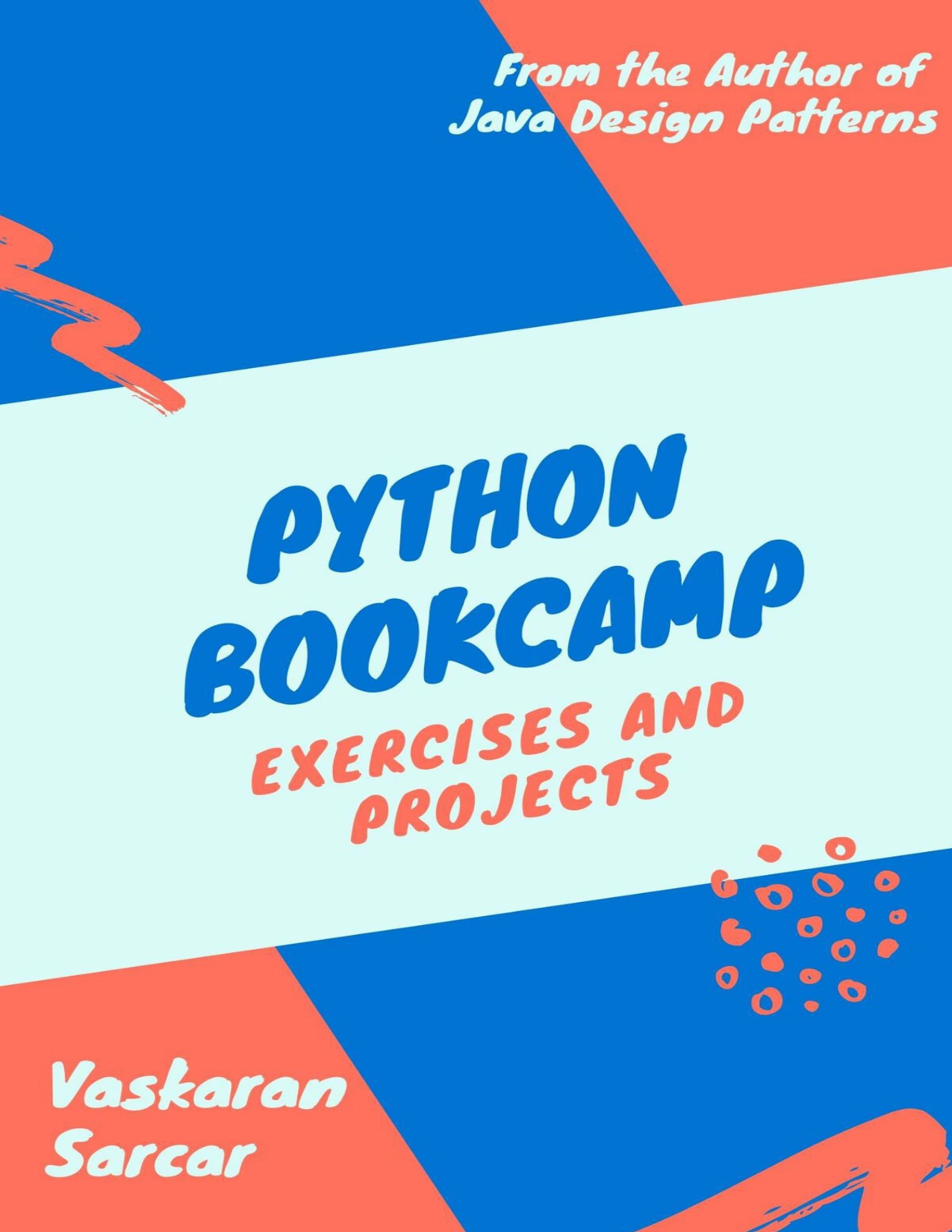
Python Bookcamp: Exercises and Projects
Learners returning to Python who want exercises, case studies, and projects to practise fundamentals.
Common traps that make Python review less useful
- Rereading without attempting recall. Reading can refresh an explanation, but first try to state or write what you remember.
- Copying code without changing it. After following an example, alter one part and predict what the change will do before running it.
- Treating a forgotten detail as total failure. Identify what is missing: syntax, a concept, or a plan for solving the task. Then practise that specific skill.
- Trying to memorize every API. Keep a reference available and focus on understanding how to use information you find.
- Jumping into a project that is too large. Break it into small functions or features, and test each piece before adding the next.
Frequently asked questions
Is it normal to forget Python syntax?
It is common to need a reminder for syntax or methods you have not used recently. Use documentation for specific details, and practise core concepts by writing small programs. Recalling every method from memory is not a sensible measure of whether you can program.
Should I start over if I forget the basics?
Not necessarily. First try a small task that uses the basics, such as looping over a list or writing a simple function. Review only the concept that blocks you, then attempt the task again. If you discover several gaps, revisiting an introductory resource can help—but you may not need to repeat every lesson from the beginning.
How often should I practise Python?
There is no universally supported schedule in the sources reviewed here. Choose a routine you can maintain, and return to important ideas after a gap so you can test what you recall. If you repeatedly cannot make progress, shorten the gap or review the relevant explanation before trying again.
Do I need to memorize Python methods?
No. Learn how to recognize the kind of operation you need and how to check the documentation for the exact method and its arguments. Familiarity with commonly used tools grows through use, but memorizing every library detail is unnecessary.
Sources and evidence
The recommendations above combine practical learning guidance with limited research evidence. The Python documentation supports pairing reading with an interpreter, but it is not a study of memory techniques. Research on spaced retrieval in introductory STEM courses reports mixed results; a calculus study found a later retention benefit alongside lower performance on some practice questions. Neither finding establishes a Python-specific effect or an ideal review interval.
- The Python Tutorial — Python 3.10 documentation
- Single-paper meta-analyses of the effects of spaced retrieval practice in nine introductory STEM courses
- Spaced Retrieval Practice Imposes Desirable Difficulty in Calculus Learning
The takeaway
Forgetting a Python detail after a course does not erase what you learned. Try a small problem before rereading, look up details when needed, and use mistakes to identify what to practise next. Repeating that process with manageable tasks can help you build confidence in recalling and applying the fundamentals—without expecting yourself to memorize the whole language.