

How to Prepare for Coding Interviews with Python
Python coding interview preparation is about more than memorizing algorithms. You need to choose suitable data structures, reason through a problem, write clear code, check edge cases, and explain your decisions. A practical approach is to review core Python, practise problem-solving patterns one at a time, and regularly solve problems under interview-like conditions.
Start with the language features you can use confidently, then build up from straightforward solutions to more efficient ones. As you practise, talk through your reasoning and test your code rather than treating a submitted answer as the only goal. This guide sets out a flexible plan, explains useful Python tools, and suggests resources for targeted practice.
Build a reliable Python foundation
Before focusing on complex algorithms, make sure you can write and read everyday Python without getting stuck on syntax. Interview problems often involve transforming or searching collections, so practise the structures and operations that make those tasks straightforward.
- Strings and lists: practise indexing, slicing, iteration, searching, sorting, and building a result.
- Dictionaries and sets: use dictionaries to associate keys with values and sets to track distinct items or check membership.
- Loops and functions: write small, focused functions with clear inputs, return values, and variable names.
- Sorting: understand what you are sorting by and whether sorting the data changes the problem’s requirements.
- Exceptions and boundaries: consider empty inputs, missing keys, repeated values, and other cases that may affect correctness.
Python’s documentation describes sets as collections of distinct elements and dictionaries as mappings from keys to values. It also explains dictionary access patterns, including using get() when a default value is useful. Review the Python data structures tutorial for details.
Choose a structure for the operation you need
Do not choose a data structure only because it is familiar. First identify the operation the solution repeats: membership checks, adding items at either end, retrieving the smallest item, or looking up a value by key. Then select a structure that suits that work.
- Use a set when you need to track distinct values or test whether an item has appeared.
- Use a dictionary when each key needs an associated value, such as a count or previously seen position.
- Use
collections.dequewhen you need efficient additions or removals at both ends, such as in a queue. Removing the first element from a list withpop(0)shifts the remaining elements; the collections documentation contrasts this with deque operations. - Use
heapqwhen you need to repeatedly retrieve the smallest item, as in a priority-queue problem. A heap is not a fully sorted list: its smallest item is at the root, while the remaining items are organized by the heap property.
Python’s references describe deque operations in collections and heap behavior in heapq. These tools can make solutions clearer, but be ready to explain their behavior and complexity.
Learn problem-solving patterns, not isolated answers
Once the Python basics feel comfortable, practise recognizing recurring ways to structure a solution. A pattern is a starting point for reasoning, not a guarantee that a particular technique fits every problem.
- Two pointers: move two indices through a sequence, often to compare items or narrow a search.
- Binary search: repeatedly reduce a search interval when the problem’s ordering or monotonicity makes that valid.
- Stacks and queues: track items in last-in-first-out or first-in-first-out order, respectively.
- Recursion: express a problem in terms of smaller instances, while accounting for a stopping condition and call-stack use.
- Trees and graphs: practise traversals and keeping track of visited nodes so the search does not revisit work unnecessarily.
- Dynamic programming: identify repeated subproblems and decide what information should be stored and reused.
For each problem, first explain the direct approach in plain language. Then ask whether repeated work, unnecessary scanning, or extra storage can be reduced. This helps you avoid reaching for a sophisticated pattern before you know what the problem requires.
Explain time and space complexity as you work
Complexity analysis describes how a solution’s resource use changes as its input grows. For each important step, ask how many times it can run and what data the algorithm stores. A nested loop may mean that work grows with pairs of input items; a dictionary used to remember items may require additional storage.
Be precise about operations rather than relying on vague labels. For example, Python’s bisect module can find an insertion point with a logarithmic search, but inserting into a list with insort() takes linear time overall because the list insertion dominates. See the bisect documentation.
You do not need to recite complexity notation without context. State what you are measuring, connect it to the code, and mention any important trade-off. If a faster approach uses extra memory, say so.
Follow a repeatable practice routine
A consistent problem-solving loop makes practice more useful than simply reading solutions. Use these steps for each exercise:
- Restate the task. Identify the input, expected output, constraints, and any details that are unclear.
- Work through a small example. Trace what should happen before writing code.
- Describe a straightforward approach. Explain the main steps and note its likely time and space costs.
- Look for a better fit. Consider whether a different data structure or pattern avoids repeated work.
- Implement in Python. Use names and structure that make your reasoning easy to follow.
- Test deliberately. Check a typical case, a boundary case, and a case with repeated or unusual values where relevant.
- Review and retry. Identify what was confusing, then attempt the problem again later without relying on the finished solution.
Example: check whether a list contains duplicates
Suppose the task is to determine whether any value appears more than once. A direct approach compares items against one another. Another approach stores values in a set as you scan the list. Before coding, clarify how an empty list should behave and whether values can be compared or added to a set.
def has_duplicate(values):
    seen = set()
    for value in values:
        if value in seen:
            return True
        seen.add(value)
    return False
Trace the function with an empty list, a list with one value, and a list where a repeated value occurs at the beginning or end. Then explain that the set stores values already encountered, so the function can stop as soon as it finds a repeat. Be prepared to discuss the extra storage used by seen and the assumptions made about the input values.
Practise communicating your reasoning
A technically correct solution is easier to assess when its reasoning is clear. Practise speaking while you solve, even when working alone. You do not need a script; the aim is to make your choices and checks understandable.
- Clarify the requirements: ask about input size, allowed values, expected behavior, and relevant constraints.
- State assumptions: make any interpretation explicit instead of silently relying on it.
- Start with a simple plan: describe a correct baseline before proposing an optimization.
- Explain trade-offs: say what your approach gains and what it costs in time or memory.
- Test aloud: trace a normal example and at least one meaningful edge case.
- Respond to new information: if a constraint changes, explain which part of your approach may need to change.
If you get stuck, narrate what you have established and what remains uncertain. That gives you a way to keep reasoning rather than silently guessing at a familiar-looking solution.
Avoid common preparation mistakes
- Memorizing finished solutions: knowing the code for one problem does not show whether you can adapt the underlying idea. Practise explaining why each step works.
- Skipping complexity: a solution can return the right answer but use unsuitable time or memory for the stated constraints. Analyze the code you wrote.
- Ignoring edge cases: empty inputs, duplicates, single-item inputs, and boundary values can expose assumptions that ordinary examples miss.
- Using tools without understanding them: built-ins are useful when permitted, but know the operations and costs you rely on.
- Practising only by reading: reading an explanation is different from producing a solution yourself. Close the reference and try again.
- Leaving out communication practice: silent practice will not help you get comfortable explaining assumptions, decisions, and tests.
- Depending on unfamiliar features: check the interview environment’s Python version and permitted libraries before relying on version-specific syntax or tools.
Choose study resources that fit the gap you have
Use books and other learning materials to strengthen a particular skill, then put the ideas into practice yourself. A resource can structure your study, but it cannot replace solving problems, explaining your approach, and checking your own code.
- For general Python exercise practice: Python Programming Exercises, Gently Explained is described in the catalog as a collection of 42 short exercises with hints and explanations. It may suit learners who want additional practice with Python problem-solving.
- For dynamic programming: Programming Interview Problems: Dynamic Programming (with solutions in Python) focuses on 25 problems, with Python implementations, walkthroughs, and complexity analysis. It is aimed at readers who want targeted practice in this area.
- For recursion: The Recursive Book of Recursion: Ace the Coding Interview with Python and JavaScript covers recursive ideas and algorithms, including backtracking and dynamic programming, with examples in Python and JavaScript.
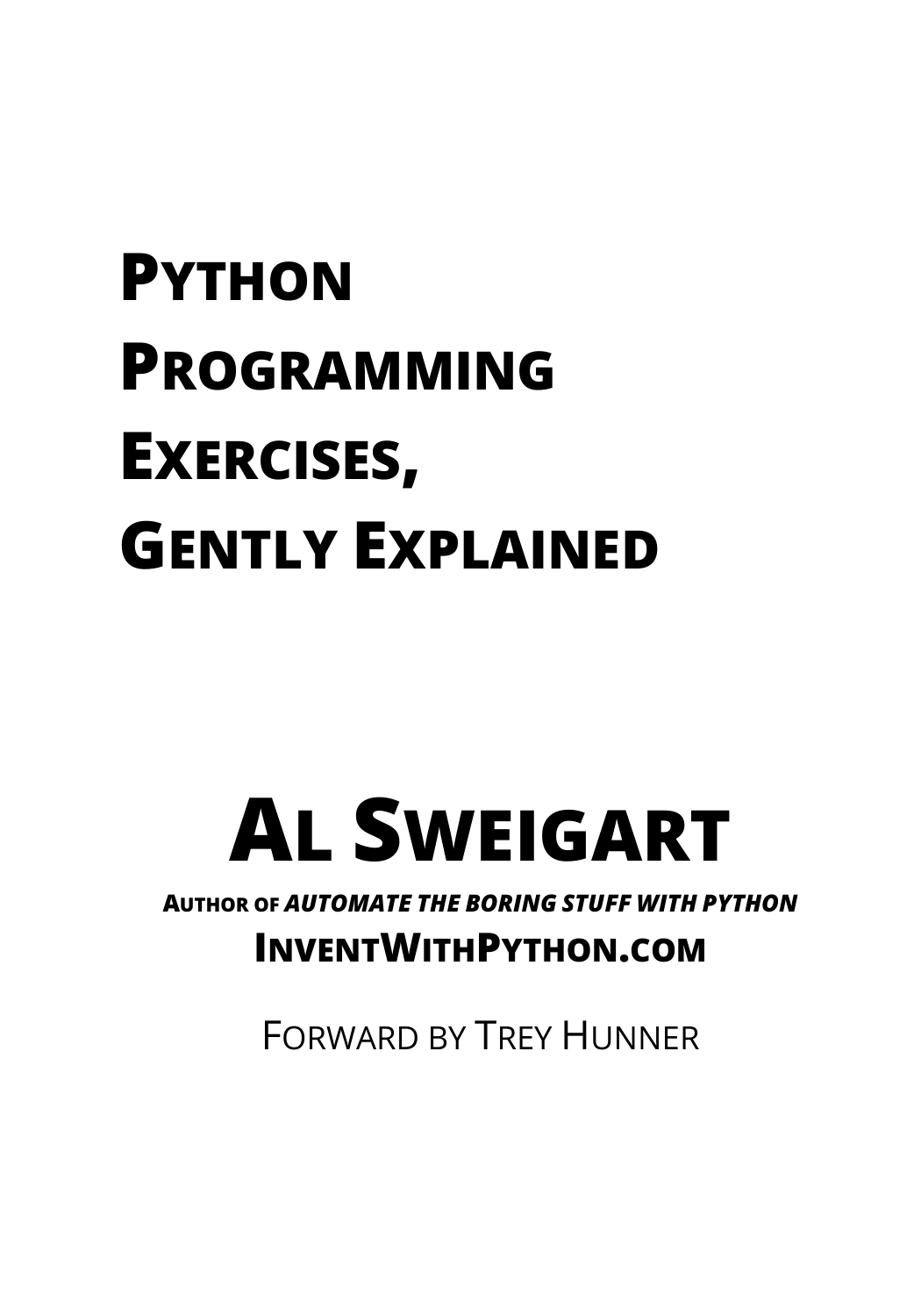
Python Programming Exercises, Gently Explained
By Al Sweigart
Learners seeking short Python exercises with hints and explanations.
Programming Interview Problems: Dynamic Programming (with solutions in Python)
Readers looking for Python solutions, walkthroughs, and complexity analysis on dynamic programming problems.
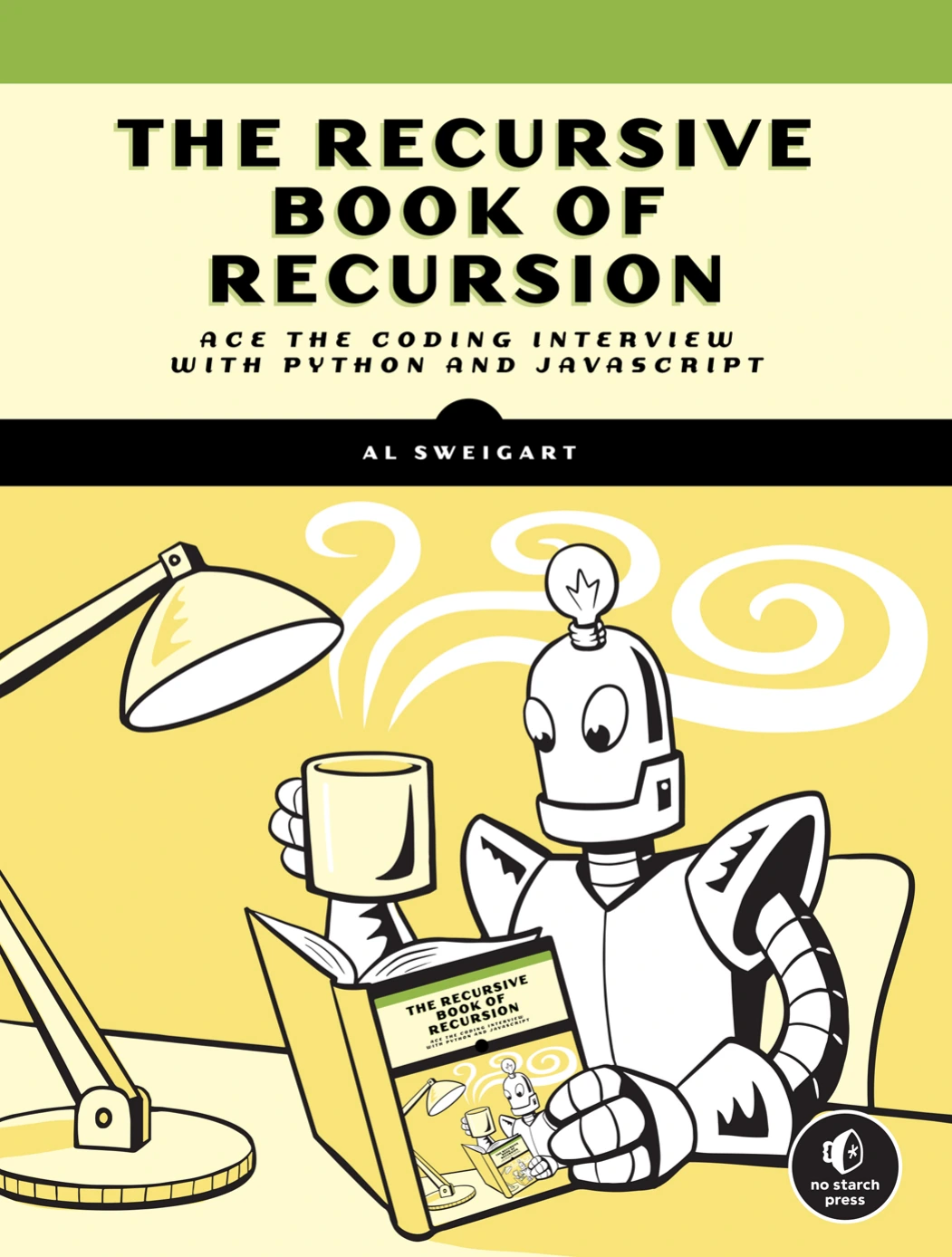
The Recursive Book of Recursion: Ace the Coding Interview with Python and JavaScript
By Al Sweigart
Learners who want guided coverage of recursion, backtracking, and dynamic programming in Python and JavaScript.
Choose one resource that matches your current need rather than trying to study everything at once. Digital Delights also has a Python book collection for browsing related learning materials.
Frequently asked questions
What Python topics should I review first?
Start with strings, lists, dictionaries, sets, loops, functions, and sorting. Practise choosing among these tools and explaining what your code does. Then work on patterns such as two pointers, binary search, recursion, tree or graph traversal, and dynamic programming.
Should I use Python built-ins in an interview?
Follow the interview’s rules and use built-ins when they are permitted and appropriate. Make sure you understand the behavior and complexity of the operations you use, and be ready to explain your choice. If the platform or interviewer asks you to implement something yourself, follow that instruction.
How should I practise explaining complexity?
After writing a solution, identify the main operations and how often they run as the input grows. Then consider the additional data the solution stores. Describe the reasoning in plain language and connect it to the code instead of giving a complexity label without explanation.
What should I check before using an interview platform?
Check the required Python version, available libraries, editor or execution environment, and any restrictions on built-in functions. Prefer standard, familiar syntax unless you have confirmed that a particular feature is supported.
Final preparation checklist
- I can use Python’s core collections and explain why I chose one.
- I can describe a simple solution before considering optimizations.
- I can discuss time and space complexity in relation to my code.
- I test normal cases and meaningful edge cases.
- I practise talking through assumptions, trade-offs, and corrections.
- I have checked the interview platform’s Python version and rules.
The most useful preparation is active: solve a problem, explain your choices, test the result, and revisit what you found difficult. Build confidence in your reasoning alongside your Python fluency, and use focused resources when a particular topic needs more work.