
Python Data Structures for Beginners: What to Learn First
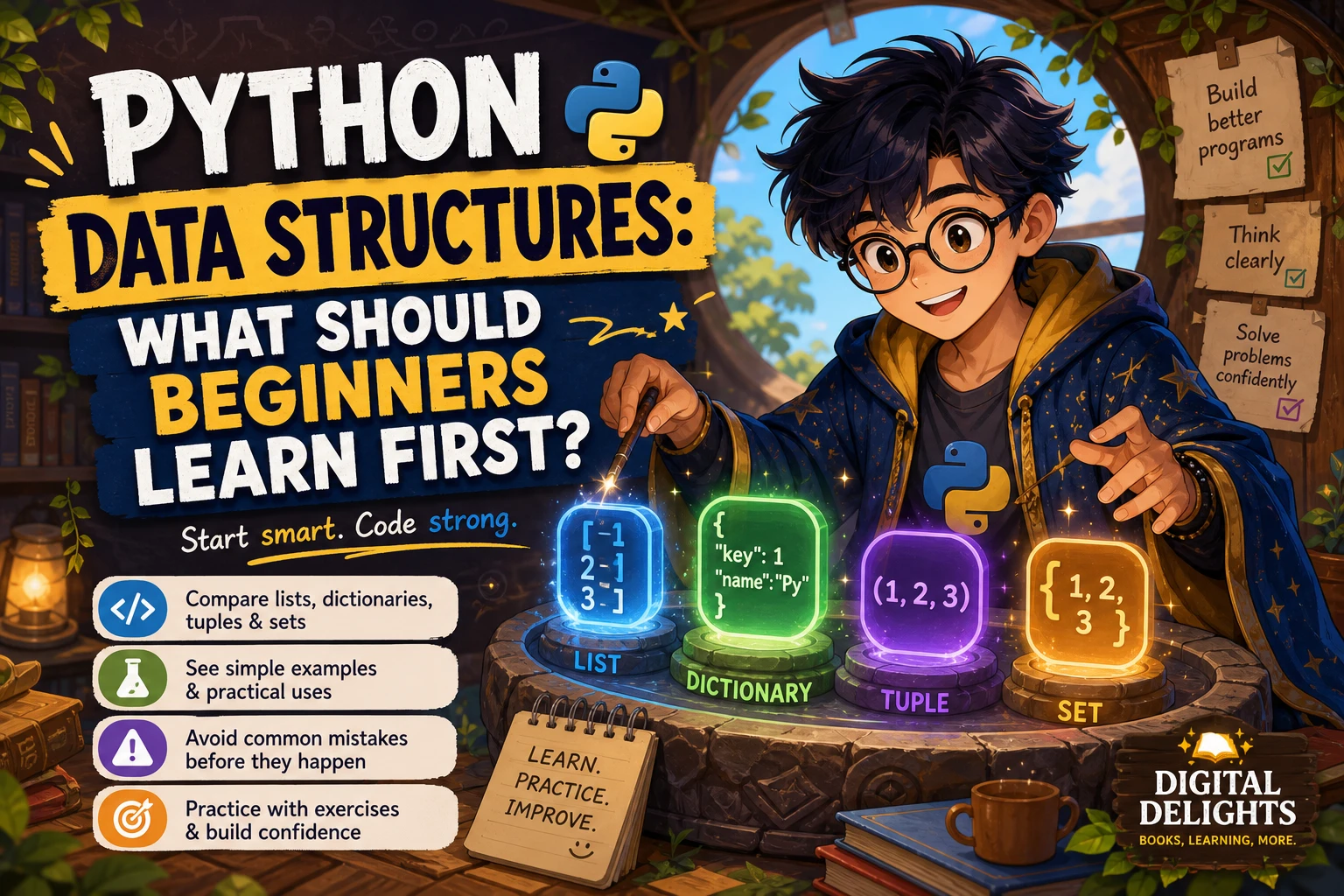
When you start learning Python, lists, dictionaries, tuples, and sets can seem like a lot of new vocabulary for things that all hold data. A practical starting order is lists first, dictionaries second, then tuples and sets. Lists help you work with sequences; dictionaries let you look up values by meaningful keys; tuples and sets introduce useful ways to represent fixed groups and distinct values.
This is a suggested learning path, not a proven universal sequence. Python’s official tutorial presents the topics in a different order, and the supplied sources do not compare teaching methods. The goal is to learn each structure through the problem it solves, then practise choosing between them.
What is a data structure?
A data structure is a way to organize data so a program can store, find, and work with it. Python’s built-in structures give you different ways to represent collections of values. Choosing one depends on how you need to access or change the information.
- Ordered means elements have a defined sequence or position.
- Mutable means an object can be changed after it is created.
- Immutable means the object itself cannot be changed after creation.
- Unique means duplicate values are not retained, as with a set.
If you are entirely new to programming, first get comfortable with variables, expressions, conditionals, loops, and functions. The official Python Tutorial notes that it is intended for readers with a basic understanding of programming.
A beginner-friendly order for Python data structures
Work through the structures by starting with everyday collection tasks, then adding new ways to retrieve or constrain the data. Try each example in a Python interpreter and change the values to see what happens.
1. Learn lists for ordered collections
A list is an ordered, changeable collection. Use one when you want to keep several items together and may need to access them by position, iterate through them, or add and remove items.
shopping = ["apples", "rice", "tea"]
shopping.append("beans")

for item in shopping:
    print(item)
Here, append() adds an item to the end, and the loop visits each item in sequence. Lists also work well when the number or contents of items may change as your program runs.
Try making a short task list. Add a task, remove one, and print the first item. Practise with indexing carefully: Python list positions start at zero, so the first item is at index 0.
2. Learn dictionaries for key–value lookups
A dictionary stores pairs of keys and values. It is useful when you want to find a value using a meaningful identifier rather than a numeric position—for example, retrieving a person’s email address using their name.
person = {
    "name": "Mina",
    "email": "[email protected]",
    "city": "Leeds"
}

print(person["email"])
Dictionary keys must be suitable immutable values; a list cannot be used as a key. Dictionary iteration follows insertion order in modern Python, as described in the Python data structures tutorial.
A useful practice exercise is to make a dictionary for a book, product, or contact. Add a new field, update a value, and retrieve a value by its key. This helps make the distinction clear: a list answers “what is at this position?” while a dictionary answers “what value belongs to this key?”
3. Learn tuples for grouped values that should stay fixed
A tuple is an ordered sequence that cannot be reassigned item by item after it is created. It can be useful for a group of related values that your code should treat as a fixed unit, such as a coordinate:
location = (53.8, -1.5)
latitude = location[0]
Immutability applies to the tuple’s own elements, not automatically to every object it contains. If a tuple contains a mutable object such as a list, that inner object may still be changed. For beginners, the practical rule is to use a tuple when the group itself should remain fixed, and a list when you expect to change the collection.
4. Learn sets for unique values and membership checks
A set holds distinct values and is useful when duplicates are not needed, when you want to check whether a value is present, or when you want to compare groups with operations such as intersection and union.
attendees = {"Mina", "Jon", "Mina"}
print(attendees)  # Each distinct name appears once

print("Jon" in attendees)
Sets are unordered, so do not rely on a particular display or iteration order. One easy syntax mistake: {} creates an empty dictionary, not an empty set. Use set() to create an empty set.
How to choose the right Python structure
| Structure | Think of it as | Useful when | Key property |
|---|---|---|---|
| List | A changeable sequence | You need positions, iteration, or a collection that changes | Ordered and mutable |
| Dictionary | A set of key–value pairs | You need to retrieve information by a key such as an ID or name | Lookup by key; keys must be suitable immutable values |
| Tuple | A fixed sequence | You want to group values that should not be reassigned | Ordered and immutable |
| Set | A collection of distinct values | You need uniqueness, membership checks, or set comparisons | Unordered and contains no duplicates |
A quick decision guide:
- If you need a sequence you can change, use a list.
- If you need to look up a value by a label or identifier, use a dictionary.
- If you need a fixed sequence of related values, consider a tuple.
- If you need distinct values or set comparisons, use a set.
These are starting points, not rigid rules. Consider how your program will retrieve, update, and use the information before choosing.
Practise by combining structures in one small task
Try building a tiny contact list. Use a list to keep several contacts together and a dictionary for each contact’s details. This gives you practice with both sequence position and key-based lookup.
contacts = [
    {"name": "Mina", "email": "[email protected]"},
    {"name": "Jon", "email": "[email protected]"}
]

for contact in contacts:
    print(contact["name"], contact["email"])
Before running the code, predict what it will print. Then try these changes:
- Add another contact dictionary to the list.
- Print only the email addresses.
- Change one contact’s email using its dictionary key.
- Make a set containing the contact names and check whether a name is present.
Predicting, running, and modifying small examples helps you connect a structure’s properties to the way you use it. If you want a book-based introduction, Think Python: How to Think Like a Computer Scientist, 3rd Edition covers lists, dictionaries, tuples, and related programming fundamentals. For a faster-paced overview that includes lists, tuples, dictionaries, and sets, see Python Crash Course.
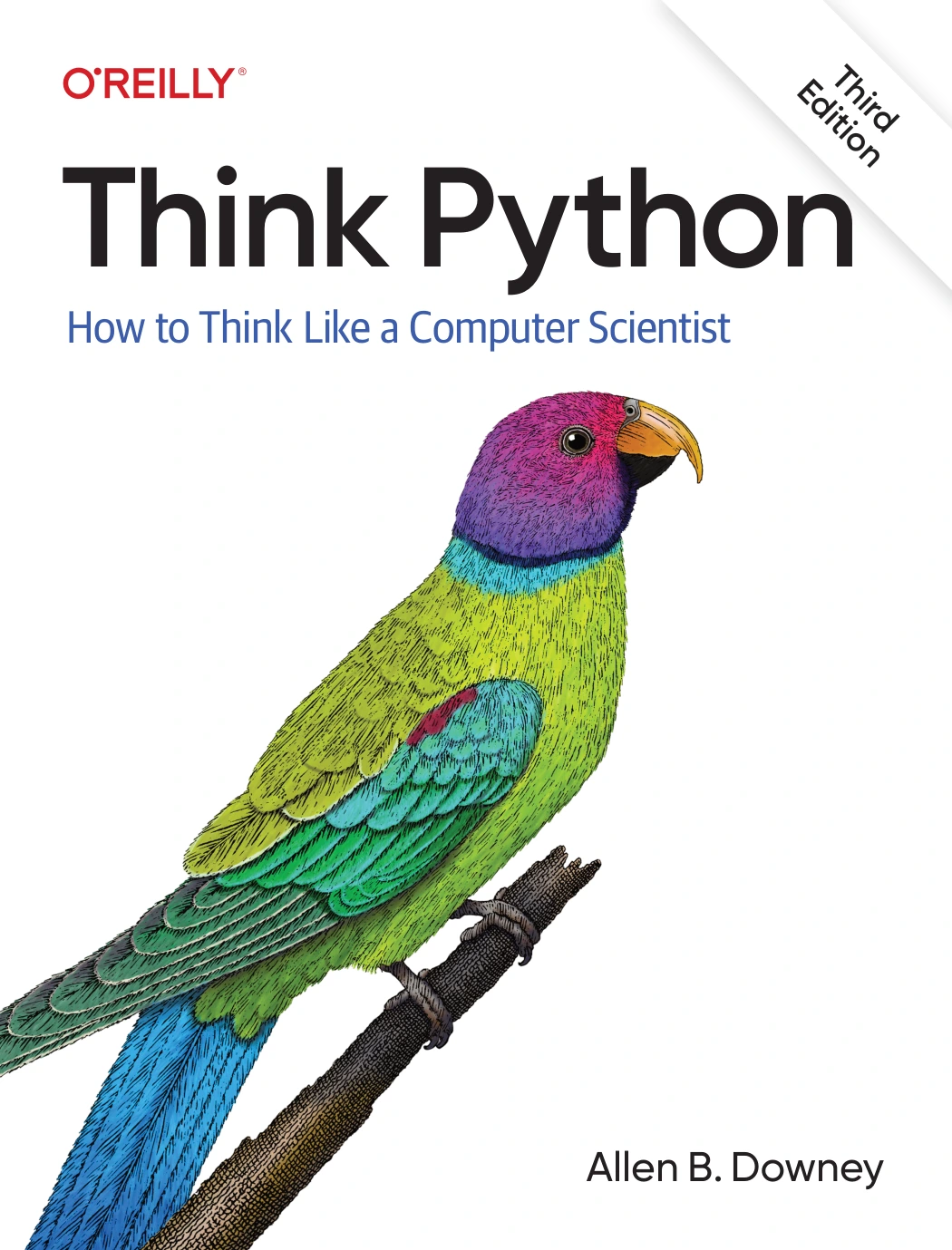
Think Python: How to Think Like a Computer Scientist, 3rd Edition
Readers who want a concept-focused Python introduction that includes data structures.
Learners who prefer a broad introduction progressing from Python basics toward practical projects.
What to learn after the basics
Once you can work with lists, dictionaries, tuples, and sets, learn about stacks and queues as ways to organize specific tasks. A stack follows a last-in, first-out pattern: a basic Python list can model one using append() to add and pop() to remove the most recently added item.
A queue follows a first-in, first-out pattern. For queue-like work, Python’s collections.deque is designed for efficient additions and removals at either end. Removing repeatedly from the front of a list can require shifting the remaining items, so a list is usually not the best choice for that pattern. See the official tutorial’s examples of lists, stacks, and queues.
You do not need to master every abstract data structure before writing useful programs. Start with a small task, identify how it needs to handle information, and learn the structure that fits.
Common beginner mistakes to avoid
- Trying to use a list as a dictionary key: Lists can change, so they are not suitable dictionary keys. Choose an appropriate immutable key instead.
- Assuming a tuple makes everything inside it immutable: The tuple cannot be reassigned element by element, but a mutable object held inside it may still change.
- Using
{}for an empty set: It creates an empty dictionary. Useset()for an empty set. - Choosing by habit rather than access pattern: Think about whether you need positions, key-based lookup, fixed grouping, or unique values.
- Trying to memorize every method at once: Begin with a small set of operations, then look up additional methods when a task calls for them.
Frequently asked questions
Which Python data structure should I learn first?
Start with lists. They make it straightforward to practise ordered collections, indexing, iteration, and adding or removing items. Learn dictionaries next when you need to retrieve data using meaningful keys. This is a practical suggested sequence, not a learning order proven to work best for everyone.
When should I use a list instead of a dictionary?
Use a list when you want a sequence of items and position or iteration matters. Use a dictionary when each value should be retrieved using a key, such as a contact’s name or an item’s ID.
Do beginners need to learn stacks and queues right away?
No. First become comfortable with the basic built-in structures and practise using them in small programs. Learn stacks and queues when a project needs last-in, first-out or first-in, first-out behaviour; a list can model a simple stack, and collections.deque is useful for queue-like tasks.
Sources and further reading
- 5. Data Structures — Python documentation
- 3. An Informal Introduction to Python — Python documentation
- The Python Tutorial — Python documentation
Conclusion
For a practical introduction to Python data structures, learn lists first, dictionaries next, then tuples and sets. Focus on what each structure helps you do: maintain a sequence, find a value by key, keep a group fixed, or work with unique values. Practise by combining them in a small program, and add stacks, queues, or other concepts when a real task calls for them.