
How to Learn Python Data Structures
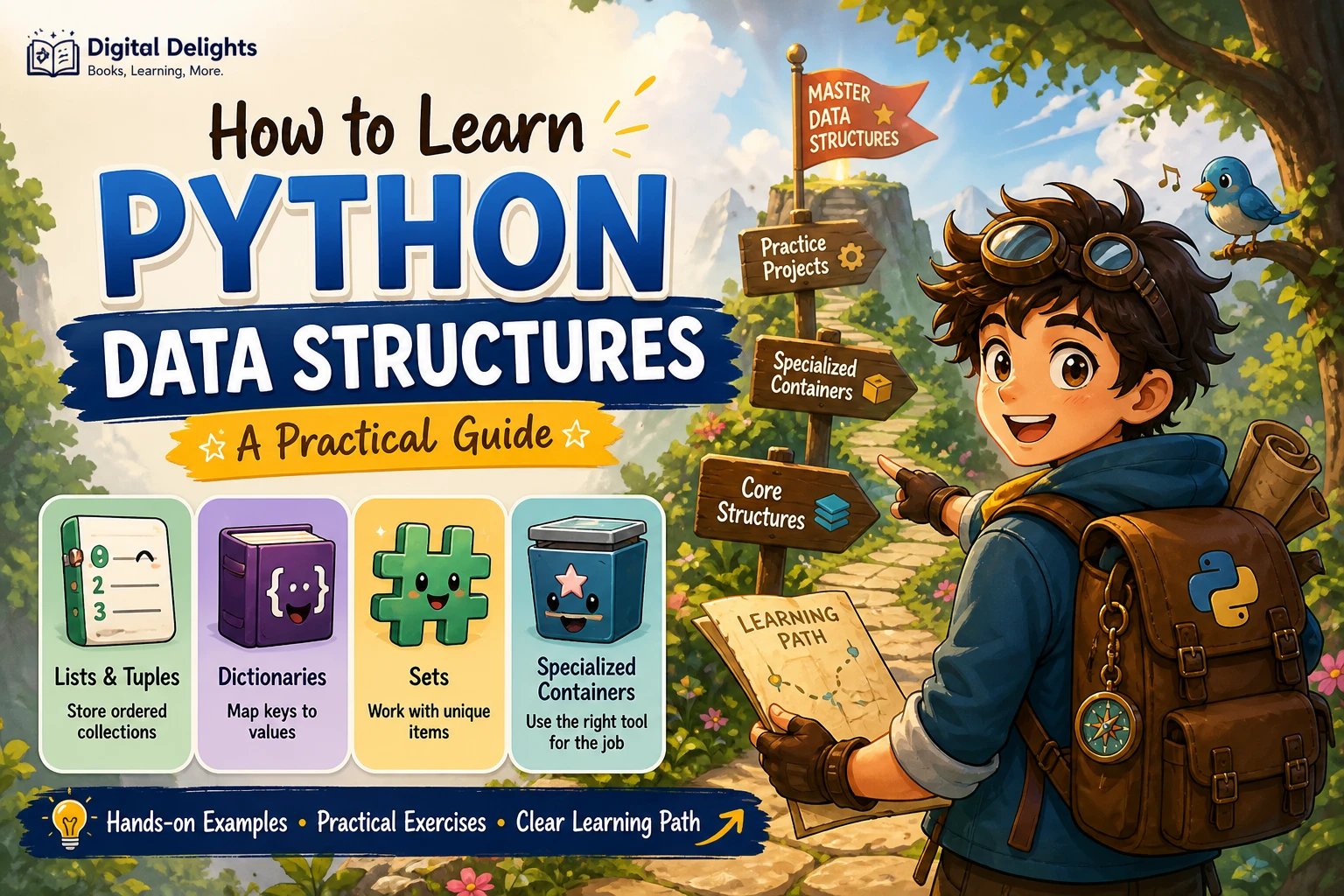
Learning Python data structures is less about memorizing definitions and more about choosing a useful way to organize information. Start with lists, then compare tuples, dictionaries, and sets by trying them on small, concrete tasks. Once those built-ins make sense, explore specialized containers such as deque and Counter.
This guide gives you a practical learning order, examples to run, and a way to decide which structure fits a problem. You do not need advanced mathematics to begin, but basic comfort with variables, loops, functions, and iteration will help. The sequence here is practical editorial guidance, not a claim that there is one universally proven teaching order.
What to know before you start
Before focusing on collections, make sure you can assign values to variables, use conditions and loops, define a simple function, and work through items one at a time. These basics let you see how a structure behaves when your program reads, changes, or searches its contents.
If you are still learning those foundations, a general introduction may be a better first step than a specialized data-structures text. For example, Python Programming for Beginners: Learn Python in a Step by Step Approach, Complete Practical Crash Course to Learn Python Coding covers lists, tuples, dictionaries, and other beginner Python topics. It is a broad introductory resource, rather than a book focused only on data structures.
Beginners who need a step-by-step grounding in Python before focusing on collections.
Learn Python’s built-in structures first
Python’s built-in collections are a useful starting point because they appear in everyday code. The official tutorial covers lists, tuples, sets, and dictionaries; use its examples alongside your own small experiments. Python’s data structures tutorial is a direct reference for their behavior.
Lists: ordered collections you can change
A list holds items in a sequence. You can access an item by position, iterate over the items, and change the collection as your program runs. Lists are a natural fit for things such as a to-do list or a series of scores.
tasks = ['read', 'practise', 'review']
tasks.append('build a small project')

for task in tasks:
    print(task)
Practise indexing, slicing, adding and removing items, and looping through a list. Then try a task such as displaying only the first few entries or collecting items that meet a condition.
Tuples: sequences for grouped values
A tuple is a sequence that cannot have its item references reassigned after it is created. It can be useful when a few values belong together as a fixed group, such as a coordinate:
point = (4, 7)
x, y = point
A tuple is not automatically a guarantee that every object inside it is immutable: a tuple can contain a mutable object. For a beginner exercise, focus on the practical distinction between changing a list’s contents and using a tuple to represent a group you do not intend to reassign.
Dictionaries: look up values by key
A dictionary associates keys with values. It works well when you want to retrieve information by a meaningful label rather than by a numeric position. For example, a contact record might map field names to details.
person = {'name': 'Sam', 'city': 'Leeds'}
print(person['name'])
Try adding a key-value pair, updating a value, checking whether a key exists, and looping through the dictionary. Dictionary keys must be hashable; common examples include strings and numbers. Consult the official tutorial for details about keys and dictionary operations.
Sets: unique items and membership checks
A set stores distinct items and is useful when duplicates should be removed or when you need to test whether an item is present. For example, a set can help identify the unique words in a short list.
words = ['maple', 'oak', 'maple']
unique_words = set(words)
print(unique_words)
Sets do not behave like an indexed sequence: use them for membership and uniqueness, not for retrieving an item by position. One small syntax detail often trips up beginners: use set() to create an empty set. An empty pair of braces, {}, creates an empty dictionary.
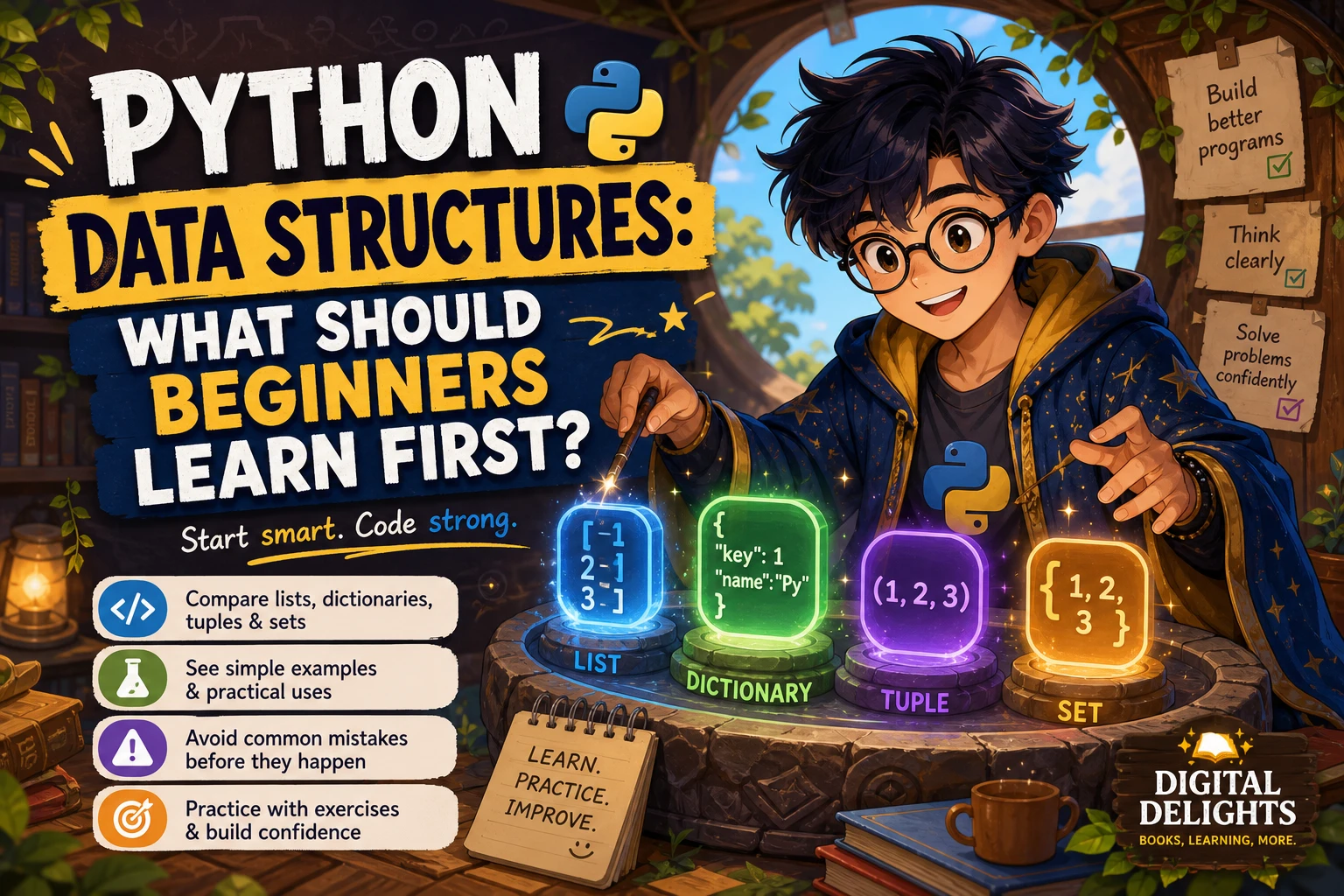
Compare the four structures by the job
| Structure | Good starting use | Question to ask |
|---|---|---|
| List | A sequence you will iterate over or update | Do I need to keep items in a sequence and change the collection? |
| Tuple | A small group of related values | Am I representing a sequence I do not intend to reassign? |
| Dictionary | Values retrieved using meaningful keys | Do I need to find a value from a label or identifier? |
| Set | Unique values or membership checks | Do duplicates matter, or do I need to check whether an item is present? |
This is a practical guide, not a complete specification of every operation. Choose based on the work your program needs to do, then check the documentation when a detail matters.
Practise by solving small problems
Short exercises make the distinctions concrete. Pick one task, write a small solution, and explain why the structure you chose fits it. Try these:
- To-do list: Store tasks in a list, add a task, and display each item.
- Word counter: Use a dictionary to associate each word with the number of times it appears.
- Remove duplicates: Convert a collection to a set when unique values are what you need.
- Group items: Use a dictionary whose values are lists to collect names or items by category.
- Represent a coordinate: Store a pair of related values in a tuple and unpack them into variables.
Use the same learning loop for each exercise:
- Predict: Before running the code, write down what you expect to happen.
- Run: Test a small example and read the result carefully.
- Vary the input: Try an empty collection, repeated values, or a different order of items.
- Explain: Describe why the output follows from the structure’s behavior.
- Adjust: If your choice makes the task awkward, try another structure and compare.
To get more guided practice, Python Bookcamp: Exercises and Projects covers lists, tuples, dictionaries, and sets through lessons and practical exercises. It is a broader hands-on Python resource, not a dedicated reference on data-structure theory.
Python Bookcamp: Exercises and Projects
Learners who know some Python basics and want structured coding practice.
Explore specialized containers when a task calls for them
After you are comfortable with the built-ins, Python’s collections module offers containers designed for recurring patterns. The standard-library documentation describes deque, Counter, and defaultdict, among other options.
deque: A double-ended queue, suited to adding or removing items at either end. The documentation describes appends and pops at either end as approximately O(1). By contrast, removing from the front of a list requires moving the remaining items, an O(n) operation. See the Python collections documentation.Counter: A specialized dictionary-like tool for counting items. It can make frequency-counting tasks more direct.defaultdict: A dictionary variant that can supply a default value for a missing key, which can be handy when grouping items.
Do not reach for a specialized container just because it exists. First describe the operation you need—such as repeatedly removing the oldest item or counting occurrences—then see whether a standard-library tool matches it.
When should you implement a data structure yourself?
For practical Python programs, begin with the built-in structures and standard-library tools. They let you solve real tasks without first writing your own collection implementation.
Implementing a simple structure yourself can still be a useful learning exercise if your goal includes understanding how data structures work internally, preparing for computer-science study, or practising algorithms. Treat that as a separate step: first learn how to use a list, dictionary, set, or queue; then build a simplified version to examine its behavior. The supplied evidence does not establish that either approach produces better learning outcomes for everyone.
Common learning mistakes to avoid
- Memorizing names without writing code. Run examples and change their inputs so you can see the behavior for yourself.
- Choosing a structure by habit. Ask whether you need sequence order, key-based lookup, uniqueness, or frequent operations at both ends.
- Assuming the structures are interchangeable. A set is not a list without duplicates, and a dictionary is not simply a list with labels; each has different behavior and uses.
- Moving to advanced libraries too soon. Learn the basic collections before adding third-party tools or specialized abstractions.
- Ignoring edge cases. Test empty inputs, repeated values, and missing keys to discover assumptions in your code.
Frequently asked questions
Which Python data structure should I learn first?
Start with lists because they make sequences, indexing, and iteration easy to practise. Then compare tuples, dictionaries, and sets through tasks that show what each one is suited to. This is a practical learning path, not a universal rule.
What is the difference between a list, tuple, set, and dictionary?
A list is a changeable sequence; a tuple is a sequence whose item references cannot be reassigned; a set holds unique items; and a dictionary associates keys with values. Choose according to how you need to store and retrieve information.
Should beginners implement linked lists?
Not before learning Python’s built-in collections. If you want to understand data-structure internals, implementing a simple linked list can be a later exercise. For ordinary Python tasks, begin by learning to use the tools Python already provides.
When should I use a deque instead of a list?
Consider a deque when your task regularly adds or removes items at both ends, such as processing items in a queue. Python’s documentation notes that operations at either end of a deque are approximately O(1), while removing the first item from a list requires O(n) movement. If your work is mostly iterating or accessing items by position, assess the actual operations you need before switching.
A simple next step
Choose one structure and one small task today: make a list of tasks, count words with a dictionary, or remove duplicates with a set. Predict the result before running the code, change the input, and explain what happened. Once the four built-ins feel familiar, try a specialized container only when a problem gives you a clear reason to use it.
Sources and further reading
- Python Tutorial: Data Structures — lists, tuples, sets, and dictionaries.
- Python Standard Library:
collections— specialized container types and documented behavior. - The Python Tutorial — its intended audience and broader tutorial scope.