
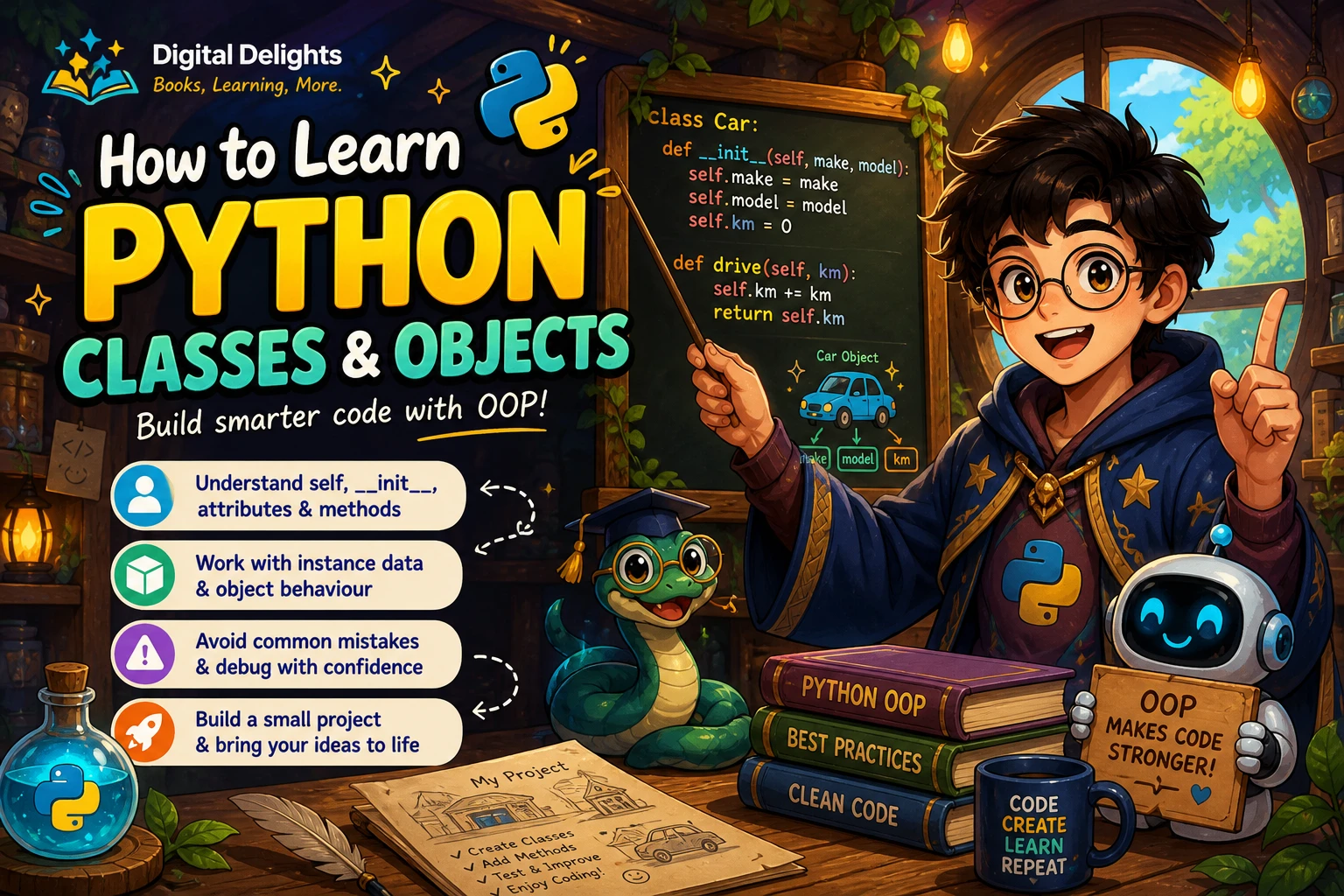
How to Learn Python Classes and Objects
Python classes and objects make more sense when you stop treating them as abstract vocabulary and build a tiny example. Define a class, create two instances, and check what information each one holds. You will see the central distinction: a class describes a kind of thing your program can create; an object, also called an instance, is one particular thing created from that class.
Start with attributes and methods before moving on to inheritance or advanced design patterns. This guide explains the class-instance relationship, shows how __init__ and self work, and gives you a practice sequence for building confidence with Python object-oriented programming.
Understand Python classes and objects
A class groups data and operations that belong together. When you call a class, Python creates an instance. The instance can hold its own state in attributes, while methods define actions that work with that state. The official Python tutorial on classes explains these language features in detail.
Think of a class as a recipe and an object as one prepared dish. The recipe describes what to make; each dish is a separate result. This is only an analogy: Python classes can model abstract concepts, services, or data structures, not just physical objects.
Here is a simple class for a book:
class Book:
    pass

first_book = Book()
second_book = Book()

print(type(first_book))
print(first_book is second_book)
Book is the class. first_book and second_book are separate instances created from it. The final expression is False: the two names refer to distinct objects, even though both came from the same class.
Learn the essential parts of a Python class
Most beginner classes use an initializer, instance attributes, and methods. Learn these parts together by making each instance store a title and author, then adding a method that uses that information.
What does __init__ do?
__init__ is a special method Python calls when a new instance is initialized. It is commonly used to give the instance its starting attributes. In everyday explanations, people often call it a constructor, though the object is created before __init__ initializes it.
What does self mean?
self is the conventional name for the instance passed to an instance method. It lets the method refer to the particular object that called it. Python supplies that instance when you call the method, so you write book.describe(), not book.describe(book). The name self is a convention rather than a special keyword, but following it makes code easier to recognize.
How do attributes and methods work?
Attributes store information associated with an object. Methods are functions defined in a class that can work with an instance. In the example below, title and author are instance attributes; describe is a method.
class Book:
    def __init__(self, title, author):
        self.title = title
        self.author = author

    def describe(self):
        return f'{self.title} by {self.author}'

first_book = Book('The Blue Castle', 'L. M. Montgomery')
second_book = Book('The Left Hand of Darkness', 'Ursula K. Le Guin')

print(first_book.describe())
print(second_book.describe())
When Book(...) is called, Python creates an instance and calls its __init__ method with that instance and the supplied arguments. Assignments such as self.title = title store data on the particular instance. As a result, each book has its own title and author.
Run the example, change the values, and add another attribute such as a publication year. Testing small changes is a useful way to check whether you understand which object holds each piece of data.
Distinguish instance attributes from class attributes
An instance attribute belongs to one particular object. A class attribute is defined directly on the class and is shared as a class-level value among instances unless an instance provides an attribute with the same name. Use instance attributes for details that should differ from object to object, such as a book’s title.
A common beginner bug is putting a mutable list on the class when each instance should have a separate list. This example demonstrates the problem:
class ReadingList:
    books = []  # Shared by instances

first_reader = ReadingList()
second_reader = ReadingList()

first_reader.books.append('A first book')
print(second_reader.books)  # ['A first book']
The list is one shared class attribute, so changing it through first_reader is visible through second_reader. If each reading list should be independent, initialize the list on each instance instead:
class ReadingList:
    def __init__(self):
        self.books = []

first_reader = ReadingList()
second_reader = ReadingList()

first_reader.books.append('A first book')
print(first_reader.books)   # ['A first book']
print(second_reader.books)  # []
As a practical rule, put per-object data in __init__ using self.attribute. Use class attributes for values genuinely shared by the class, and be especially cautious about putting mutable lists or dictionaries there. The official classes documentation describes the distinction and the shared-mutable-value pitfall.
Practise Python classes in a useful sequence
Work in small steps. You do not need to design a large application to learn the mechanics.
- Write a class with a few attributes. Try
Bookwith a title, author, and whether you have finished reading it. - Create multiple instances. Give each a different set of values, then print their attributes to confirm that their state is independent.
- Add methods that use or update that state. For example, write a method that marks a book as finished or returns a formatted description.
- Test boundary cases. What happens if a value is empty? What changes when you create an instance without the expected arguments?
- Build a small project. A task tracker might have a
Taskclass with a description and completion status. A simple library catalogue might use book instances and methods to add or find entries.
For each exercise, predict what the code will print before running it. If the output surprises you, inspect the instance attributes and trace which object each method receives. Keep the project small enough that you can explain every class and method you wrote.
If you want a structured introduction alongside these exercises, Python Programming for Beginners: Learn Python in a Step by Step Approach, Complete Practical Crash Course to Learn Python Coding covers classes and objects as part of a broader beginner path through Python fundamentals. Its catalog description also lists inheritance, encapsulation, and polymorphism.
New learners who want step-by-step coverage of Python basics and an introduction to classes and related OOP topics.
Avoid common beginner mistakes
- Confusing a class with an instance:
Bookis the class;Book('Title', 'Author')creates an instance. - Leaving out
self: An instance method normally includes the instance parameter first. Python passes it automatically when you call the method on an instance. - Using an attribute before assigning it: Make sure an instance has the expected attributes before a method tries to read them.
- Putting per-instance state on the class: Define values in
__init__when each instance needs its own value. - Sharing a mutable class attribute by accident: A list or dictionary stored on the class can be changed through one instance and observed through another.
- Adding inheritance before you need it: First make sure you can create instances, store separate data, and call methods clearly.
What should you learn after basic classes?
Once the class-instance model is comfortable, learn composition and inheritance. Composition means one object uses or contains another object; it can be a straightforward way to combine responsibilities. Inheritance lets a class derive behavior from another class, and is useful when the relationship between the types is clear. Neither needs to be the first tool you reach for: simple functions and data structures are often enough for small tasks.
It also helps to separate two learning goals. Understanding Python mechanics means knowing how instances, attributes, methods, and inheritance behave. Object-oriented design is the broader task of deciding how to organize a program so its parts remain understandable. Begin with mechanics, then practise making design choices in small projects.
For a more focused study of OOP decisions and maintainable Python applications, Python Object-Oriented Programming covers topics including composition, inheritance, properties, abstract base classes, protocols, and design principles. It is more appropriate as a next-step resource once the basic class syntax is familiar than as a first explanation of Python.
Python Object-Oriented Programming
Learners comfortable with basic class syntax who want to explore composition, inheritance, and other OOP design concepts.
The official Python tutorial says it expects readers to have a basic understanding of programming. If you are still learning variables, functions, loops, and data structures, strengthen those foundations alongside your class exercises.
Frequently asked questions
Is an object the same as an instance in Python?
In this context, yes. An instance is an object created from a particular class. “Object” is the broader Python term; “instance” emphasizes the object’s relationship to its class.
What does self mean in Python?
self conventionally refers to the instance a method is working with. Python passes the instance as the first argument when an instance method is called, letting the method read or update that object’s attributes.
Do beginners need to learn inheritance right away?
No. First practise defining a class, creating multiple instances, and writing methods that use instance attributes. Learn inheritance after you can explain that simpler model and have a problem where a derived class is useful.
What is the quickest way to practise Python classes?
Write a tiny class, create two instances with different data, and add one method that reads or changes that data. Then make a small project, such as a task tracker, and run your code often to check your assumptions.
Conclusion: learn classes by building small examples
To learn Python classes and objects, begin with one class and two instances. Practise how __init__ initializes each instance, how self identifies the object in a method, and how instance attributes keep each object’s data separate. Watch for shared mutable class attributes, then build a small project before moving on to inheritance and broader design decisions.
For more learning material, browse the Python books and resources available through Digital Delights.