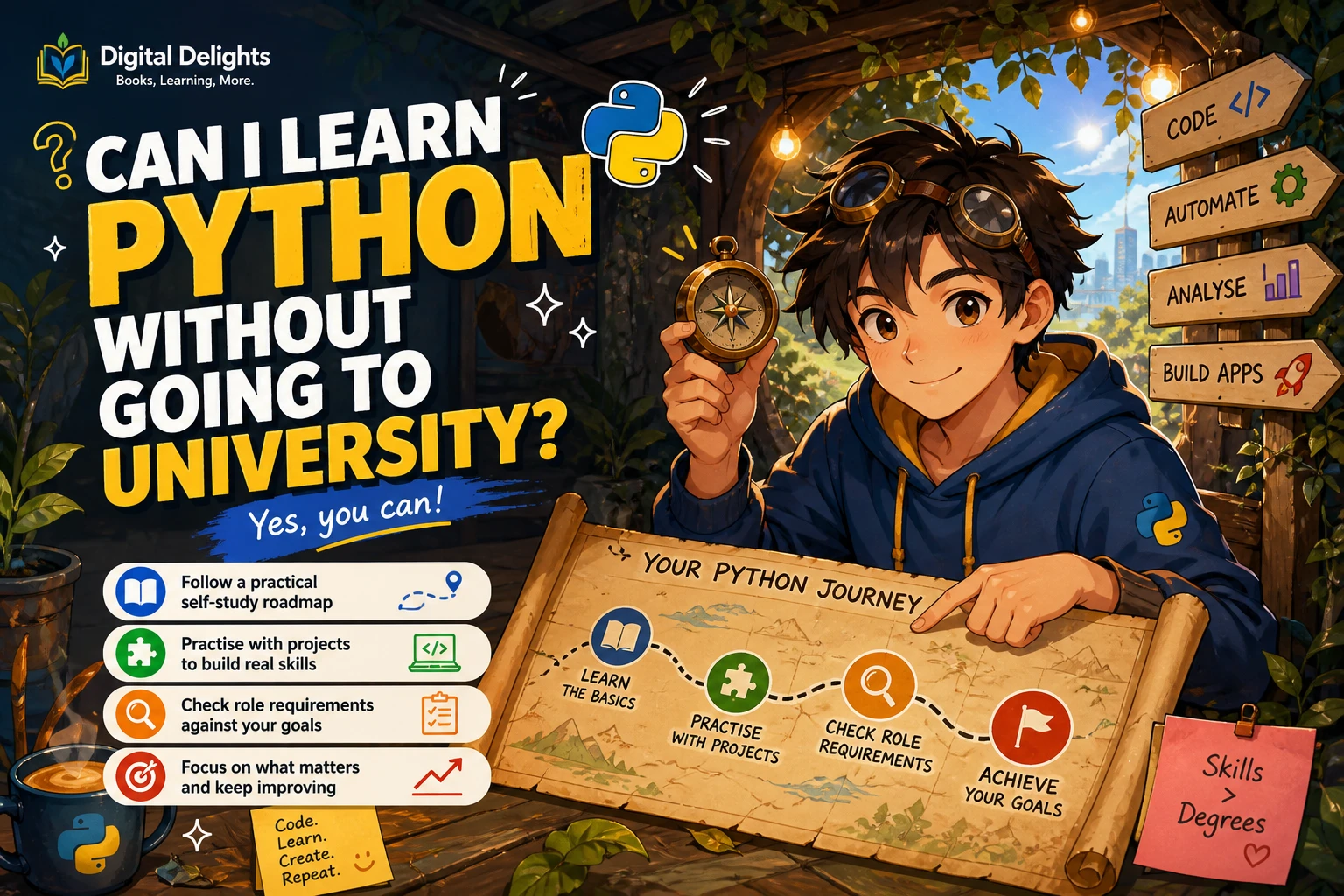
Can I Learn Python Without Going to University?
Yes—you can learn Python without going to university. A degree is not a prerequisite for learning the language: Python.org provides beginner guidance, installation information, documentation and other learning resources. What self-study can accomplish depends on your goals, the time and practice you put in, and any requirements attached to the job or program you eventually want.
It helps to separate two questions: “Can I learn Python on my own?” and “Will my learning route meet the requirements for a particular opportunity?” The first has a clear yes. The second needs a closer look at the specific role or course. This guide offers a practical self-study path, ways to practise and show your work, and advice on choosing a starting resource.
What does learning Python without a degree involve?
Self-study means taking responsibility for your learning plan: choosing materials, writing code regularly, working through mistakes and deciding what to learn next. You do not need a university timetable to begin, but you do need a way to practise—not just read about programming.
Python.org’s getting-started guidance is intended to help people new to programming find tools and beginner resources. The official Python tutorial, however, assumes some familiarity with programming concepts. If you have never coded before, start with a resource that explains those concepts from the beginning, then use the official tutorial as a reference when it fits your background.
That distinction matters: Python can be approachable to new learners without every official resource being written for a complete beginner.
What you need to get started
You can begin with a computer, a way to run Python, a learning resource, and small problems to solve. Python.org notes that installation is generally straightforward but can differ depending on your computer. Check the official Python site for current download and setup guidance rather than relying on old version-specific instructions.
- A place to write and run code: Use an editor or other beginner-friendly environment that lets you run your examples and see the results.
- A structured starting point: Choose one beginner resource that explains the basics in a sequence you can follow.
- A practice habit: Type and change examples yourself. Reading code is not the same as learning to write it.
- A way to keep notes: Record new ideas, errors you solved and questions to revisit. A simple text file is enough.
You do not need to settle on a career direction before your first lesson. Start with general programming foundations, then choose a practical direction once you know what kinds of problems interest you.
A self-study roadmap for learning Python
Move through the fundamentals in a useful order. You do not have to master every detail before proceeding; aim to understand each idea well enough to use it in a small program and explain what it does.
| Stage | What to learn | Practice outcome |
|---|---|---|
| 1. Core building blocks | Values, variables, strings, numbers, input and output | A short program that accepts information and responds with a result |
| 2. Decisions and repetition | Conditions, comparisons and loops | A program that handles more than one possible input or repeats a task |
| 3. Reusable code and collections | Functions, lists, dictionaries and other basic collections | A small program split into clear functions that works with several pieces of data |
| 4. Everyday program structure | Files, exceptions, modules and debugging | A script that reads or saves information and handles an expected problem clearly |
| 5. Apply and specialize | Projects, then topics tied to your interests | A finished project you can explain and improve |
1. Learn the basic building blocks
Begin with variables and common data types, such as strings and numbers. Learn how a program receives input, displays output and uses conditions to make decisions. Then practise loops and functions. These building blocks appear in many kinds of Python programs, so understanding them gives you a base for later topics.
When you meet a new concept, write a tiny example of your own. For instance, make a program ask for a name and print a greeting. Then change it: handle an empty response, ask for another detail or put the greeting logic in a function. Small modifications make you reason about the code rather than simply copy it.
2. Work with collections and files
Once basic variables and control flow feel familiar, learn how to store and work with groups of values. Lists and dictionaries are useful starting points. Try a small task list, a simple contact lookup or a program that counts items in a sequence.
Next, practise reading and writing files. Add basic error handling so your program can respond sensibly when a file is missing or its contents are not what you expected. Learn how modules help organize code and use existing functionality. You do not need to study every library at once; focus on what a project requires.
3. Build projects that use what you have learned
A project gives separate concepts a reason to work together. Choose something small enough to finish, such as a quiz, a personal expense tracker, a text-based guessing game or a script that organizes information in a file. These are practice ideas, not a prescribed portfolio standard.
Start with a plain version. Write down what it should do, build the smallest working version, and add one improvement at a time. If you use a tutorial, close it periodically and try to recreate the important parts without looking. When something fails, reduce the problem to a short example you can inspect.
4. Pick a direction after the fundamentals
Python is used in different areas, and the next topics depend on what you want to make. You might explore automation, data analysis or web development. Treat these as possible routes, not requirements every learner must follow. Select one area, identify the tools and concepts it calls for, and build a modest project that lets you practise them.
If you are not sure which direction to choose, try a small project from two areas before committing to a longer course of study. Your own interest in the work is a useful guide to what you will want to keep practising.
How to practise without a classroom
A repeatable study session can replace some of the structure a class provides. Try this sequence:
- Study one idea. Read a short explanation or follow one lesson, rather than collecting many resources at once.
- Write an example from scratch. Use your own variable names or input so you have to recall how the idea works.
- Solve a small problem. Make a modest change or add a feature that uses the concept.
- Run the code and inspect errors. Read the message, check the relevant line and test one possible fix at a time.
- Summarize what you learned. Write down what the code does and what confused you. Revisit that note later.
For learners who prefer a project-led approach, Python Practice Lab: Learn How to Code through Interactive Examples is a catalog resource described as using projects such as chatbots, recommendation systems and image tools to introduce programming concepts. It may suit a beginner who wants examples that build toward interactive programs. Use it alongside your own coding, not as a substitute for typing, modifying and debugging code yourself.
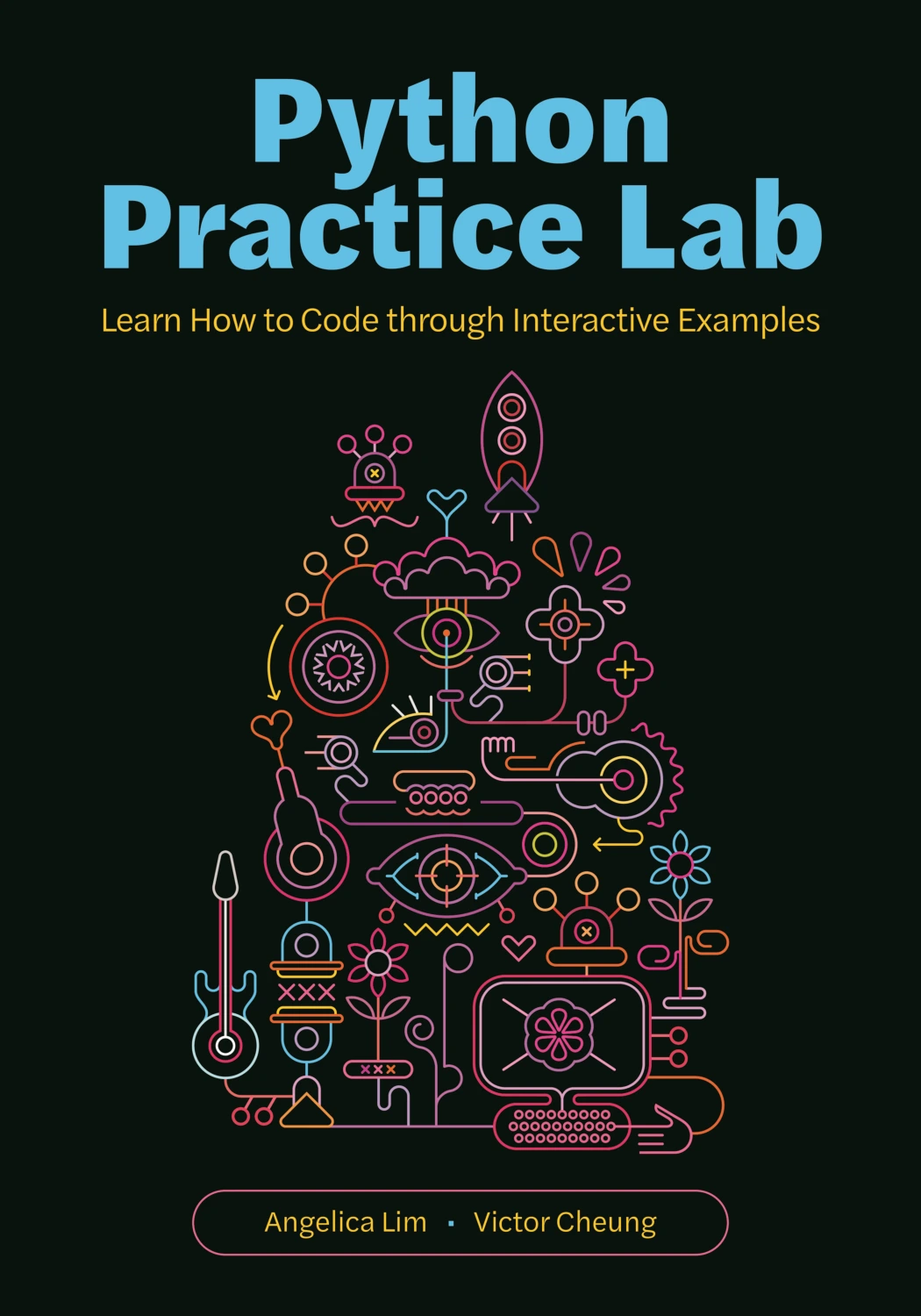
Python Practice Lab: Learn How to Code through Interactive Examples
By Angelica Lim
Beginners who want to encounter programming concepts through interactive examples, chatbots, recommendation systems and image tools.
Keep the routine manageable. Regular practice and finishing small tasks are more useful than making an elaborate schedule you cannot sustain. There is no single study pace that applies to everyone.
How can you demonstrate what you can do?
Keep a record of projects you have completed and be ready to explain them. For each one, note:
- The problem: What were you trying to make easier or possible?
- Your approach: How did you break the problem into steps?
- Your decisions: Why did you organize the code or data that way?
- What you learned: What error or obstacle did you work through?
- Limitations and next steps: What does the program not handle yet, and what would you improve?
A project does not need to be large to give you something concrete to discuss. The important learning exercise is being able to explain how it works, what you changed and where it could be improved. The supplied research does not establish a universal number or format of projects expected by employers, so avoid treating any one portfolio recipe as a guarantee.
Does self-study prepare you for a Python job?
Learning Python and qualifying for a particular job are related but different goals. A role may ask for Python alongside other technical skills, experience, formal education or particular domain knowledge. Requirements can vary by employer and position, so check current job postings for the roles you are considering and compare them with the skills you are developing.
Do not assume that a degree is always required—or that it is never required. The official Python learning resources show that independent study materials are available; they do not compare career outcomes for self-taught learners and university graduates or establish what every employer accepts. If you are studying toward a specific program or role, check its stated entry criteria directly.
This same approach applies if your goal is not employment. A course, qualification or project may have its own prerequisites. Identify those before deciding whether independent study alone is enough for your particular next step.
Common pitfalls when learning on your own
- Reading without writing code: After an explanation, close the page and recreate a small example yourself.
- Switching resources constantly: Choose a main learning path and stay with it long enough to practise its ideas. Use other references to answer specific questions.
- Copying a project without understanding it: Change a feature, explain the code in your own words and try to rebuild a small part from memory.
- Taking every error as a sign you cannot program: Errors are information about what the program did and what it expected. Read them, isolate the issue and test changes.
- Jumping into a specialization too early: If a tutorial depends on concepts you have not met, pause and strengthen the relevant foundations before continuing.
- Assuming one official guide fits every beginner: The Python tutorial states that it is aimed at people with basic programming understanding. Complete beginners may need an introductory resource first.
Frequently asked questions
Do I need prior coding experience to learn Python?
No prior coding experience is required to begin learning Python, but choose materials designed for first-time programmers. Python.org provides guidance for people new to programming, while the formal Python tutorial assumes familiarity with basic programming concepts.
Do I need advanced maths to learn Python?
The supplied official sources do not establish one mathematics requirement for every Python learner. The maths you need depends on what you plan to do with Python. Check the prerequisites for your chosen course, project area or role instead of assuming a single answer applies to all uses.
How should I choose a first Python learning resource?
Check whether it is intended for complete beginners, whether the explanations follow a clear sequence and whether it gives you opportunities to practise. Prefer a resource you can work through actively, with examples you can type and modify. If the material assumes programming experience, it may be a better second resource than a first one.
Is the official Python tutorial suitable for complete beginners?
Not necessarily. The tutorial says it is for people who are new to Python but already understand basic programming concepts. If you have never coded, begin with material aimed at complete beginners and return to the tutorial as a reference when it matches your background.
Can self-study alone meet a particular employer’s requirements?
There is no universal answer in the supplied evidence. Requirements vary, so read current postings for the role and employers you are targeting. Compare their stated education, experience and skill requirements with your own learning plan rather than relying on a broad claim about degrees.
Learn Python on your own, with a clear next step
You can learn Python without going to university by choosing a beginner-appropriate resource, practising the fundamentals and applying them in projects you can explain. A degree is not required to start learning the language, but self-study does not automatically settle whether you meet the requirements for a particular job or program. Let your goal guide what you study next, and verify those requirements directly.
For further reading, explore the Python books and resources available through Digital Delights, and use the official Python beginner guidance and language tutorial according to your experience.