

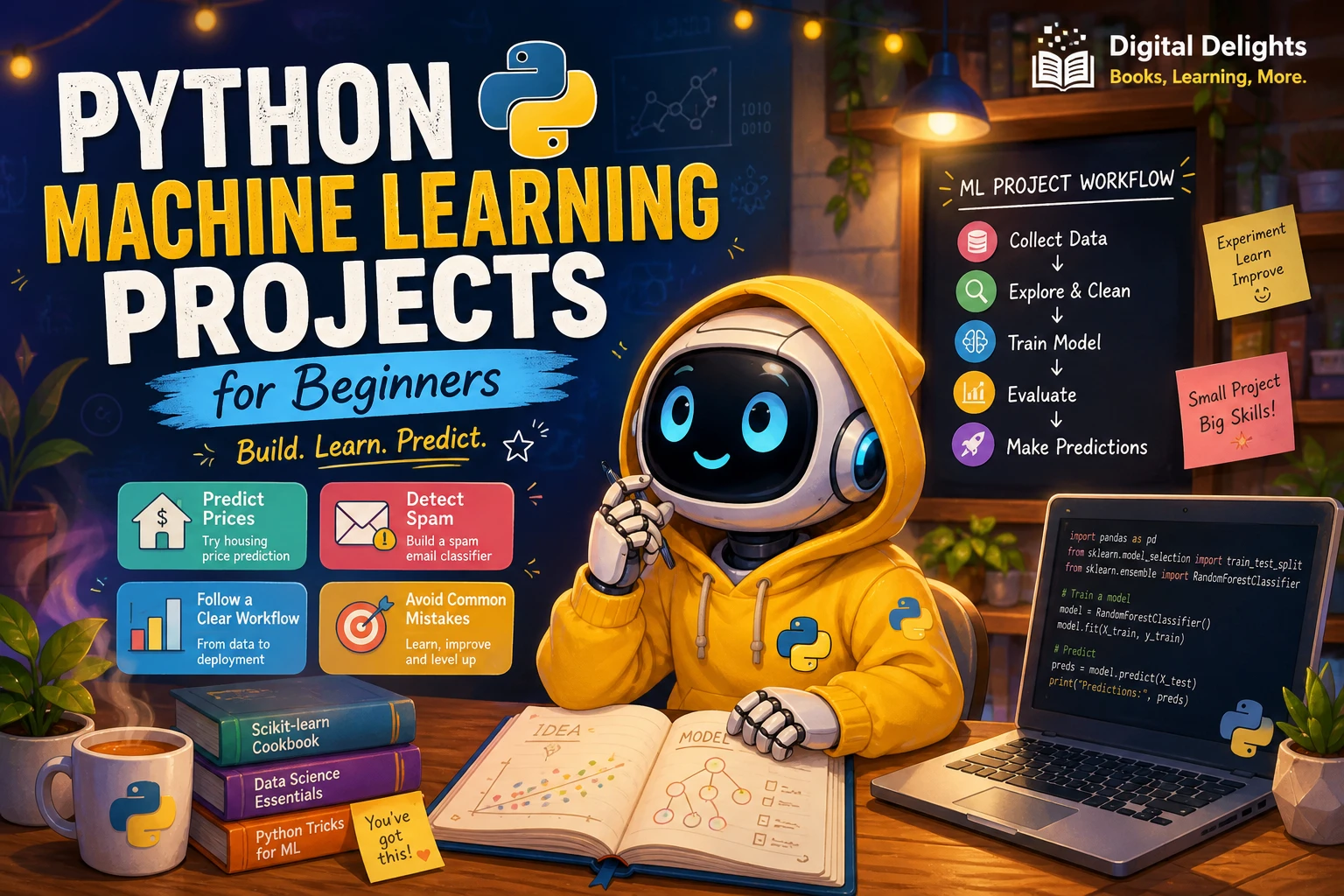
Python Machine Learning Projects for Beginners
A good first machine learning project is small enough to finish, but complete enough to show the whole process: define a question, prepare data, build a simple model, evaluate its predictions, and explain where it falls short. Training an algorithm is only one part of the work.
Four approachable project types are car-price prediction, customer-churn classification, spam detection, and customer or item clustering. They introduce different ways to work with data without requiring you to start with complex neural networks. This guide explains what each project teaches, how to choose one, and how to turn it into a clear learning portfolio piece.
What Should You Know Before Starting?
You do not need to master all of Python before trying machine learning. You should, however, be comfortable reading and writing basic code, using variables and functions, working with lists or dictionaries, and following simple control flow. The official Python tutorial introduces these fundamentals, including data structures, functions, and files.
For data projects, you will also need to practise loading a dataset, checking its columns and values, and making straightforward changes to the data. You can learn these skills as you go; the key is not to treat a model as a magic box that fixes messy inputs automatically.
Keep each project’s setup separate
Use a separate virtual environment for each project so that its installed packages are isolated from other work. Record the dependencies you use so that you, or another reader, can recreate the setup later. Python’s documentation explains how virtual environments isolate packages and how requirements files can record them: Virtual Environments and Packages.
Before installing a library, check its own documentation for supported Python versions and setup instructions. Compatibility can differ between tools, so do not assume that an example written for an older environment will run unchanged today.
Four Python Machine Learning Projects for Beginners
These project ideas are useful starting points, not a definitive ranking. Publisher descriptions of project-based learning resources include examples such as price prediction, churn classification, spam detection, and clustering; your best choice depends on the data you can access and the question you want to answer. See Machine Learning Bookcamp for examples of project topics.
| Project | Core task | What you practise | Possible extension |
|---|---|---|---|
| Car-price prediction | Estimate a price from vehicle details | Regression, data inspection, feature preparation | Compare errors across different vehicle groups |
| Customer-churn classification | Predict which customers may leave | Classification, evaluating predictions, class balance | Examine which kinds of errors matter most |
| Spam detection | Classify messages as spam or not spam | Text preparation, classification, false positives | Review messages the model labels incorrectly |
| Customer or item clustering | Group records by similarities | Unsupervised learning, feature scaling, interpretation | Compare groups and assess whether they are useful |
1. Predict car prices
Question: Can you estimate a car’s price from details such as its age, make, mileage, or other recorded attributes?
This is a regression task because the output is a numeric estimate. The learning value is not just fitting a model: you must inspect the available fields, decide how to handle incomplete or inconsistent entries, and compare predictions with known prices. Start with a small, clearly defined dataset and keep the target—what you are trying to predict—separate from the input features.
Try next: Review where estimates are most inaccurate. Do the errors look different for older vehicles or particular price ranges? Treat any pattern as something to investigate, not proof that the model will behave the same way on new data.
2. Classify customer churn
Question: Based on recorded customer information, can a model identify accounts that may stop using a service?
This is a classification project: the prediction belongs to a category, such as “may leave” or “may stay.” It is a useful way to learn that an overall score alone may hide important mistakes. For example, a team may care about missed likely departures, while also wanting to avoid flagging too many customers who would have stayed.
Try next: Examine the two kinds of incorrect predictions separately and explain what the project would need to learn before anyone used its output to make decisions. A model trained on historical records can reflect gaps or biases in those records.
3. Build a spam detector
Question: Can a model distinguish unwanted messages from ordinary messages?
Spam detection introduces text data. Before a model can use messages, you need to turn their words into a representation it can process. Keep the first version modest: prepare the text, train a basic classifier, and inspect examples it gets wrong. A false alarm matters here: a legitimate message marked as spam may be more troublesome than a spam message that slips through.
Try next: Look for recurring types of errors, such as unfamiliar wording or short messages. Do not assume that a model that works on one collection of messages will work equally well on messages from a different source.
4. Group customers or items with clustering
Question: Can records be grouped by similarities when you do not have a known category for each one?
Clustering is an unsupervised learning task: the method forms groups from patterns in the inputs rather than learning from labelled answers. You still have to interpret the result. A set of clusters is not automatically meaningful just because a method produced it. Check whether the groups are understandable, whether choices made during preparation affect them, and whether they help answer a practical question.
Try next: Compare the groups using a few relevant characteristics, then describe what makes each group different. Avoid presenting a cluster as a real-world customer “type” unless the data and context justify that interpretation.
A Repeatable Workflow for Every Project
Use the same basic sequence whether you choose prices, churn, text, or clustering. Repeating a workflow helps you focus on the reasoning behind the project instead of rushing from a dataset straight to an algorithm.
- Define the question. Write down what you want to predict or discover, who might use the result, and what a useful answer would look like.
- Inspect the data. Identify the target, the available features, missing values, duplicates, and anything that looks inconsistent. Check that the data actually matches the question.
- Prepare a simple baseline. Establish a basic point of comparison before trying more involved approaches. A baseline helps you judge whether added complexity is doing anything useful.
- Separate training and evaluation data. Assess the model on data that was not used to fit it. Reusing training examples for evaluation can give an overly reassuring picture of how the model may perform on new cases.
- Check for leakage. Look for information in the inputs that would not genuinely be available at prediction time, or that gives away the answer. Leakage can make a model appear more capable than it is.
- Review errors and limitations. Look beyond a single summary score. Inspect incorrect predictions, consider which errors matter for the task, and state what the data cannot tell you.
- Document the work. Explain the question, data source, preparation choices, evaluation approach, environment, and limitations so another person can follow your reasoning.
Project-based resources can help you see this sequence applied to examples. The catalog listing for Python Machine Learning: The Beginner’s Guide To Learn Python Machine Learning Including Keras, Numpy, Scikit Learn and PyTorch describes coverage of data processing, evaluation, and practical machine learning techniques. It may suit a learner who wants an ML-focused guide alongside their own small project.
Beginners looking for a guide described as covering data processing, evaluation, and practical machine learning methods.
How to Choose Your First Project
Choose the project where you can explain the question in one sentence and understand what the data represents. For many learners, a small tabular prediction task is a straightforward place to practise preparation and evaluation before moving on to text or clustering. That is a teaching suggestion, not a claim that one project is universally easiest.
- Pick a manageable scope. One prediction question is enough. Avoid trying to build a complete product around your first model.
- Check the data before committing. Confirm where it came from, whether you can use it, what its columns mean, and whether it is suitable for your question.
- Choose a project that interests you. Interest makes it easier to spend time understanding odd values and model errors.
- Increase complexity gradually. Start with a basic tabular task, then consider a text project or clustering once you can explain your preparation and evaluation choices.
If you need more grounding in data handling before building models, Python for Data Science: After work guide to start learning Data Science on your own is catalog-described as covering a data science workflow along with NumPy, Pandas, visualization, and machine learning basics. It is a possible companion for readers who want to connect programming practice to data work.

Self-directed beginners wanting a resource described as covering NumPy, Pandas, visualization, and machine learning basics.
Common Beginner Mistakes to Avoid
- Skipping the baseline: Without a basic comparison, it is hard to tell whether a more elaborate model has helped.
- Evaluating on training data: A model’s performance on examples it has already seen does not establish how it will handle unfamiliar examples.
- Letting information leak: Features that reveal the answer or would not exist at decision time can distort evaluation.
- Relying on one score: A single summary can obscure which cases the model handles poorly. Look at errors in the context of the task.
- Treating clusters as facts: Algorithm-generated groups need interpretation and validation; they are not automatically meaningful categories.
- Leaving out setup details: Record the environment and dependencies, plus the steps needed to reproduce the work.
- Overstating the result: A learning project demonstrates a method on a particular dataset. It does not, by itself, prove that the model is suitable for real-world decisions.
What Should a Portfolio-Ready Project Include?
A useful portfolio project lets someone understand both what you built and how you reasoned. Include:
- A short statement of the problem and intended prediction or discovery.
- A description of the data source and any important usage or quality limitations.
- Clear notes on cleaning, preparation, and feature choices.
- A baseline and an explanation of how you evaluated the model.
- A discussion of representative errors and what they reveal.
- Setup and dependency instructions, with enough detail to reproduce the work.
- A conclusion that distinguishes what the results suggest from what they do not establish.
Readable explanations matter as much as adding another algorithm. A modest project with transparent decisions is easier to assess than a complicated notebook whose results and setup are unclear.
Frequently Asked Questions
Do I need to know Python before starting a machine learning project?
Basic Python fluency is helpful: practise variables, control flow, functions, and working with data structures first. You do not need to learn every part of the language before beginning. The official Python tutorial is one place to review these foundations.
Which machine learning project is easiest for a beginner?
There is no single easiest project for everyone. A small prediction task with understandable data can be a practical starting point because it lets you practise a complete workflow. Choose based on the data’s clarity and your interest, rather than the project’s label.
Where should I get data for a beginner project?
Choose a source you can identify and inspect. Before using a dataset, check its origin, permitted use, quality, and whether its fields are appropriate for your question. No specific dataset has been verified for this article, so the project ideas above are task types rather than dataset recommendations.
What makes a machine learning project portfolio-ready?
Make the work reproducible and explain your choices: state the question, describe the data, show how you prepared and evaluated it, discuss errors and limitations, and record the project setup. A clear account of the process is more useful than an unsupported claim that the model is accurate.
Should I start with deep learning?
Not necessarily. The projects here let you practise data preparation, baselines, and evaluation with approachable problem types. You can explore more complex methods after you can explain the basic workflow and the limitations of your results.
Next Steps
Pick one question, locate suitable data, and finish a deliberately small version of the project. Write down what you expect to learn before training anything; then compare that expectation with the errors and limitations you find. That habit turns a collection of Python machine learning projects into a repeatable way to learn.
For a structured overview spanning Python basics and machine learning topics, the catalog also includes Python: 2 Bundles in 1, described as combining beginner Python programming with machine learning and data analysis material.
Learners seeking a bundled introduction to Python programming alongside machine learning and data analysis.
Sources and Further Reading
- The Python Tutorial — Python documentation
- Virtual Environments and Packages — Python documentation
- Machine Learning Bookcamp — Manning
The project ideas are learning examples, not independently ranked recommendations. Dataset suitability and current library compatibility should be checked for the specific project you choose.