
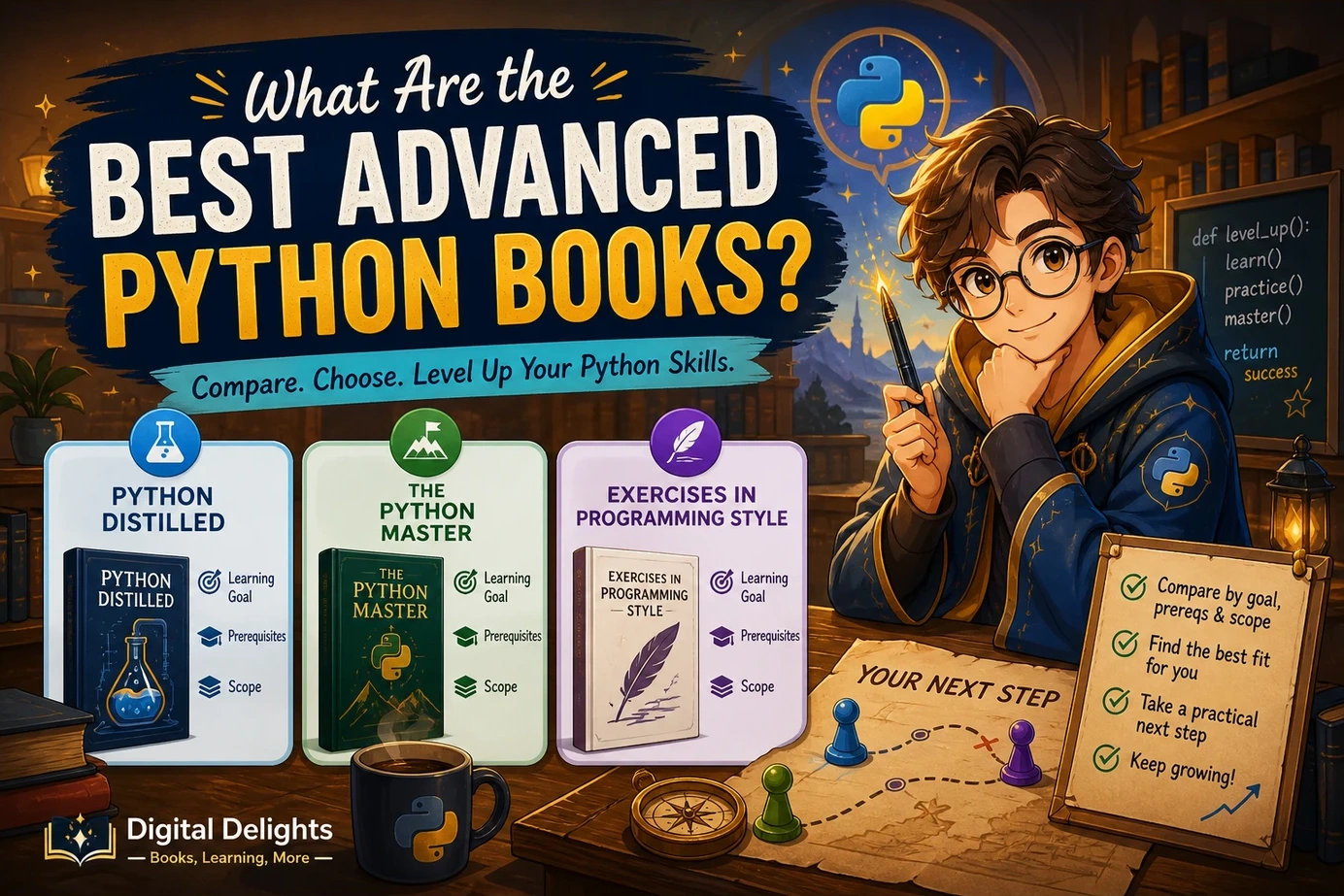
What Are the Best Advanced Python Books?
The best advanced Python books address the problem you have next—not simply the most complicated features of the language. If you can already write working scripts but struggle to organize them, your next book should help with design. If unfamiliar protocols and decorators make other people’s code difficult to read, deeper language coverage is a better fit.
Among the catalog-supported choices considered here, Python Distilled is a practical starting point for consolidating core language knowledge, The Python Master suits readers seeking deeper object-model and metaprogramming topics, and Exercises in Programming Style, Second Edition helps readers compare different ways to structure software.
These are editorial recommendations based on documented coverage, not tested rankings or an exhaustive list of everything available. The comparison below explains what each book offers, where its focus ends, and how to turn reading into better programming decisions.
Best advanced Python books at a glance
Start by choosing between three goals: understanding the language, exploring advanced mechanisms, or improving your design judgment. The suggested prerequisites below are a reading guide, not formal requirements set by the publishers.
| Book | Learning goal | Suggested prerequisites | Approach | Scope to keep in mind |
|---|---|---|---|---|
| Python Distilled — David M. Beazley | Consolidate core Python and understand idiomatic language features | Comfort with functions, collections, exceptions, and basic classes | Concise language-focused guide | Its emphasis is Python itself, rather than a survey of application frameworks |
| The Python Master — Robert Smallshire and Austin Bingham | Explore object internals, descriptors, metaclasses, and byte-oriented programming | Confident intermediate Python, especially classes and attribute access | Focused study of advanced language mechanisms | Choose it for those mechanisms, not as a first programming course |
| Exercises in Programming Style, Second Edition — Cristina Videira Lopes | Compare programming paradigms and software-design choices | Ability to read and modify complete Python programs | A shared word-frequency problem expressed in different styles | It is a design exploration rather than a conventional Python language reference |
If you want one starting choice: choose Python Distilled when your goal is general language development. Choose one of the other two when you can identify a more specific gap. None of these choices needs to become a commitment to read every page before building anything.
Books for mastering the Python language
Python Distilled — a focused next step beyond the basics
Python Distilled by David M. Beazley concentrates on the core language. Its catalog description includes functions and scoping, closures, decorators, objects and protocols, generators, context managers, asynchronous functions, modules, and packages. The publisher’s listing for Python Distilled provides an additional reference for the title and its scope.
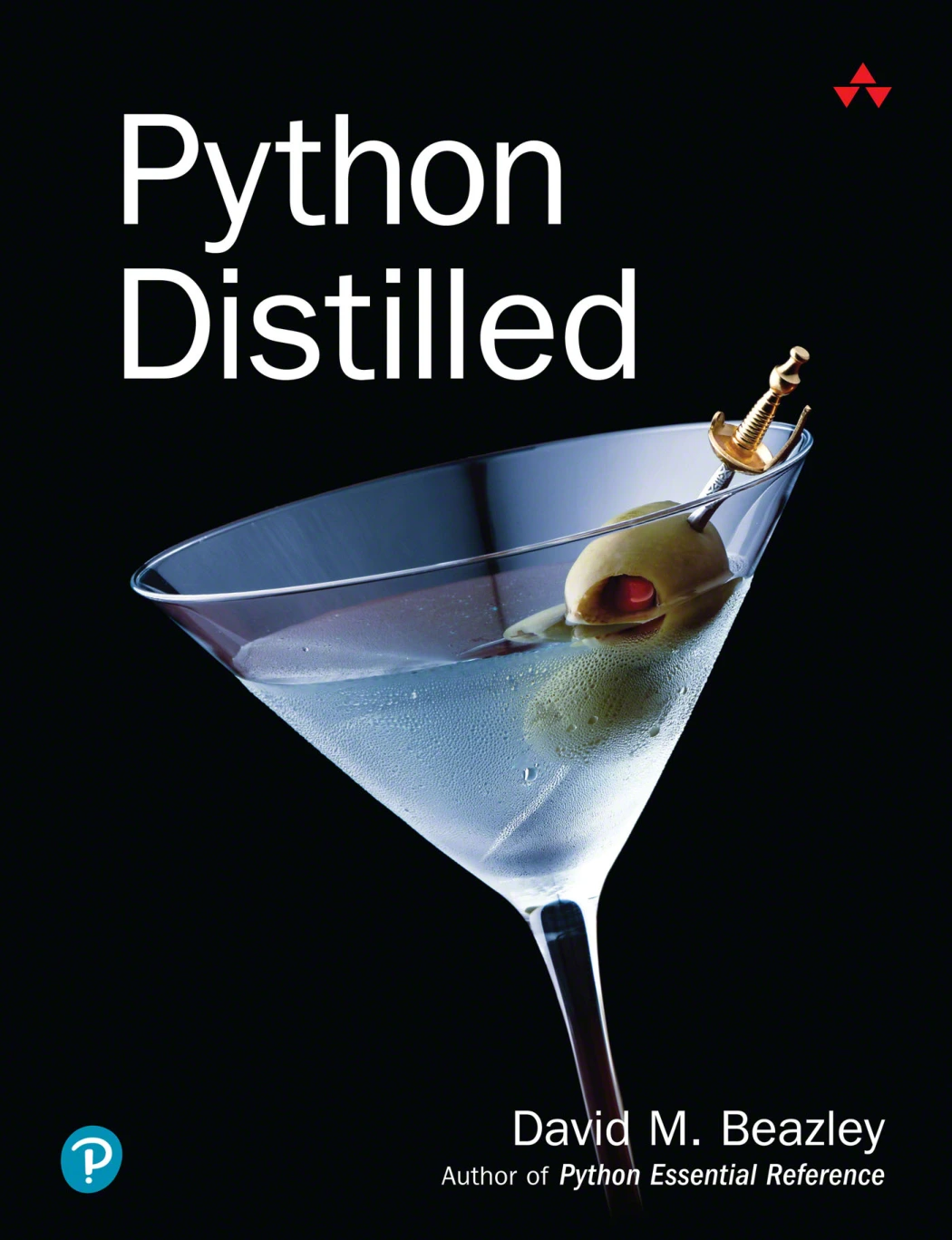
Programmers seeking focused coverage of functions, generators, decorators, protocols, and the object model.
That combination makes it a sensible choice for a reader who knows basic syntax but still sees advanced code as a collection of unfamiliar tricks. Rather than immediately specializing in a framework, you can strengthen the language knowledge that carries across projects.
A useful reading question is: What behavior does this feature let me express more clearly? For example, when studying generators, look for a task that can process items in stages. When studying context managers, look for a resource whose setup and cleanup should remain together.
- Choose it if: you want a compact, coherent route through Python’s everyday and more advanced features.
- Use it alongside: a small program you already understand well enough to modify.
- Keep in mind: learning the language does not replace learning the particular tools your application needs.
For programmers arriving from another language, this is also a useful direction: focus on how Python expresses a solution rather than translating every familiar pattern unchanged.
The Python Master — targeted depth in advanced mechanisms
The Python Master by Robert Smallshire and Austin Bingham addresses advanced flow control, byte-oriented programming, object internals, descriptors, instance creation, metaclasses, and class decorators. The supplied catalog positions it as the advanced volume in the authors’ Python trilogy; its Leanpub listing is the supplied original source.
Confident intermediate learners interested in descriptors, metaclasses, object internals, and byte-oriented programming.
This is the more targeted choice if your questions concern how objects and classes behave underneath ordinary application code. You might want to understand an unfamiliar attribute-access pattern, investigate class creation, or work more deliberately with binary data.
The important distinction is between understanding a mechanism and needing to use it. Studying metaclasses can make framework code less mysterious without making metaclasses the right solution for your own project.
- Choose it if: you are comfortable with intermediate Python and want deeper explanations of specific language mechanisms.
- Use it alongside: small, isolated experiments that make one behavior visible at a time.
- Keep in mind: unfamiliarity with functions, inheritance, or exceptions is a reason to strengthen those foundations first.
For each topic, write down a simpler alternative. Could an ordinary function, a property, composition, or a class decorator solve the same problem? That comparison keeps advanced study connected to practical judgment.
A book for improving software-design judgment
Exercises in Programming Style, Second Edition — compare approaches instead of memorizing patterns
Exercises in Programming Style, Second Edition by Cristina Videira Lopes takes a different route. It explores 40 programming styles through a shared word-frequency task, with examples updated to Python 3. These details are documented in the supplied catalog and its original book listing.
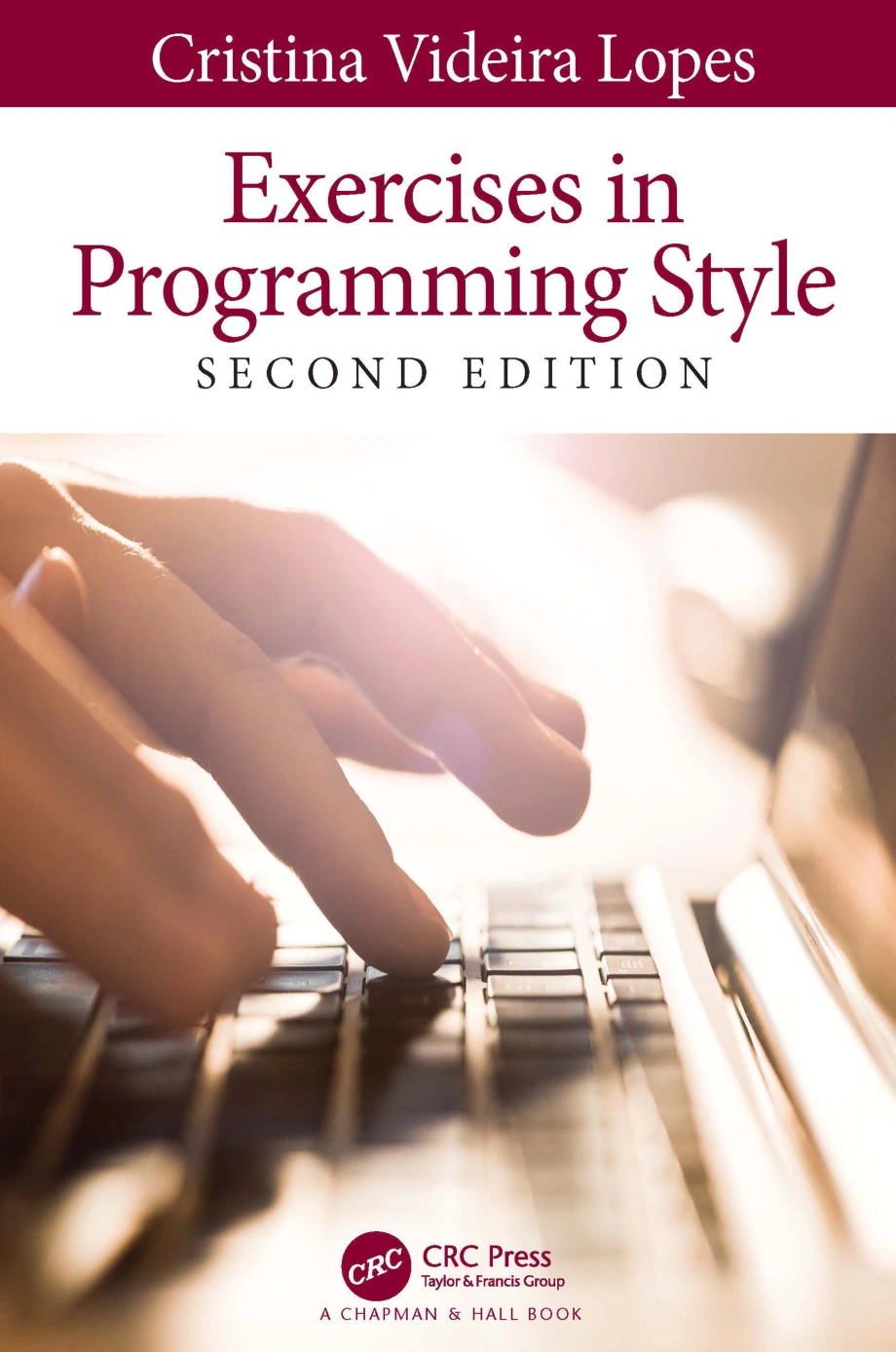
Exercises in Programming Style, Second Edition
Readers who can follow complete programs and want to compare programming styles through a shared task.
Keeping the task constant gives you a useful basis for comparison. Instead of asking whether two unrelated examples look elegant, you can examine what changes when the same work is organized around functions, objects, data flow, or other constraints.
This makes the book relevant when you can produce correct code but have difficulty explaining why one structure would be easier to extend or maintain than another. It is less about collecting syntax and more about noticing how structure affects the work of understanding a program.
- Choose it if: you want to develop a vocabulary for discussing programming styles and design trade-offs.
- Use it alongside: your own implementation of a small text-processing problem.
- Keep in mind: comparison is the purpose; you do not need to adopt every style you encounter.
After reading an example, ask where its decisions are located. How easy would it be to change the input source? Where would you test the transformation logic? What would another programmer need to understand before making a small change?
Those questions help turn an interesting example into a reusable way of evaluating software.
What does “advanced Python” mean for your next book?
Advanced learning has more than one direction. A reader who understands descriptors may still need help writing reliable tests. Someone who maintains a large application may have little reason to customize class creation. Neither situation is unusual.
Language depth
Choose this route when Python’s behavior is the obstacle. You can write basic programs, but iteration, decorators, special methods, or attribute access still feel opaque. Python Distilled offers a broader language-focused route; The Python Master addresses a more concentrated set of advanced mechanisms.
Design and maintainability
Choose this route when the program works but changes are difficult. Perhaps one function mixes file access, transformation, and reporting, or several classes have unclear responsibilities. Exercises in Programming Style can help you compare structures, although applying those comparisons to your own code remains essential.
Specialist application skills
Concurrency, browser testing, statistics, and machine learning each involve additional subject knowledge. Do not assume that a broad advanced-language book is a complete course in those areas. If your immediate problem is specialist, inspect a resource’s contents for that subject rather than choosing it because its title promises mastery.
For asynchronous programming in particular, look for treatment of failure handling, cancellation, resource cleanup, and the relationship between asynchronous tasks, threads, and processes. A specialist resource can complement language study without replacing it.
How to choose—and learn from—one book
1. Check whether you are ready
You do not need to know every advanced feature before opening an advanced book. However, this practical checklist helps distinguish a productive challenge from a missing foundation:
- You can split a program into functions with understandable inputs and outputs.
- You can use lists and dictionaries without copying every example.
- You understand basic classes, instances, and methods.
- You can handle exceptions and read a traceback.
- You can organize code into modules and import them.
- You understand ordinary iteration and can explain what a loop processes.
If several items are still uncertain, work on them before diving into object internals. If only one is weak, review that topic as you go. Readiness is not an all-or-nothing label.
2. Name one problem you want to solve
“Become advanced” is too vague to guide a purchase. Try a goal you can evaluate:
- “I want to understand the decorators in this codebase.”
- “I want to separate data transformation from file handling.”
- “I want to explain whether this class needs customized attribute access.”
- “I want to compare two structures for the same text-processing task.”
Match that goal to documented contents. A shorter book that addresses your problem can be more useful than a broader one you will not apply.
3. Pair reading with a small project
Use a project small enough that you can see the effect of each change. These are suggested practice activities, not claims about exercises included in the books:
- For Python Distilled: build a log-processing pipeline that reads records, filters them, and produces a summary. Explore generators while keeping the output checkable.
- For The Python Master: build a tiny validation example using ordinary properties, then investigate whether a descriptor improves reuse. Explain the trade-off before expanding it.
- For Exercises in Programming Style: implement word counting in two styles. Compare how each handles input, testing, and a new output requirement.
Keep the original implementation. Comparing before and after is more informative than assuming that a more sophisticated version must be better.
4. Reproduce, change, explain, and test
- Reproduce: make a small example run and understand its output.
- Change: alter an input, remove a component, or introduce an edge case.
- Explain: describe why the behavior changed without simply repeating the text.
- Test: add checks for the behavior you intend to preserve.
- Compare: identify a simpler implementation and explain which you would keep.
This method makes passive familiarity less likely to masquerade as understanding.
Check editions and version-sensitive advice
An older book can still explain valuable concepts, but some examples and recommendations depend on the interpreter or library version. Treat edition details and runtime assumptions as part of your selection process.
For example, the official What’s New in Python 3.14 documentation describes deferred annotation evaluation, support for optional free-threaded Python, and changes affecting asyncio. These are reasons to check typing and concurrency advice against the runtime you actually use—not reasons to dismiss every older explanation.
- Confirm the edition and any stated Python version before choosing a book.
- Run examples in a separate project environment.
- Consult current documentation when behavior differs from the text.
- Distinguish a lasting design principle from a version-specific API detail.
- Do not assume thread behavior is identical across all Python builds.
The examples in the recommended books have not been comprehensively checked against current runtimes for this guide.
Common mistakes when choosing advanced Python books
- Choosing by title alone. “Advanced” can describe language internals, an application domain, or a progression that starts with beginner material.
- Collecting overlapping introductions. Check what a book adds to knowledge you already have.
- Using complexity as proof of progress. A clever mechanism is not automatically a clearer solution.
- Reading without changing code. Recognition is easier than explaining behavior or making a safe modification.
- Expecting one book to cover everything. Language knowledge, software design, and specialist tools require different kinds of study.
Frequently asked questions
Which book should I read after learning the Python basics?
Among these choices, Python Distilled is the most natural general next step if you can already write small programs and want to consolidate the language. If functions, exceptions, and classes remain difficult, reinforce those topics first.
Do I need metaclasses to write good Python?
No. Understanding metaclasses can help you interpret specialized code, but using them is not a requirement for writing clear applications. Prefer a simpler solution when it adequately expresses the behavior you need.
Are older advanced Python books still useful?
Yes, when their explanations address concepts you need. Check version-sensitive examples, especially around typing, dependencies, and concurrency. A book’s age alone does not tell you whether a particular chapter will be useful.
Should I choose a broad guide or a specialist book?
Choose a broad language guide when several core features remain unfamiliar. Choose a specialist resource when you can name a specific problem and its contents directly address it. There is little benefit in repeating broad coverage while your real obstacle remains untouched.
Should I read all three recommended books?
Not necessarily. Start with the one closest to your current need, apply what you learn, and reassess. A second book should add a different perspective or fill a remaining gap rather than duplicate your first purchase.
Final recommendation: choose the next skill, not the biggest promise
Start with Python Distilled for focused language development, choose The Python Master for advanced object-model mechanisms, or choose Exercises in Programming Style, Second Edition for comparing design approaches.
The useful next step is to select one book, one small project, and one question you want to answer. Measure progress by what you can explain, modify, and test—not by how many advanced terms you recognize.
For related learning resources, browse the Python collection at Digital Delights and compare each resource’s stated coverage with your goal.
Sources and selection notes
Book descriptions and scope comparisons draw on the supplied Digital Delights catalog and the linked original book listings. Version-related observations use the linked official Python documentation. Publisher and catalog descriptions establish subject coverage; they do not demonstrate comparative learning outcomes. The recommendations are editorial judgments, without firsthand testing, reader ratings, or claims of universal superiority.