

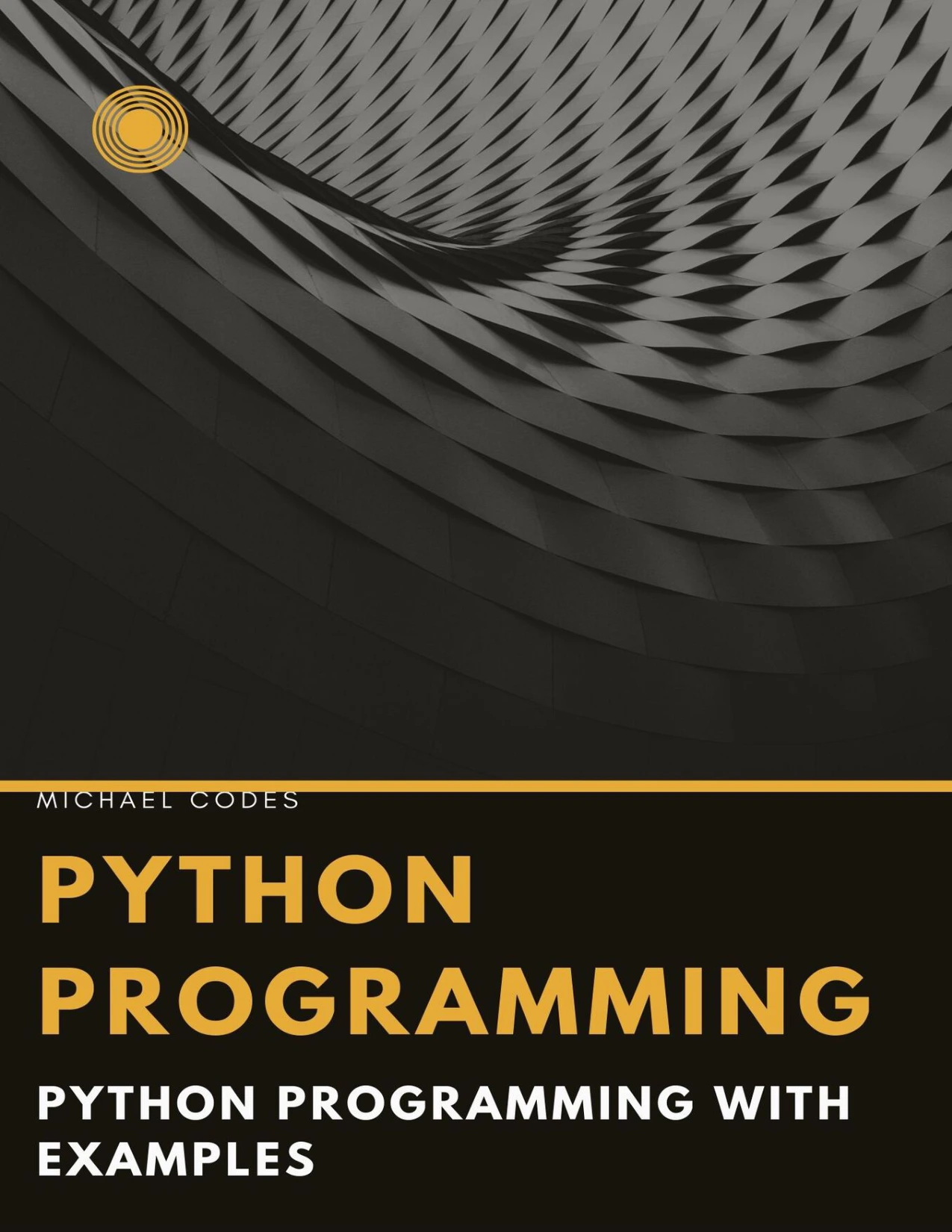
Programming for Idiots: Python Programming for Beginners
Original price was: $5.00.$2.50Current price is: $2.50.

Michael Cods yyy
Product Specs:
- File Type: PDF
- File Size: 921.9 KB
- Book Language: English
- Total Page Count: 164
- Instant Download
A Beginner’s Python Guide with an Old-School Voice 💻
Programming for Idiots: Python Programming for Beginners is aimed at readers who have never written a line of code. Instead of assuming prior knowledge, it starts with the wider story of programming languages and then narrows to Python 3, the interpreter, and the interactive IDLE environment.
The result is a short, direct ebook that treats programming as a skill learned by doing. It is not a massive reference; it is a starting point for readers who want to understand what a program is, how Python runs, and how to begin typing real expressions.
From Machine Code to Python
Early chapters trace the evolution of programming languages: machine code and assembly, Fortran, Basic, Pascal, C, C++, Java, PHP, C#, and Python. This historical context helps explain why different languages exist and why Python became a popular choice for learning, scripting, scientific work, web development, and more. The book also notes Python’s use in system programming, graphical applications, databases, rapid prototyping, and game development.
Getting Started with Python 3 and IDLE
Readers learn what is needed to run Python programs: the Python interpreter, available free from the official source, and the IDLE environment. The text shows how Python can be used like an interactive calculator, then introduces numeric data types, integer and floating-point values, and core math operators. Addition, subtraction, division, floor division, exponentiation, and modulo are all explained with examples.
Variables and expressions follow naturally. A simple equation such as y = x + 3 * 6 becomes an opportunity to practice assigning values and evaluating results. Error messages are presented as helpful feedback rather than failures, which is a useful mindset for new programmers.
Data Structures, Algorithms, and Building Up
Later sections discuss the importance of structuring raw data, choosing appropriate data structures, and designing algorithms. The author compares programming to preparing a salad: first gather and organize the ingredients, then follow a clear set of steps. The book recommends breaking large problems into smaller subtasks, testing each piece, and combining them into a working whole.
The course-like structure moves from numeric basics toward algorithms and eventually the creation of a graphical interface. That progression gives beginners a sense of how small syntax lessons connect to actual program-building.
Who Will Get the Most from This Ebook
- Absolute beginners who want a brief introduction to Python 3
- Students and self-learners who prefer a direct, example-based style
- Readers curious about the history and purpose of programming languages
- Anyone who wants to understand the interpreter and IDLE before moving to larger projects
Experienced developers looking for advanced Python topics, modern frameworks, or deep project work will likely find this too introductory. The English text has a translated, slightly informal feel, and the material reflects an older tutorial style. For the right reader, that simplicity is the point: it lowers the barrier to writing that first program.
Start Coding with a Clear First Step
This digital edition is a practical starting point for anyone who has been meaning to learn Python but does not know where to begin. It focuses on the foundations—language history, installation, IDLE, numbers, operators, variables, data, and algorithms—and keeps the path short enough to follow without getting lost. If you want a no-nonsense beginner’s guide to Python 3, this ebook is ready for your reading device.
User Reviews
Be the first to review “Programming for Idiots: Python Programming for Beginners”
You must be logged in to post a review.
Original price was: $5.00.$2.50Current price is: $2.50.
There are no reviews yet.