

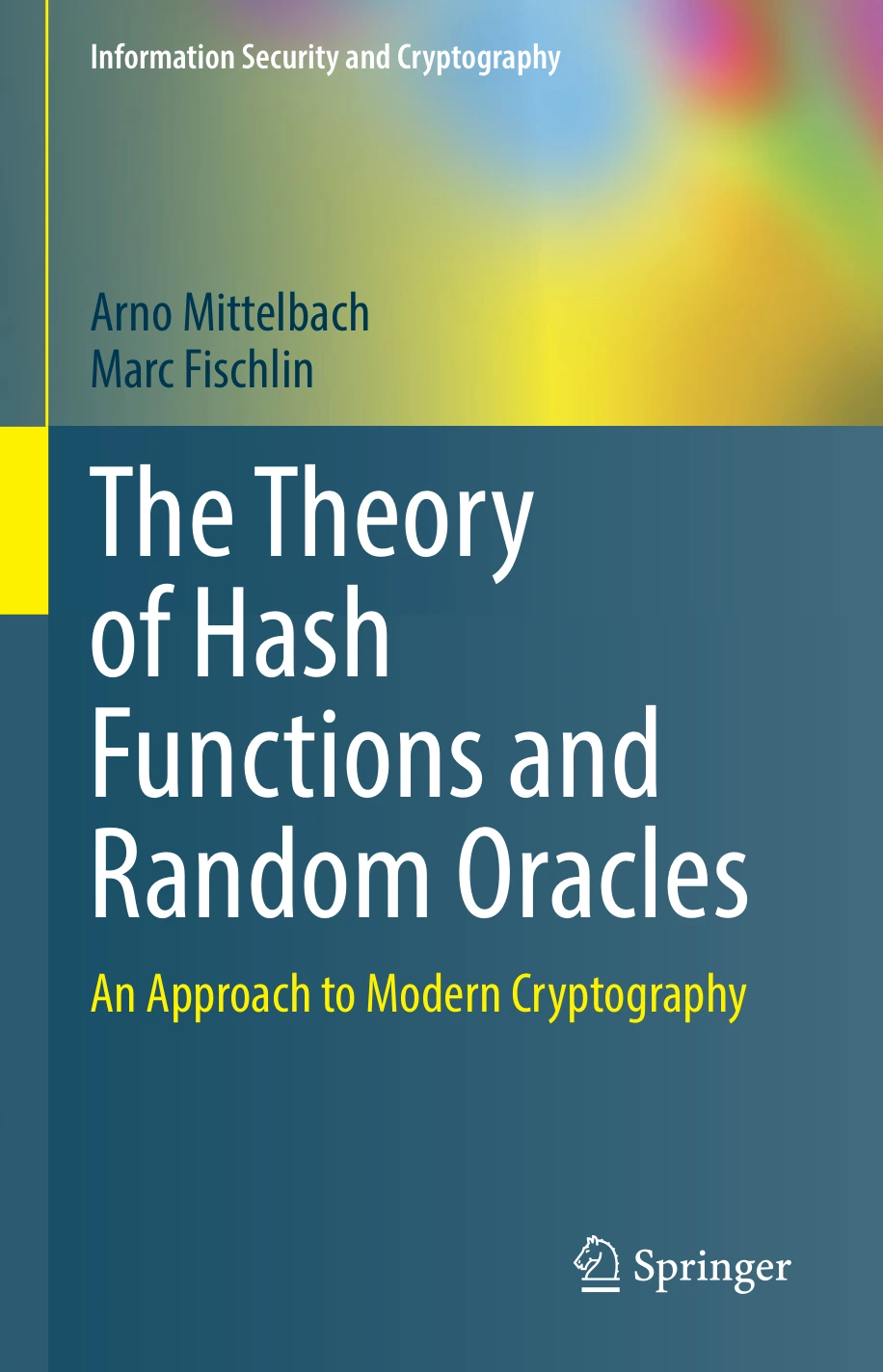
The Theory of Hash Functions and Random Oracles: An Approach to Modern Cryptography
Original price was: $5.00.$2.50Current price is: $2.50.

Arno Mittelbach
Product Specs:
- File Type: PDF
- File Size: 7.9 MB
- Book Language: English
- Total Page Count: 798
- Instant Download
Hash Functions at the Center of Modern Cryptography 🔐
Arno Mittelbach and Marc Fischlin place one of cryptography’s most versatile tools exactly where it belongs: at the center of the conversation. Rather than treating hash functions as a side note in a broader encryption narrative, this book builds a rigorous, modern introduction to cryptography around them.
Hash functions quietly power password storage, data integrity checks, digital signatures, blockchains, randomness extraction, and countless protocols. Their apparent simplicity hides a demanding collection of security properties—collision resistance, one-wayness, pseudorandom output, and more. This text explains what those properties mean, how they relate, and why the idealized random oracle model has become such a powerful—and sometimes controversial—tool for designing practical schemes.
What Makes This Treatment Different
Existing textbooks often discuss hash functions only briefly. Here, the authors use hash functions as the lens for understanding computational security, one-way functions, pseudorandomness, encryption, signatures, and message authentication. That focus allows them to cover important results that usually remain buried in research papers, including limitations of the random oracle methodology and detailed security analyses of real-world constructions.
Inside the Book 📚
The book begins with a fast-paced review of the necessary mathematical and theoretical background, then unfolds in three parts:
- Part I establishes the foundations of modern cryptography, including one-way functions, indistinguishability, game-based proofs, collision resistance, encryption, signatures, and non-cryptographic hashing.
- Part II explores the random oracle methodology, its proof techniques, its limitations, and the subtle gap between idealized models and real hash functions.
- Part III examines how cryptographic hash functions are actually built, covering Merkle–Damgård, Sponge constructions, block-cipher-based compression functions, and detailed discussions of MD5, SHA-1, SHA-2, and SHA-3.
Every chapter includes exercises and notes pointing to the research literature, making the book suitable for both structured study and independent exploration.
Who Will Benefit 💡
Students of computer science and cryptography will find a self-contained introduction that does not shy away from formal definitions and proofs. Lecturers can use it as a primary textbook for introductory or specialized graduate courses. Practitioners who want a deeper understanding of SHA-2, SHA-3, HMAC, and the guarantees they provide will also find clear, detailed explanations that bridge theory and real-world design.
For anyone serious about modern cryptographic practice, this is an authoritative and carefully structured guide to the functions that hold much of today’s digital infrastructure together.
User Reviews
Be the first to review “The Theory of Hash Functions and Random Oracles: An Approach to Modern Cryptography”
You must be logged in to post a review.
Original price was: $5.00.$2.50Current price is: $2.50.
There are no reviews yet.