

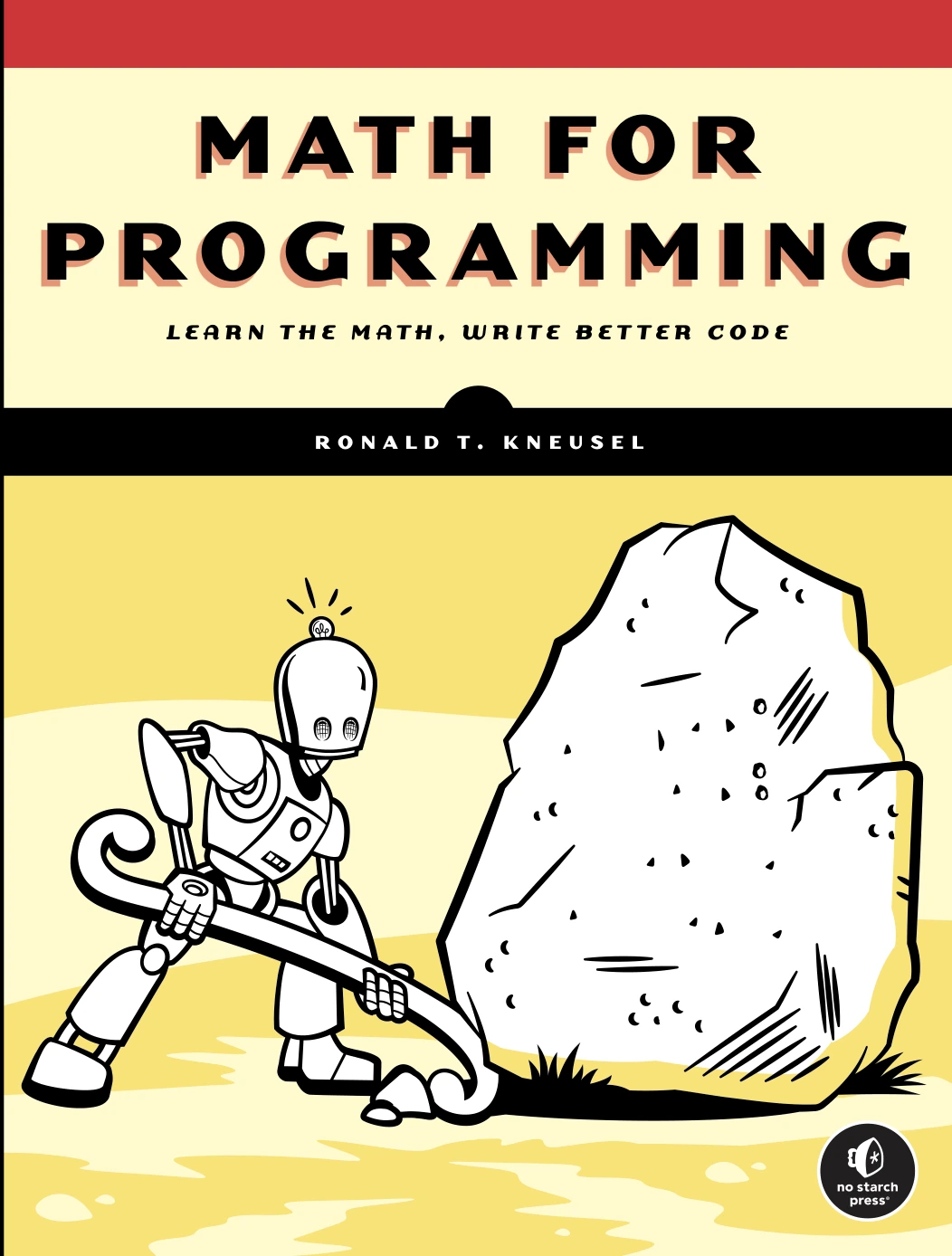
Math for Programming: Learn the Math, Write Better Code
Original price was: $5.00.$2.50Current price is: $2.50.

Ronald T. Kneusel
Product Specs:
- File Type: PDF
- File Size: 21.2 MB
- Book Language: English
- Total Page Count: 507
- Instant Download
Where Code Meets Mathematical Thinking 💻
Programming often begins with loops, functions, and data structures. But the deeper you go—whether you are optimizing an algorithm, training a machine-learning model, compressing data, or modeling a dynamic system—the more often you run into mathematics. Math for Programming is a guide to that territory, written for people who want to write better code by understanding the ideas underneath the routines.
Ronald T. Kneusel takes a broad view of the subject. The book moves from numbers and logic to abstract algebra, recursion, graphs, probability, linear algebra, and calculus, always keeping the programmer’s perspective in sight. It is not a collection of isolated formulas. It is an argument that mathematical fluency makes software development more precise, more efficient, and more interesting.
What the Book Covers 📐
Across 507 pages, the material builds a bridge between mathematical theory and everyday development. The chapters are organized around concepts that show up repeatedly in computing:
- Numbers and sets: how computers represent values, perform arithmetic, and avoid overflow or precision errors.
- Logic and proof: the foundations of conditional statements, control structures, and reasoning about algorithm correctness.
- Recurrence and recursion: tools for analyzing performance and solving problems that call themselves.
- Counting and combinatorics: permutations, probability, and resource allocation.
- Graphs and networks: connectivity, routing, searching, sorting, and parsing.
- Probability and statistics: modeling uncertainty and supporting machine-learning workflows.
- Linear algebra and calculus: vectors, matrices, optimization, differential equations, and continuous models.
Why It Matters for Working Programmers
Math for Programming does not treat mathematics as an isolated academic exercise. Each topic is tied to a coding concern: data structures, cryptography, error detection, algorithm design, software components, complexity analysis, network design, route optimization, randomized processes, model validation, computer graphics, and scientific computation. That practical framing helps explain why a concept matters and where it might appear in real systems.
For example, number representation affects how you store and manipulate data. Recursion and recurrence shape how you reason about performance. Graph theory informs searching and parsing. Probability and statistics become essential when software has to make decisions under uncertainty. Linear algebra and calculus underpin graphics, machine learning, and simulation. Seen together, these subjects form a useful map of the mathematical landscape that modern programming frequently touches.
Who Will Get the Most From It 🧠
If you are comfortable writing code but want a stronger mathematical foundation, this book is aimed at you. It may also suit students who want to connect their programming practice with formal ideas, and developers who have learned enough math to get by but want a clearer, more organized understanding of the concepts they are already using.
No Starch Press published the book in 2025. Its chapters move from foundational topics to more advanced material, including differential equations, so there is room to grow with the subject. The writing keeps the focus on programming rather than pure theory, making the mathematical ideas easier to place in context.
A Clear Path Through the Mathematics ✨
Math for Programming is not about memorizing proofs for their own sake. It is about recognizing the mathematical structures that already appear in software—and using them deliberately. Readers who want to move beyond trial and error, write more reliable algorithms, and understand the reasoning behind common techniques will find a thoughtful guide here.
User Reviews
Be the first to review “Math for Programming: Learn the Math, Write Better Code”
You must be logged in to post a review.
Practical Deep Learning, 2nd Edition: A Python-Based Introduction
Sold by Ronald T. Kneusel Original price was: $5.00.$2.50Current price is: $2.50.


There are no reviews yet.