

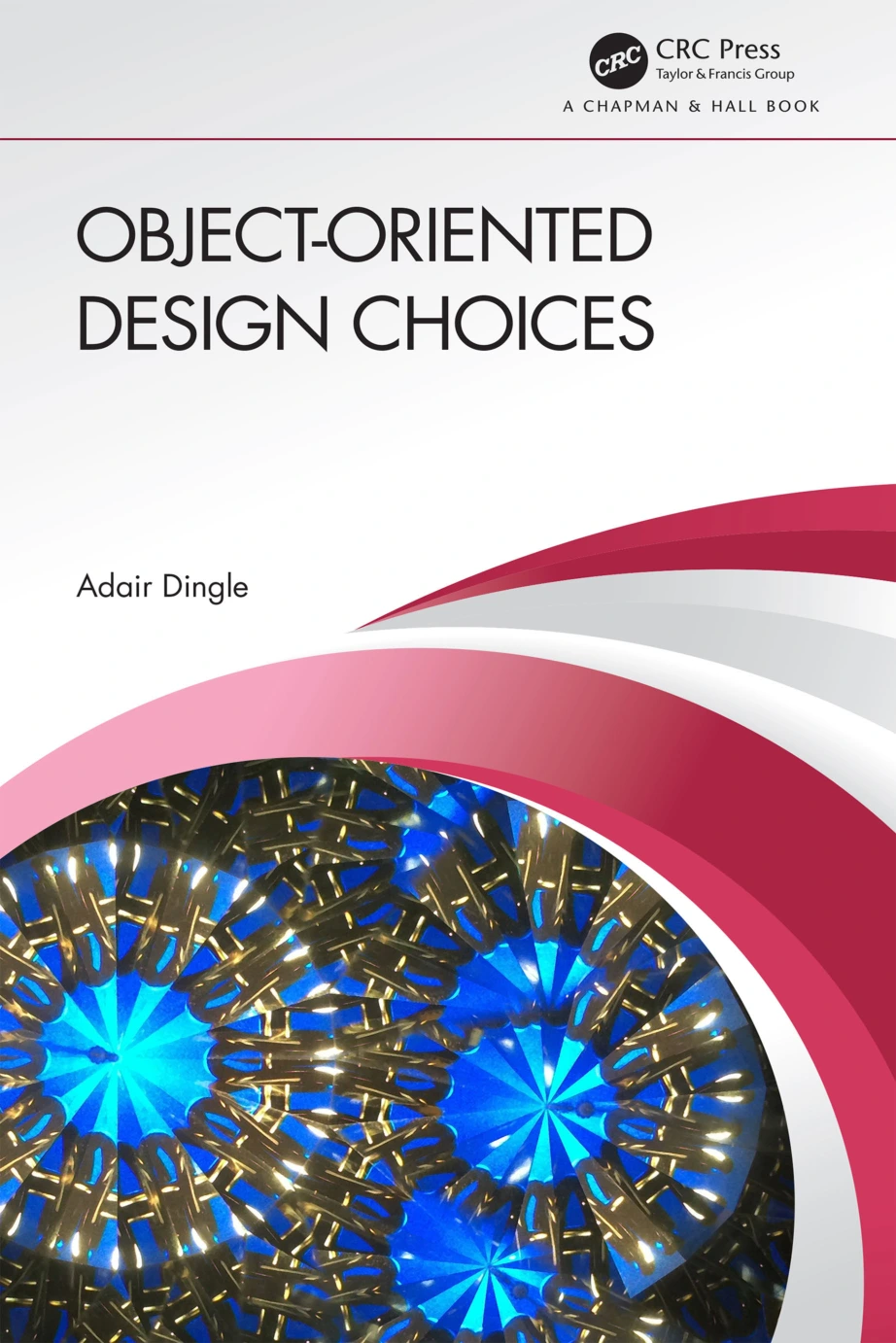
Object-Oriented Design Choices
Original price was: $5.00.$2.50Current price is: $2.50.

Adair Dingle
Product Specs:
- File Type: PDF
- File Size: 8.2 MB
- Book Language: English
- Total Page Count: 349
- Instant Download
Object-Oriented Design as a Series of Deliberate Choices 💻
Designing object-oriented software is less about memorising a syntax and more about making deliberate trade-offs. Adair Dingle’s Object-Oriented Design Choices treats those trade-offs as the main subject, examining how decisions about type design, coupling, reuse, memory ownership, and inheritance ripple through a codebase. The book draws on C++ and C# to show how language features shape design, and why two implementations that look equivalent on the surface can behave very differently over time.
What the Book Explores ⚙️
The material is organised into three broad sections that move from the stability of individual types to the ways types work together and are reused.
- Stable Type Design — contractual design, encapsulation, constructors, accessors, mutators, destructors, invariants, ownership and heap memory, data integrity, copying, aliasing, move semantics, and C++ smart pointers.
- Strategic Type Coupling — composition, containment, interfaces, wrappers, delegates, dependency injection, inheritance, polymorphism, dynamic binding, abstract classes, and the tension between inheritance and composition.
- Effective Type Reuse — design longevity, type extraction, multiple inheritance and its simulation, class hierarchies, and operator overloading in C++ and C#.
Why the Design Choices Matter 🧠
Object-oriented design decisions rarely stay local. A choice about how an object owns memory can affect copying, equality, destruction, and long-term maintenance. A decision to inherit from a class can constrain future extension in ways that composition would not. By comparing features across C++ and C#, the book highlights how explicit deallocation, garbage collection, reference counting, smart pointers, and language-level contracts change the practical consequences of a design.
How the Material Is Organised
Chapters pair conceptual discussion with concrete examples and design exercises. Many chapters close with a summary, a set of OO design principles, design exercises, and conceptual questions. That structure supports readers who want to reason through design alternatives rather than simply follow a recipe. The progression from stable types to strategic coupling and then to effective reuse gives the book a coherent arc, with each section building on earlier concerns.
Who May Find It Useful
The book is likely most rewarding for software developers, students, and practitioners who already have a working grasp of an object-oriented language and want to examine the reasoning behind design decisions. C++ and C# developers will find the language-specific comparisons especially relevant, while readers interested in software architecture, maintainability, and code reuse can use the chapters as a basis for deeper study and discussion.
Study Object-Oriented Design with Digital Delights
Digital Delights offers this ebook for readers who want a focused, example-driven look at object-oriented design choices. For readers revisiting familiar concepts or preparing for advanced work in software design, the book’s emphasis on trade-offs, contracts, and long-term consequences makes it a useful addition to a technical library.
User Reviews
Be the first to review “Object-Oriented Design Choices”
You must be logged in to post a review.
Original price was: $5.00.$2.50Current price is: $2.50.


There are no reviews yet.