
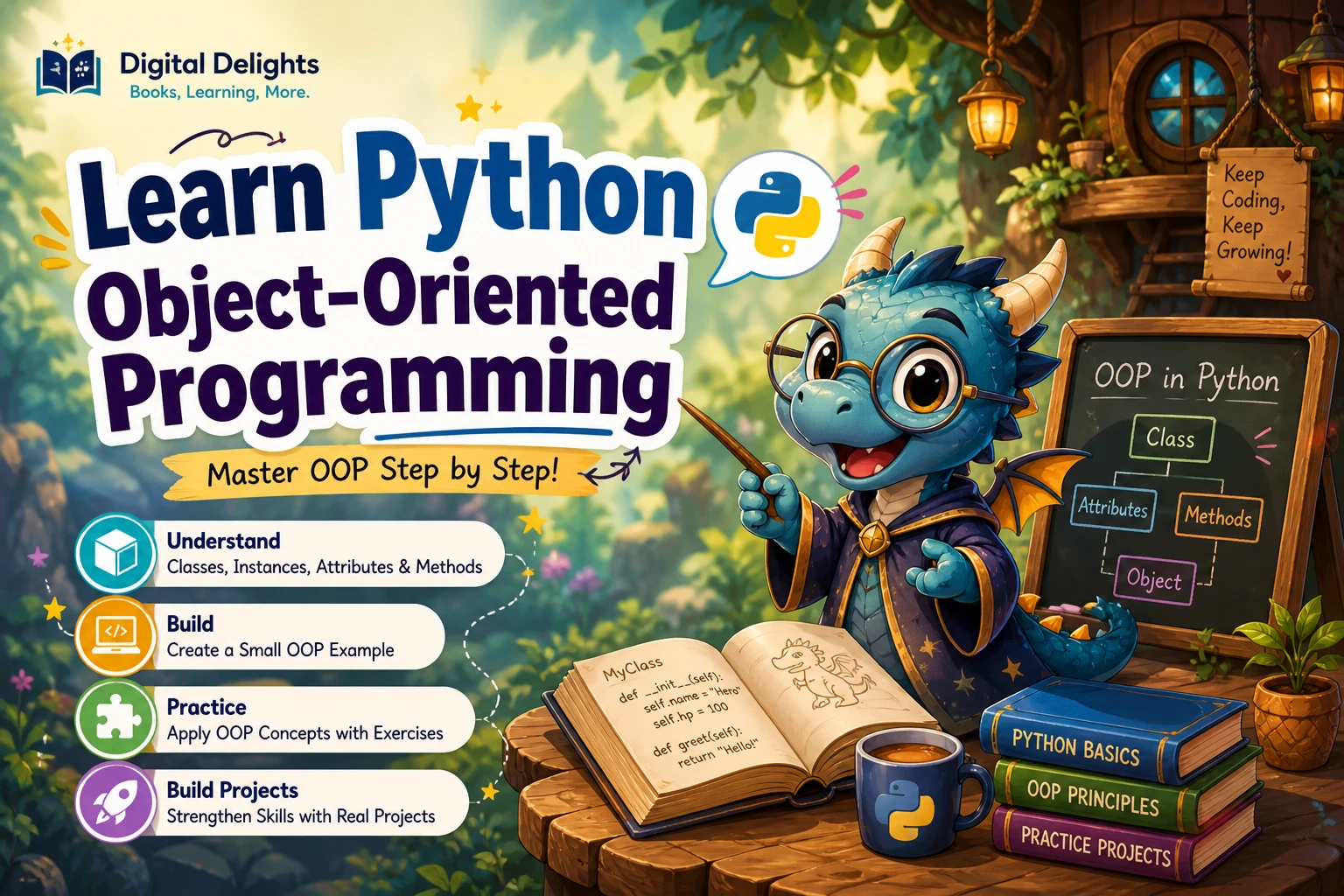
How to Learn Python Object-Oriented Programming
To learn Python object-oriented programming, start with a small, familiar problem and use a class only when it helps organize related data and behavior. First understand classes, instances, attributes, methods, self, and __init__. Then build a few small examples, compare them with function-based code, and study inheritance after the basics make sense.
You do not need to master every Python feature before starting. A working grasp of variables, conditionals, loops, functions, and basic collections will make the examples easier to follow. This guide explains the core ideas, walks through a small Book class, suggests practice projects, and offers a realistic route from first class to independent use.
What to know before learning Python OOP
Object-oriented programming (OOP) is a way to organize a program around objects that combine data with the operations that work on that data. Python classes provide a structure for defining those objects. The official Python tutorial describes classes as a way to bundle data and functionality together.
Before studying classes, it helps to be comfortable with:
- Variables and common data types, such as strings, numbers, and booleans
ifstatements and loops- Functions, parameters, and return values
- Lists and dictionaries
These are useful preparation, not a strict entrance test. If a class example uses a function or list you have not met, pause and learn that piece first. A beginner-focused resource such as Python Programming for Beginners covers fundamentals including data types, control flow, functions, data structures, and classes.
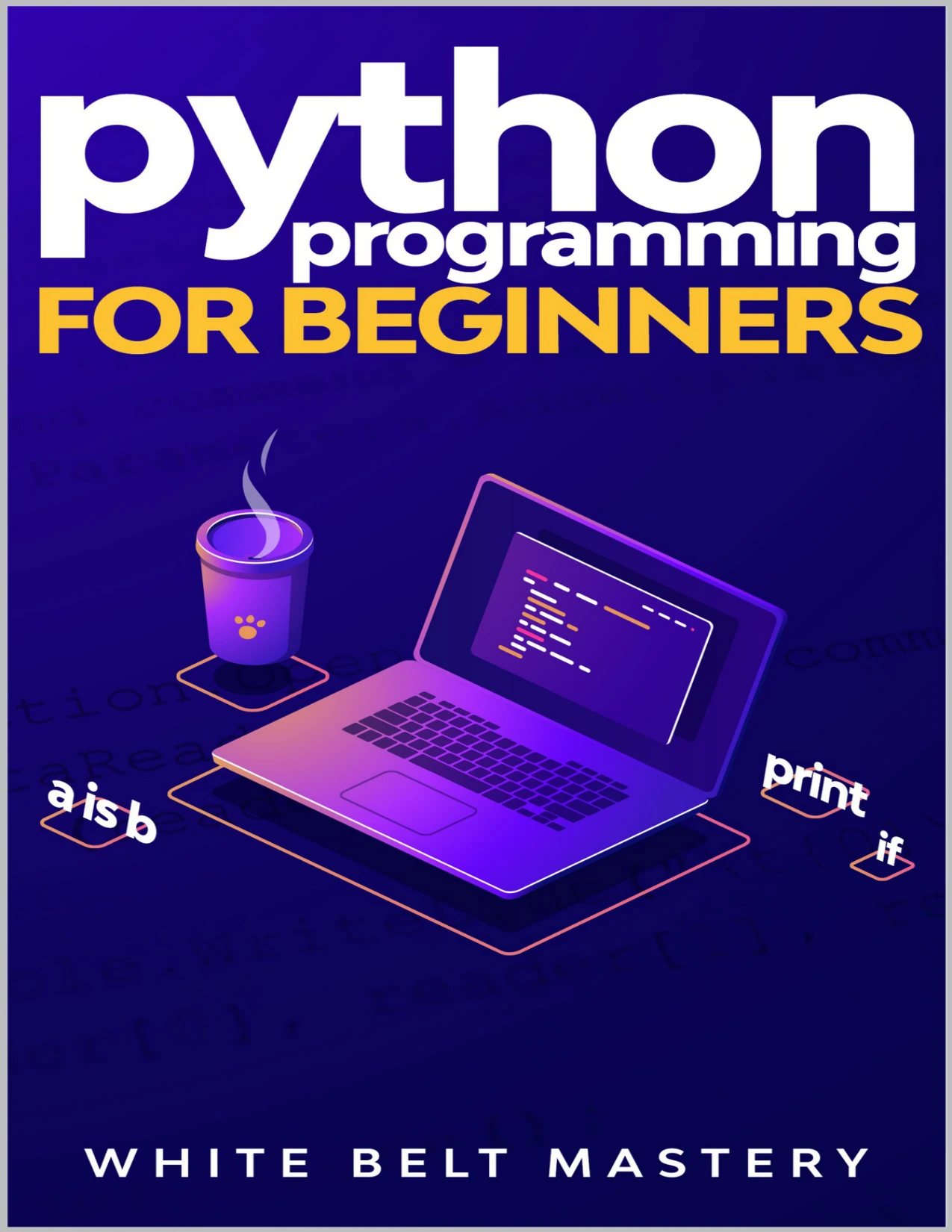
Readers who want a step-by-step introduction covering fundamentals, functions, collections, and classes.
Understand the core Python OOP concepts
Classes and instances
A class defines a kind of object: what information it can hold and what actions it can perform. An instance is one particular object made from that class. If Book is a class, a specific copy of a book with its own title and loan status can be an instance.
A class is not the same thing as the objects made from it. You can create many instances from one class, and each instance can hold its own state.
Attributes and methods
Attributes are values associated with an object. A book might have a title, an author, or a value indicating whether it is on loan. Methods are functions defined on a class that describe actions associated with its objects, such as checking out or returning a book.
What are self and __init__?
In a regular instance method, self refers to the particular instance the method is operating on. When you call a method on an object, Python supplies that instance as the method’s first argument. Writing self.title, for example, accesses the title attribute belonging to that instance.
__init__ is an initializer method that runs when you create an instance. It is commonly used to set the initial values of its attributes. The double underscores are part of the method name; they are not decoration to remove.
Instance attributes and class attributes
An instance attribute belongs to one object, so different instances can have different values. A class attribute is defined on the class and can be shared or used as a default across its instances. Use instance attributes for per-object details, such as an individual book’s loan status. Class attributes suit values that genuinely belong to the class as a whole, not data that should vary independently for each object.
Python’s tutorial explains instance and class variables and shows how classes support methods and inheritance. See the official Python tutorial on classes for the language details.
Build a small class step by step
A short example is easier to understand than a large application. This Book class stores a title and author, tracks whether that particular book is on loan, and provides two actions:
class Book:
    def __init__(self, title, author):
        self.title = title
        self.author = author
        self.is_on_loan = False

    def check_out(self):
        if self.is_on_loan:
            return f"{self.title} is already on loan."
        self.is_on_loan = True
        return f"Checked out: {self.title}"

    def return_book(self):
        if not self.is_on_loan:
            return f"{self.title} was not checked out."
        self.is_on_loan = False
        return f"Returned: {self.title}"

first_book = Book("The Left Hand of Darkness", "Ursula K. Le Guin")
second_book = Book("Kindred", "Octavia E. Butler")

print(first_book.check_out())
print(first_book.is_on_loan)   # True
print(second_book.is_on_loan)  # False
Notice that both objects come from the same class, but checking out one does not change the other. The title, author, and loan status describe each instance; the methods define actions that work with that instance’s attributes.
Compare the class with simpler code
OOP is not automatically better than functions. If a program only needs to perform one short task, a function may be clearer. A class becomes more useful when several related values and operations need to stay together, or when a program creates multiple similar objects with independent state.
| Situation | A straightforward option | Why |
|---|---|---|
| One calculation or transformation | Function | The task can be expressed without storing ongoing object state. |
| A few related values used together once | Dictionary or simple data structure | A class may add ceremony without making the code easier to follow. |
| Many similar items with their own state and actions | Class and instances | Each object can keep its data and related methods together. |
Think of this as a decision aid, not a fixed rule. Start with the clearest small solution, then introduce a class if it makes the growing program easier to understand.
Practice Python OOP with small projects
Practice by extending a working example one feature at a time. After each change, run the program and check what happens in both the expected and an unusual case.
- Library catalog: Create a
Bookclass, then keep several books in a list. Add a way to find a book by title and track loans. - Inventory tracker: Model a product with a name and quantity. Add a method to restock it, and decide how the program should handle an invalid quantity.
- Simple game character: Store a character’s name and health. Add methods to take damage or recover, then check that the health value changes as intended.
For each project, try this loop:
- Describe the problem in plain language.
- List the information each object needs to keep.
- Choose one or two actions that should operate on that information.
- Write the smallest useful class and create two instances.
- Test normal cases and edge cases, then add the next feature.
Once you understand the basic structure, a dedicated text can help you explore design choices and more advanced Python features. Python Object-Oriented Programming by Steven F. Lott and Dusty Phillips covers object-oriented design alongside Python topics including composition, inheritance, properties, abstract base classes, and protocols. The catalog describes it as a practical guide to applying OOP principles in maintainable Python applications.
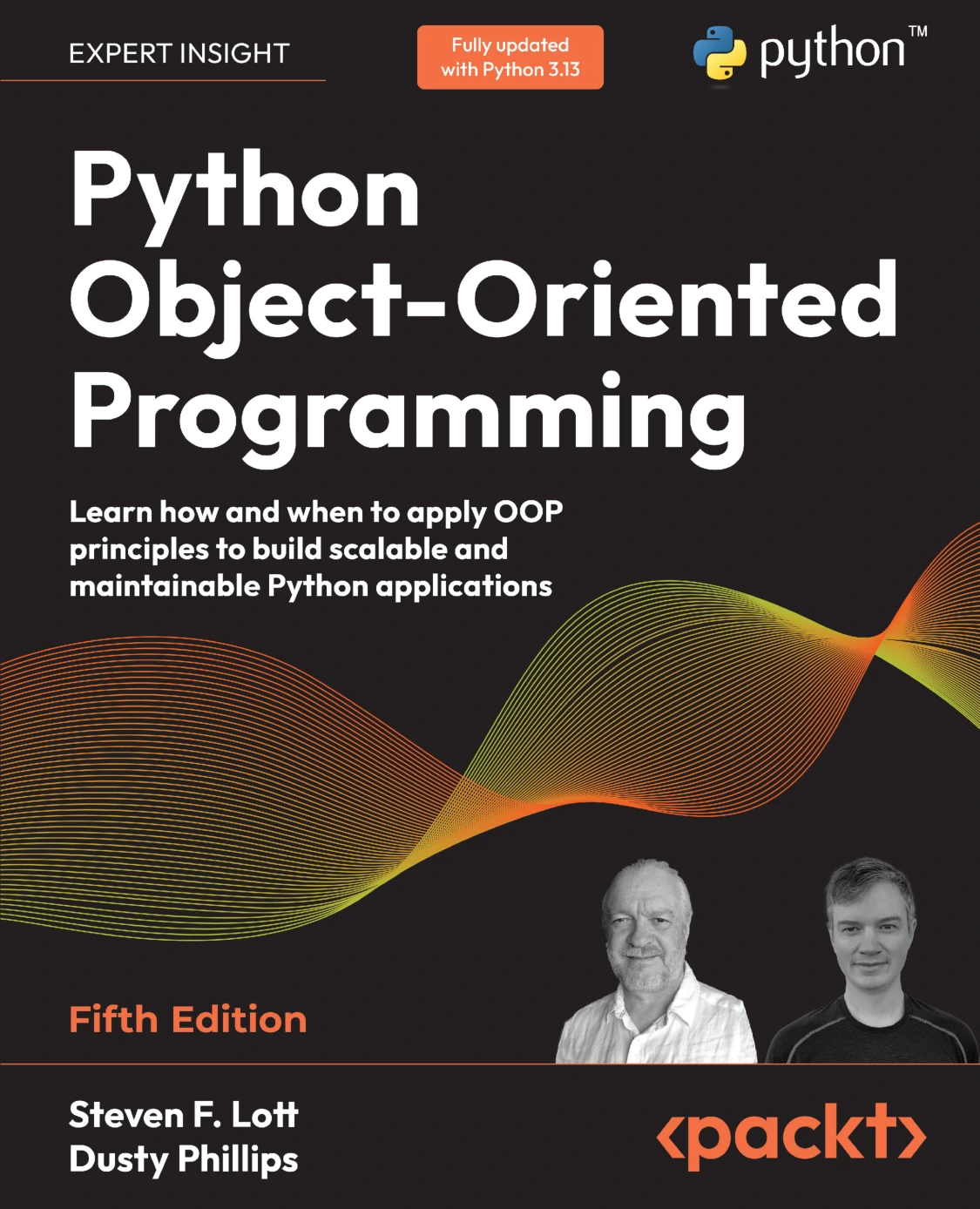
Python Object-Oriented Programming
Learners with basic Python familiarity who want to study design, composition, inheritance, and related OOP features.
Learn inheritance after the basics
Inheritance lets a class derive from another class, gaining or adapting its behavior. A subclass can override a method to provide a more specific version. Python supports inheritance, but it is one available OOP feature—not a requirement for every class or the place every learner must begin.
class Notification:
    def send(self, message):
        return f"Sending: {message}"

class EmailNotification(Notification):
    def send(self, message):
        return f"Email sent: {message}"

notice = EmailNotification()
print(notice.send("Your item is ready"))
EmailNotification inherits from Notification and replaces the send method with its own implementation. This example demonstrates overriding; a real design should also make clear why the two classes share a common concept.
Another design option is composition: one object contains or uses another object instead of inheriting from it. For instance, a Library might hold a list of Book objects. As a practical starting point, use inheritance when the relationship and shared behavior are clear; consider composition when an object is better described as having or using another thing. These are design guidelines rather than universal laws.
Common beginner mistakes to avoid
- Making a class for every task: A short function or a list may be simpler. Choose the smallest structure that keeps the code understandable.
- Treating inheritance as the goal: OOP can organize data and behavior without any subclassing.
- Mixing up class and instance attributes: Ask whether a value belongs to each individual object or is genuinely shared at the class level.
- Building too much at once: Start with one class and a couple of instances. Add features after the first version works.
- Assuming attributes are strictly private: Python uses naming conventions to signal intended access; it does not enforce privacy in the same way as some languages. Follow the conventions used by the codebase you are reading.
- Reading without writing code: Type, run, change, and test examples instead of relying only on recognition from a page.
A practical learning plan for Python OOP
- Review the basics. Revisit functions, collections, and control flow if they feel unfamiliar.
- Learn the class vocabulary. Explain classes, instances, attributes, methods,
self, and__init__in your own words. - Write tiny examples. Create a class, instantiate it more than once, and observe how each object’s state differs.
- Compare approaches. Solve a small problem with functions and data structures, then consider whether a class improves the organization.
- Build a small project. Choose a catalog, tracker, or simple game and develop it feature by feature.
- Study inheritance and composition. Use them to solve a clear design need rather than adding them just to demonstrate a feature.
- Review your code. Ask whether each class has a clear purpose and whether a simpler solution would be easier to maintain.
There is no single proven schedule or exercise sequence that suits every learner. Treat this as a practical path: adjust the pace, revisit concepts when needed, and keep the examples small enough to reason about.
Frequently asked questions about learning Python OOP
Do I need to know Python before learning OOP?
You do not need advanced Python experience, but familiarity with variables, conditionals, loops, functions, and basic collections helps. These concepts appear inside class methods and examples, so review them as needed.
What is the difference between a class and an object?
A class defines the structure and behavior for a kind of object. An object, often called an instance, is a specific example created from that class and can hold its own attribute values.
When should I use a class in Python?
Consider a class when a program needs several similar objects, each with related data and operations or its own changing state. For a one-off task or a simple transformation, a function may be clearer.
Do I need to learn inheritance right away?
No. First become comfortable creating classes, instances, attributes, and methods. Learn inheritance afterward so you can judge whether a parent-and-subclass relationship actually helps your design.
Sources and further reading
- Python documentation: Classes — classes, instance and class variables, methods, and inheritance.
- Python documentation: Programming FAQ — concise answers to programming questions, including class and method concepts.
Conclusion
The clearest way to learn Python object-oriented programming is to connect the terminology to working code. Begin with a small class, create multiple instances, and see how attributes and methods relate. Use classes when they make related state and behavior easier to manage; keep simpler problems simple. Once that foundation is clear, practice with a small project and then explore inheritance and composition as design tools.