

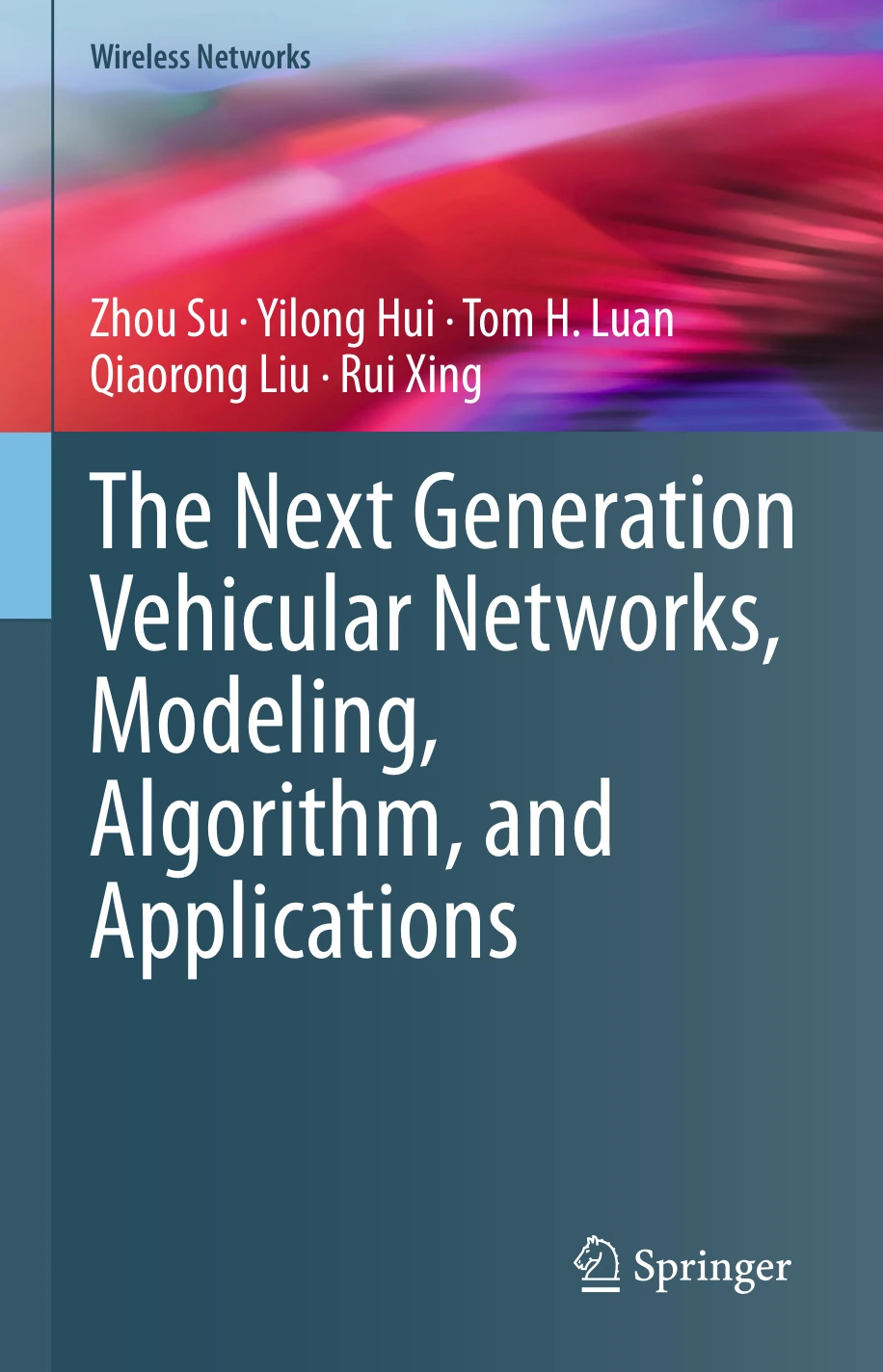
The Next Generation Vehicular Networks, Modeling, Algorithm, and Applications
Original price was: $5.00.$2.50Current price is: $2.50.

Zhou Su
Product Specs:
- File Type: PDF
- File Size: 5.8 MB
- Book Language: English
- Total Page Count: 167
- Instant Download
Understanding the Road Ahead for Connected Vehicles 🚗
Vehicular networks are moving far beyond simple data exchange between cars and roadside units. This book focuses on the next generation of these systems, where low latency, efficient content delivery, secure offloading, and even autonomous driving become practical engineering goals. The authors bring together modeling, algorithm design, and simulation-based evaluation to show how emerging technologies can work together inside real vehicular environments.
Six Frameworks That Address Real Network Challenges
Instead of a broad survey, the book proposes concrete solutions for six pressing problems. Each one is developed with a clear network architecture, relevant mathematical or algorithmic tooling, and performance analysis.
- Reputation-based content delivery in information centric vehicular networks
- Contract-based edge caching to exploit social relationships among vehicles
- Stackelberg game-based computation offloading between vehicles and mobile edge computing servers
- Auction game-based secure computation offloading to constrain bid prices and maintain service quality
- Bargain game-based secure content delivery with trust evaluation and authority units
- Deep learning-based collaborative autonomous driving that lets autonomous vehicles learn and drive in groups
Modeling and Algorithms With a Practical Edge ⚙️
The text does not stop at conceptual description. It uses tools such as game theory, contract theory, trust evaluation, and deep learning to build solution frameworks. Simulation results are included for each major proposal, which helps readers understand how the models behave under different network conditions. This balance between theory and evaluation is especially useful for engineers who need to move from concept to implementation.
What the Chapters Cover
Chapter 1 introduces the architecture of vehicular networks and the enabling technologies—5G, mobile edge computing, network function virtualization, software defined networks, blockchain, information centric networks, edge caching, autonomous driving, and artificial intelligence. The following chapters each tackle one major framework in depth, from network model and mathematical formulation to simulation and results. The final chapter concludes with future research directions.
Who Will Find This Ebook Useful 💡
Researchers, graduate students, and practicing engineers in wireless communications, intelligent transportation systems, mobile edge computing, and smart city development will find this book directly relevant. While some prior exposure to networking concepts and mathematical modeling is helpful, the authors consistently explain their assumptions and objectives, making the material accessible to motivated technical readers.
A Focused Addition to the Wireless Networks Series
As part of Springer’s Wireless Networks series, this volume provides a cohesive overview that is more detailed than a survey article but narrower than a general textbook. It offers a research-oriented perspective on how vehicular networks can evolve to meet the demands of future transportation systems. For anyone working at the intersection of mobility, communication, and edge intelligence, this title supplies a solid foundation and a range of practical algorithmic ideas.
User Reviews
Be the first to review “The Next Generation Vehicular Networks, Modeling, Algorithm, and Applications”
You must be logged in to post a review.
Original price was: $5.00.$2.50Current price is: $2.50.





There are no reviews yet.