

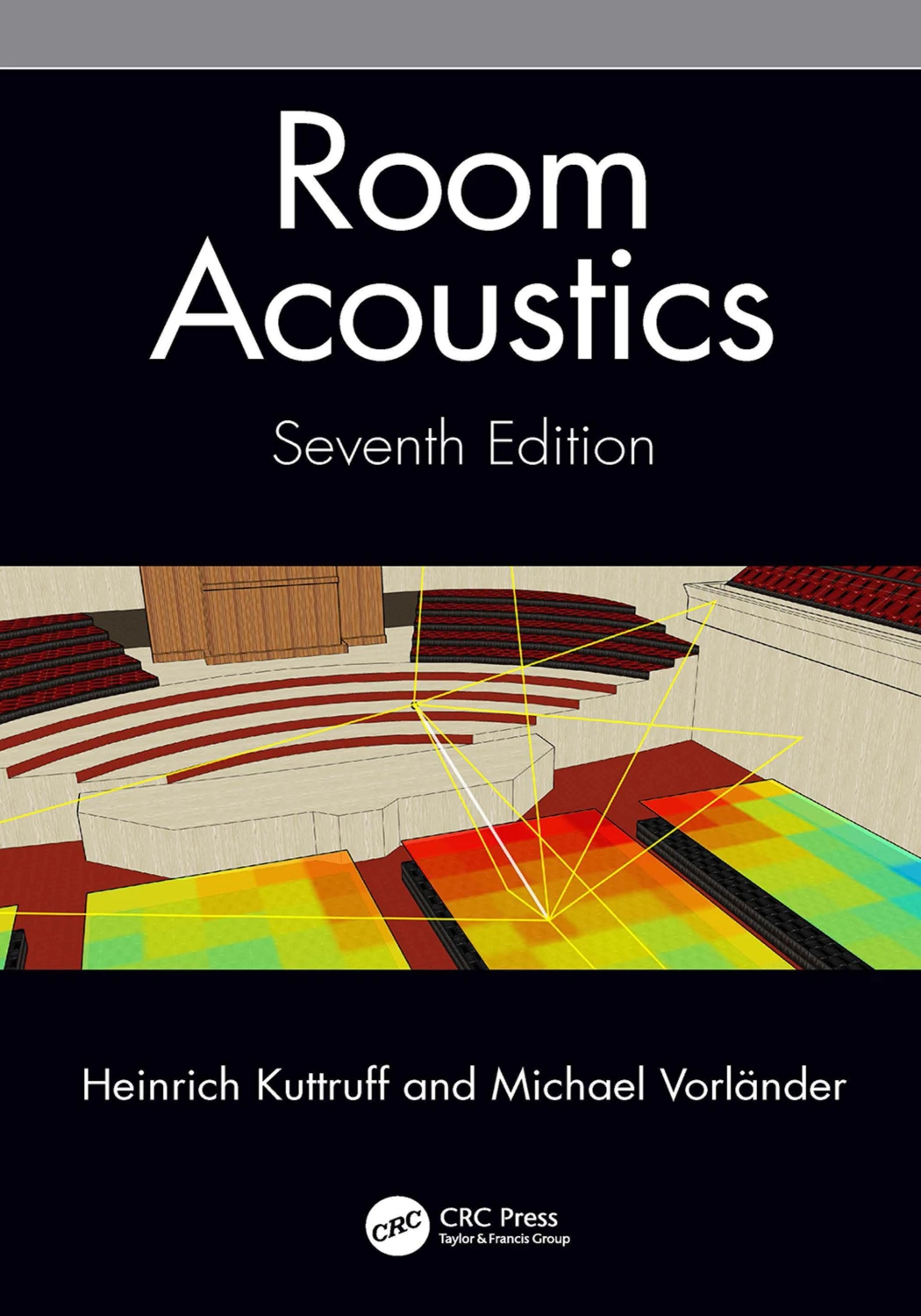
Room Acoustics: Seventh Edition
Original price was: $5.00.$2.50Current price is: $2.50.

Heinrich Kuttruff
Product Specs:
- File Type: PDF
- File Size: 23.1 MB
- Book Language: English
- Total Page Count: 345
- Instant Download
A Reference That Has Shaped the Field 🔊
Room Acoustics first appeared in 1973 and has remained a specialized textbook and working reference for anyone concerned with how sound behaves in enclosed spaces. The seventh edition, prepared by Heinrich Kuttruff and Michael Vorländer, carries that tradition forward while reflecting the tools and questions of contemporary acoustics.
This is not a light introduction. It is a rigorous treatment of the physical principles, measurement methods, and design procedures that shape auditoria, studios, classrooms, and other architectural spaces.
What the Book Explores
Across its chapters, Room Acoustics moves from fundamental wave behavior to the practical prediction of real-room performance. Topics include:
- Sound waves, sources, and human hearing
- Reflection, scattering, and boundary behavior
- Room modes, transfer functions, and decaying sound fields
- Geometrical room acoustics and radiosity integral methods
- Reverberation theory and steady-state energy density
- Sound absorption mechanisms and absorber types
- Subjective parameters such as clarity, spaciousness, and reverberance
- Measurement techniques for impulse responses, absorption, and scattering
- Design considerations for concert halls and multipurpose spaces
- Scale models, computer simulation, and auralization
- Electroacoustical systems and immersive audio in rooms
New and Updated in the Seventh Edition 📐
This edition adds coverage of new measurement and simulation techniques, including spatial and directional analysis. It also presents recent psychophysical experimental approaches to auditory perception in concert halls. Readers will find updated material on sound absorption and its practical application, scattering through wall corrugations, and the design and performance of sound reinforcement systems. Reverberation remains a central theme, with attention to both properties and calculation.
From Theory to Practice
The book connects mathematical foundations with the tools acousticians actually use. Chapters on finite element methods, radiosity, hybrid prediction models, and auralization show how theoretical models translate into design decisions. Measurement chapters cover impulse response examination, reverberation measurement, directional distribution, tube and reverberation-chamber absorption methods, and scattering coefficients. For designers, later chapters address noise level prediction, direct sound, room shape, reverberation time, concert halls, and multipurpose halls.
Who Will Benefit 🎧
The publisher identifies graduate students, acoustical engineers, and architects as the primary audience. That fits the book’s level: it assumes a serious interest in acoustics and a willingness to engage with equations, measurement principles, and design reasoning. It can serve as a course text, a professional reference, or a bridge between architectural design and technical acoustics.
About the Authors
Heinrich Kuttruff is Emeritus Professor and former Head of the Institute of Technical Acoustics at RWTH Aachen University, Germany. He has received the Rayleigh Medal from the British Institute of Acoustics, the Helmholtz Medal from the German Society for Acoustics, and the silver medal from the French Society of Acoustics. Michael Vorländer has been Professor of Technical Acoustics at RWTH Aachen University since 1996. His research interests include auralization and acoustic virtual reality in architectural acoustics, automotive applications, and noise control.
Why It Remains Essential
Room acoustics sits at the intersection of physics, engineering, architecture, and human perception. This seventh edition keeps a classic text current without losing the depth that made it valuable in the first place. For readers who need to understand why a space sounds the way it does—and how to predict or improve it—Room Acoustics remains a substantial and authoritative resource.
User Reviews
Only logged in customers who have purchased this product may leave a review.
Original price was: $5.00.$2.50Current price is: $2.50.




There are no reviews yet.