

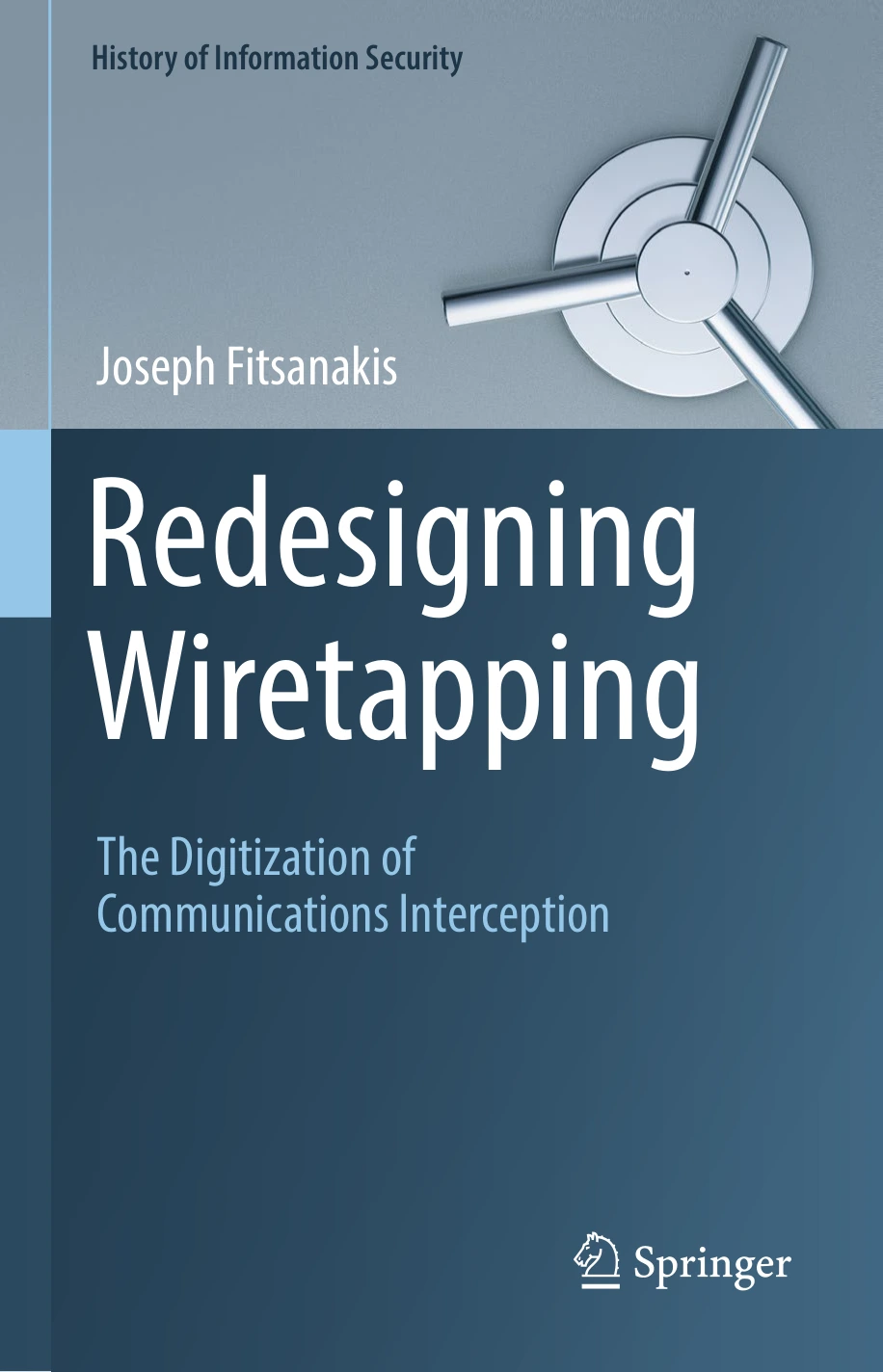
Redesigning Wiretapping: The Digitization of Communications Interception
Original price was: $5.00.$2.50Current price is: $2.50.

Joseph Fitsanakis
Product Specs:
- File Type: PDF
- File Size: 2.0 MB
- Book Language: English
- Total Page Count: 204
- Instant Download
When Wiretapping Had to Be Redesigned
By the 1990s, the telephone networks that law enforcement had learned to intercept were disappearing. Digital switching, wireless telephony, and deregulated telecommunications markets made traditional wiretapping increasingly difficult, and governments in the United States and the United Kingdom faced a question with profound consequences for privacy, security, and industry: how should lawful communications interception work in a digital environment?
Joseph Fitsanakis’s Redesigning Wiretapping is a detailed historical and political study of that question. It traces how two landmark laws—the U.S. Communications Assistance for Law Enforcement Act (CALEA) of 1994 and the British Regulation of Investigatory Powers Act (RIPA) of 2000—sought to preserve interception capabilities while telecommunications providers, regulators, security agencies, and civil liberties advocates negotiated the terms.
Two Countries, Two Laws, One Digital Problem
CALEA and RIPA were not simply technical fixes. They were responses to a broader sociotechnical shift: the digitization and deregulation of telecommunications after 1984. As networks changed, interception moved from hardwired taps and analog switching to complex arrangements involving service providers, standards bodies, and government mandates. Fitsanakis explores how those changes affected information security and, by extension, privacy.
Inside the Negotiation Room
The book draws on previously unpublished qualitative data, including government and industry reports and more than 40 in-depth interviews with people involved in the RIPA and CALEA negotiations. Their accounts illuminate the competing visions of national policy experts, government advisers, corporate decision-makers, and regulatory bodies. Rather than treating communications interception as a purely legal or technical subject, Fitsanakis shows how political actors, commercial interests, and bureaucratic imperatives shaped the outcome.
What the Book Explores
- The historical emergence of CALEA and RIPA and why both remain relevant
- The impact of digitization and deregulation on communications interception
- Techniques of analog and digital interception, from hardwired taps to switch-based solutions
- The roles of telecommunications service providers as guarantors and gatekeepers of interception access
- The relationship between information security, secrecy, surveillance, and accountability
- The transatlantic comparison between American and British approaches
A Scholarly History of Information Security
Published in Springer’s History of Information Security series, this monograph is aimed at readers who want a rigorous account of how security policy, telecommunications infrastructure, and state power intersect. It is suited to scholars and students in security studies, surveillance studies, intelligence history, and the history of technology, as well as policy professionals and researchers interested in the evolution of lawful interception.
Why It Still Matters
The debates that produced CALEA and RIPA did not end in the 1990s or 2000s. Questions about encryption, provider obligations, cross-border data, and the balance between investigative powers and privacy remain central to information security policy. Redesigning Wiretapping offers historical depth for understanding those contemporary arguments.
Digital Delights makes this Springer monograph available as a digital ebook for readers who need a careful, research-driven account of how communications interception was reshaped for the digital age.
User Reviews
Be the first to review “Redesigning Wiretapping: The Digitization of Communications Interception”
You must be logged in to post a review.
Original price was: $5.00.$2.50Current price is: $2.50.


There are no reviews yet.