

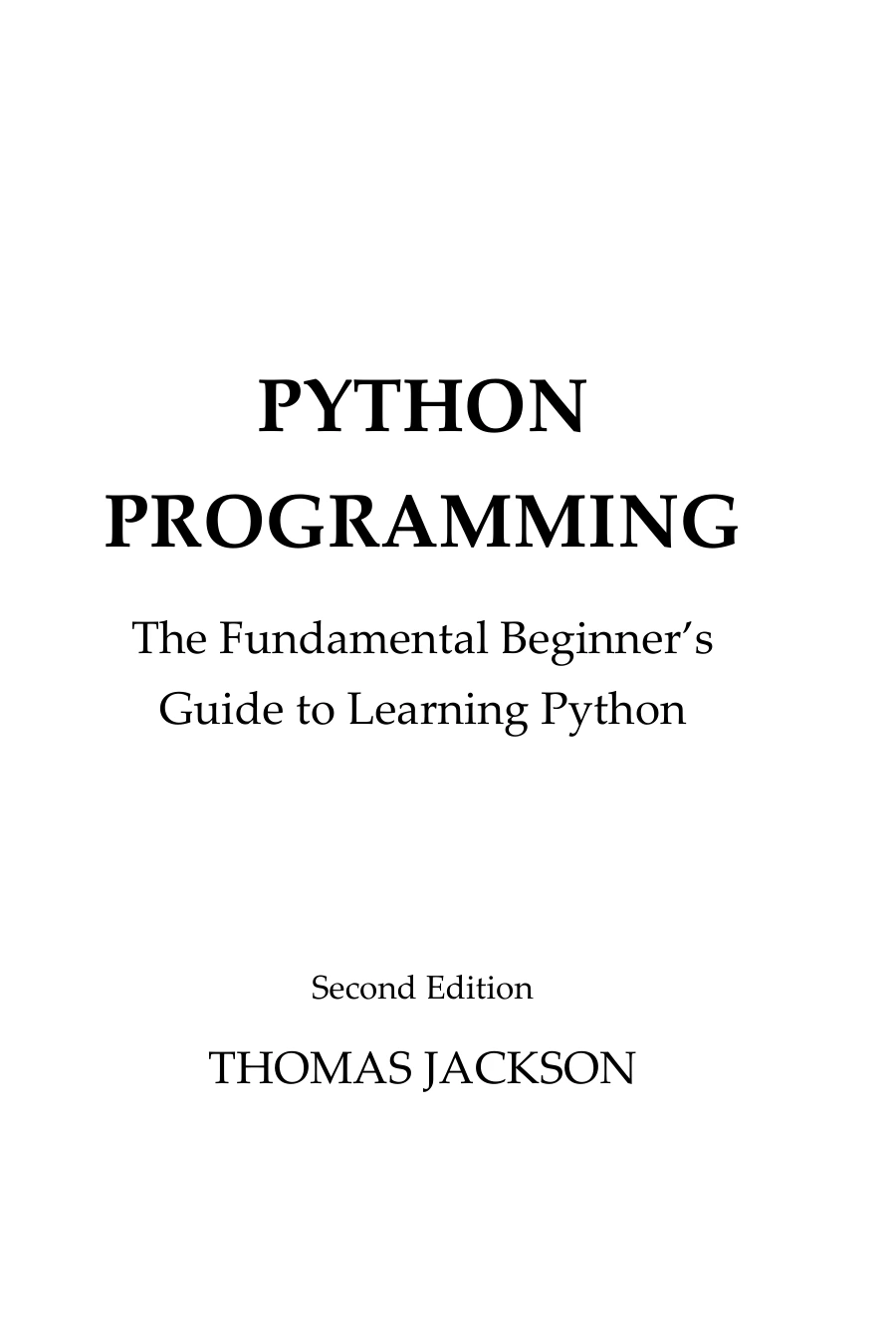
Python Programming: The Fundamental Beginner’s Guide to Learning Python
Original price was: $5.00.$2.50Current price is: $2.50.

Thomas Jackson
Product Specs:
- File Type: PDF
- File Size: 2.1 MB
- Book Language: English
- Total Page Count: 127
- Instant Download
Start Programming with Python 🐍
Python Programming: The Fundamental Beginner’s Guide to Learning Python, Second Edition is a hands-on introduction for people who have never written a program before. Thomas Jackson begins with the assumption that readers need a clear path from setup to first code, and the book builds steadily from there. The material is written for beginners, not for experienced developers looking for advanced architecture or production engineering topics.
From Installation to First Program 💻
The opening chapters cover what a new programmer needs before writing code: understanding Python’s features, downloading Python, choosing a text editor, installing PyCharm, and running a first program. That setup-focused start matters because beginners often lose momentum before they reach the language itself. Here, the environment is part of the lesson, not an obstacle left for the reader to solve alone.
Core Language Foundations
The book then moves through variables and data types, user input, and the major operator groups. Readers meet arithmetic, logical, comparison, assignment, identity, membership, and bitwise operators. Conditional statements are introduced with if-else and if-elif-else examples, followed by loops, break, and continue. These are the building blocks that turn isolated instructions into programs that can make decisions and repeat work.
Data Structures and Functions
Lists, tuples, dictionaries, and arrays each receive attention, with coverage of creating, accessing, slicing, changing, adding, removing, and iterating through elements. Functions follow: why they matter, how to declare them, how parameters work, returning results, default arguments, anonymous functions, lambda expressions, and variable scope. By connecting data structures with reusable functions, the material shows how Python programs become organized rather than repetitive.
Files, Classes, and Object-Oriented Programming 🧠
Later sections introduce writing to files and creating a new file, then move into object-oriented programming. Readers encounter fundamental OOP principles, attributes and methods, constructors, built-in class functions and attributes, and constructors with inheritance. These chapters give beginners an early look at how Python code can model real objects and relationships, preparing them for further study after the fundamentals are in place.
Who This Ebook Is For
This Second Edition is aimed at beginners and anyone who has not yet engaged seriously with programming. It assumes basic computer literacy and a willingness to learn, not previous coding experience. Students, self-taught learners, career changers, and hobbyists can use it as a structured first pass through Python. It does not promise to cover everything needed to work as a software engineer, but it does lay groundwork for building further technical skills.
A Clear Starting Point for Learning Python
Read in sequence, the book moves from installing tools to writing small programs, then to functions, files, and classes. The progression is deliberate, and the explanations stay focused on fundamentals. For readers who want a patient, beginner-oriented introduction to Python, this digital edition offers a practical place to begin.
User Reviews
Be the first to review “Python Programming: The Fundamental Beginner’s Guide to Learning Python”
You must be logged in to post a review.
Original price was: $5.00.$2.50Current price is: $2.50.
There are no reviews yet.