

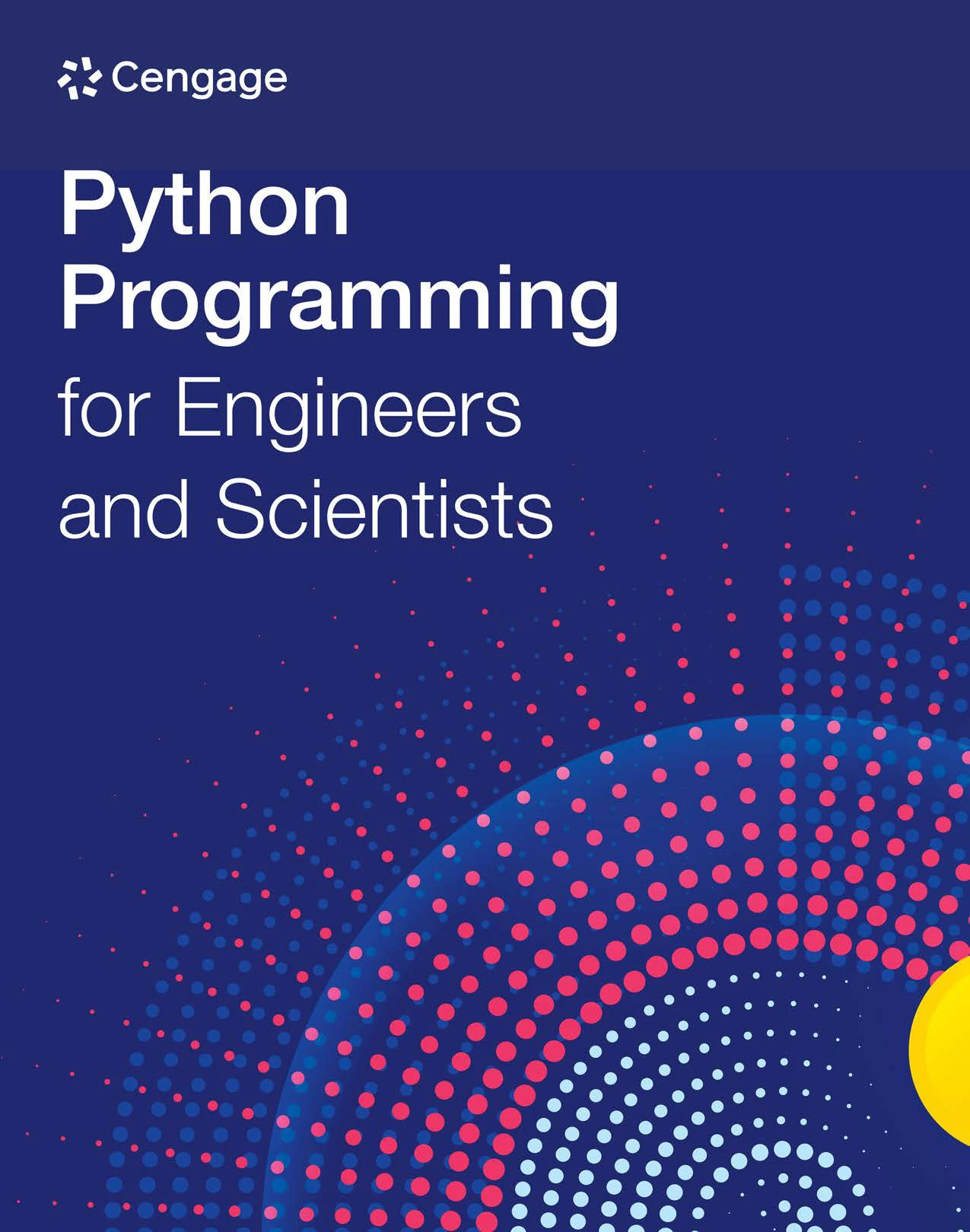
Python Programming for Engineers and Scientists
Original price was: $5.00.$2.50Current price is: $2.50.

Kenneth A. Lambert
Product Specs:
- File Type: PDF
- File Size: 11.1 MB
- Book Language: English
- Total Page Count: 530
- Instant Download
Python Skills for Technical Problem Solving 💻
Engineers and scientists often need a programming language that can move from quick calculations to full-scale data analysis, simulation, and automation. Python Programming for Engineers and Scientists is a Cengage Learning textbook that builds that capability from the ground up. Rather than treating Python as a list of isolated syntax rules, it develops a working understanding of how programs are designed, tested, and used in scientific and engineering contexts.
What the Book Covers
The book opens with the foundations of computer science and Python programming, then moves through software development, data types, expressions, loops, selection statements, strings, and text files. Later chapters explore lists, dictionaries, functions, recursion, simple graphics and image processing, graphical user interfaces, and object-oriented design with classes. The final chapters turn to data analysis and visualization, multithreading, networks, client/server programming, and the analysis of searching and sorting algorithms.
Appendices round out the coverage with Python resources, guidance on installing the images and breezypythongui libraries, an API for image processing, notes on transitioning from Python to Java and C++, and suggestions for further reading.
From Fundamentals to Real Applications 🐍
One of the book’s strengths is the way it links core programming ideas to practical technical work. Readers encounter recursion, higher-order functions, data modeling, and complexity analysis, but they also see Python applied to tasks such as image processing, graphical interfaces, and data visualization. That progression helps clarify not just how Python works, but where it can fit into engineering and scientific workflows.
Practice, Debugging, and Lab Work
Each chapter includes review questions, programming exercises, and debugging exercises, and many chapters add lab activities. These range from setting up an initial test code and building robot pseudocode to working with loops and branching logic, files and data management, palindrome checkers, string reversal, custom multiply functions, the Luhn algorithm, recursive custom multiply, turtle operations, and a collage maker. The result is a textbook that expects readers to write code, not just read about it.
Who Will Find It Useful 📚
This edition is aimed at engineering and science students, as well as professionals who want a structured introduction to Python for technical computing. It can support a formal course, independent study, or reference use for topics such as data structures, GUI programming, image processing, and algorithm analysis. Instructors may also value the chapter exercises and lab activities as ready-made teaching material.
Why This Cengage Edition Stands Out
Published by Cengage Learning with a 2025 copyright, this edition reflects a modern approach to Python instruction. It balances foundational computer science with applied examples that speak directly to engineers and scientists. If you want a single volume that starts with the basics and carries you through data analysis, networking, and complexity analysis, this book is designed for that journey.
Bring Python Into Your Technical Toolkit
Digital Delights is pleased to offer this digital edition for readers who want a rigorous, readable, and application-focused path into Python. Whether you are taking your first programming course or adding Python to an established technical skill set, this textbook provides a clear sequence of concepts, examples, and exercises to work through at your own pace.
User Reviews
Be the first to review “Python Programming for Engineers and Scientists”
You must be logged in to post a review.
Fundamentals of Python: Data Structures
Sold by Kenneth A. Lambert
Fundamentals of Python: First Programs, Third Edition
Sold by Kenneth A. Lambert Original price was: $5.00.$2.50Current price is: $2.50.




There are no reviews yet.