

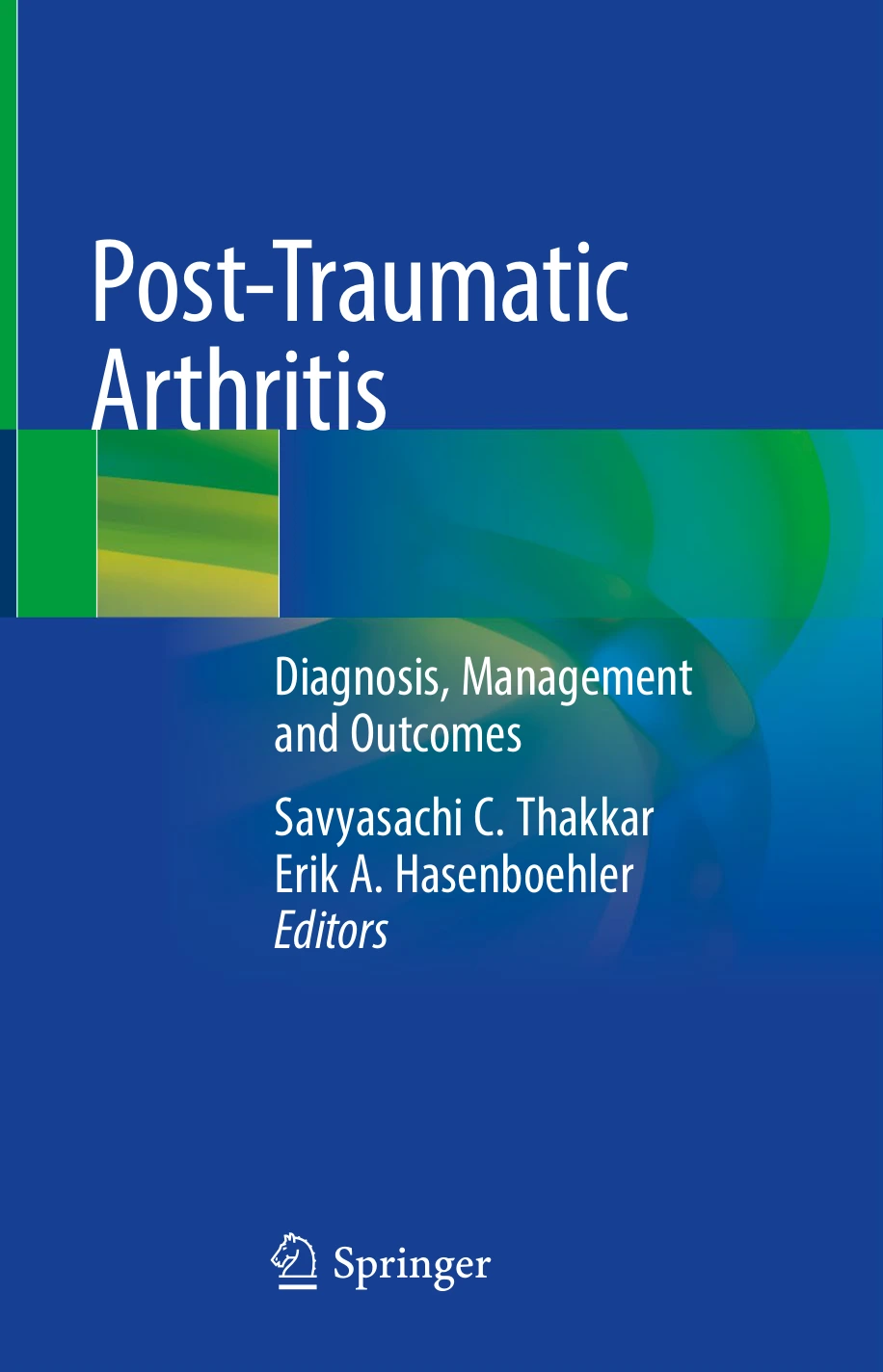
Post-Traumatic Arthritis: Diagnosis, Management and Outcomes
Original price was: $5.00.$2.50Current price is: $2.50.

Savyasachi C. Thakkar
Product Specs:
- File Type: PDF
- File Size: 10.3 MB
- Book Language: English
- Total Page Count: 223
- Instant Download
Post-Traumatic Arthritis: A Clinical Guide to an Unpredictable Joint Problem
Joint trauma does not end when the fracture heals or the ligament is reconstructed. Post-traumatic osteoarthritis (PTOA) can emerge later, with variable timing, severity, and complexity—and it remains one of the more difficult consequences to predict and manage. Post-Traumatic Arthritis: Diagnosis, Management and Outcomes brings together orthopaedic surgeons, radiologists, and basic science researchers to examine how PTOA develops and how clinicians can approach it from assessment through treatment planning and follow-up.
What the Book Covers
Edited by Savyasachi C. Thakkar and Erik A. Hasenboehler, this Springer reference is organized into two main clinical sections—upper extremity and lower extremity—while also addressing the broader foundations of the condition. Early chapters cover the basic science of cartilage degeneration after trauma, imaging modalities used to visualize and plan treatment for arthritic joints, and the economic impact of post-traumatic osteoarthritis.
The joint-specific chapters move through the shoulder, elbow, wrist, and hand, then the acetabulum, proximal femur, distal femur, proximal tibia, ankle, and foot. Each area is considered within the context of anatomic principles, timing of treatment, and the surgical and non-surgical decisions that shape outcomes.
From Basic Science to Surgical Planning
What makes post-traumatic arthritis challenging is not a single technique or procedure. It is the interplay of injury patterns, joint mechanics, biological response, and patient-specific factors. The book reflects that complexity by connecting the underlying science of cartilage degeneration with the practical realities of imaging, reconstruction, and long-term care. Readers can expect a framework for thinking through PTOA rather than a one-size-fits-all protocol.
Written for Orthopaedic Practice
The editors describe the book as written for general orthopaedic surgeons and subspecialty-trained orthopaedic surgeons in equal measure, as well as for orthopaedic surgeons in training who need a broad overview of the subject. The chapters are authored by contributors from orthopaedic surgery, radiology, and basic science, giving the text a multidisciplinary perspective on a condition that rarely fits neatly into one clinical silo.
Why This Reference Matters
As the incidence and prevalence of post-traumatic arthritis increase globally—driven by longer life expectancy, higher activity levels, and injuries—clinicians need clear guidance on how to assess and manage joints that may deteriorate unpredictably after trauma. This book addresses that need with a joint-by-joint approach, an emphasis on anatomic principles, and attention to the timing of treatment and subsequent care that can influence outcomes.
A Specialist Resource for Complex Joint Care
This is a focused medical reference for orthopaedic surgeons, residents, fellows, and clinicians involved in trauma and joint reconstruction. It is not a general-reader guide to arthritis. Instead, it offers a structured, evidence-informed look at diagnosis, management, and outcomes in post-traumatic arthritis, with the clinical depth expected from a Springer surgical text.
User Reviews
Be the first to review “Post-Traumatic Arthritis: Diagnosis, Management and Outcomes”
You must be logged in to post a review.
Original price was: $5.00.$2.50Current price is: $2.50.
There are no reviews yet.