

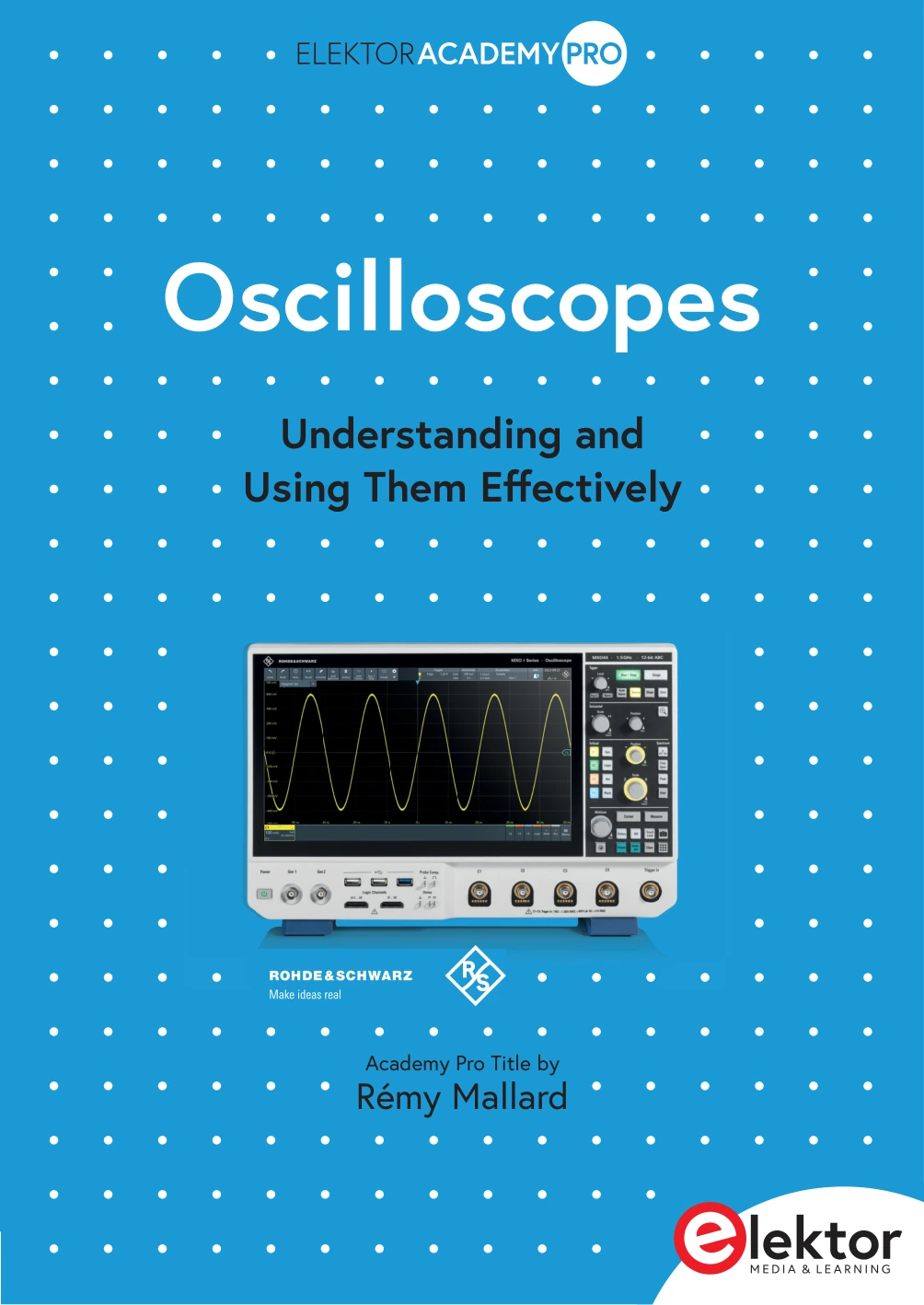
Oscilloscopes: Understanding and Using Them Effectively
Original price was: $5.00.$2.50Current price is: $2.50.

Rémy Mallard
Product Specs:
- File Type: PDF
- File Size: 67.1 MB
- Book Language: English
- Total Page Count: 328
- Instant Download
An oscilloscope can show you almost anything happening in a circuit—but only if you know how to set it up, trust the probe, and interpret what appears on screen. Oscilloscopes: Understanding and Using Them Effectively by Rémy Mallard is a practical Elektor guide to the instrument itself and to the measurements it makes possible. Instead of treating the scope as a magic box, the book builds a clear working understanding of what each control, specification, and connection actually does.
From First Trace to Confident Measurement ⚡
The opening chapters explain what an oscilloscope is and how analogue and digital scopes operate. You will meet the vertical and horizontal scales, bandwidth, sampling rate, resolution, memory depth, and refresh rate—the numbers that determine whether a scope can show a signal faithfully. From there, the book turns to probes: passive, active, differential, high-voltage, current, near-field, and contact types, along with the safety and frequency limits that shape real measurements.
Choosing, Setting Up, and Triggering
A scope only becomes useful once it is configured well. The book walks through choosing between analogue and digital instruments, laboratory and portable models, PC-based and tablet scopes, and specialist types such as DSO, MSO, DPO, and MDO. It then moves to the bench: initial setup, probe calibration, coupling modes, triggering, cursors, display modes, and the essential adjustments that make a trace stable and readable.
Measurements That Go Beyond the Basics 📊
Basic voltage and timing work is covered first, including constant and alternating voltages, DC offset, time intervals, periods, frequency, duty cycle, phase shift, and rise or fall times. Later chapters move into more demanding territory: mains and power-supply measurements, noise, XY displays and Lissajous figures, computed traces, and serial data decoding for I²C, SPI, and UART/RS-232. There is also material on spectral analysis, impedance, bandwidth, and jitter, giving readers a path from simple checks to advanced diagnosis.
Built for the Bench
This is not a theoretical survey. The book is structured around the questions that come up when an engineer, technician, student, or serious hobbyist sits down with a scope and a circuit. It explains not just which button to press, but why a setting matters and when a measurement may be misleading. Across its 328 pages, the emphasis stays on practical understanding: probes, grounding, triggering, decoding, and the habits that lead to repeatable results.
Who Will Benefit
- Electronics engineers and technicians who want more reliable scope measurements.
- Students learning instrumentation, signal analysis, and embedded debugging.
- Makers and hobbyists ready to move beyond basic meter readings.
- Anyone choosing an oscilloscope and trying to match specifications to real needs.
If you already own a scope but only use a fraction of its capability, or you are about to buy one and want to understand the specifications before you spend, this guide offers a structured way to build confidence. Digital Delights is pleased to offer it as an ebook for readers who want practical electronics knowledge close at hand.
User Reviews
Be the first to review “Oscilloscopes: Understanding and Using Them Effectively”
You must be logged in to post a review.
Original price was: $5.00.$2.50Current price is: $2.50.

There are no reviews yet.