

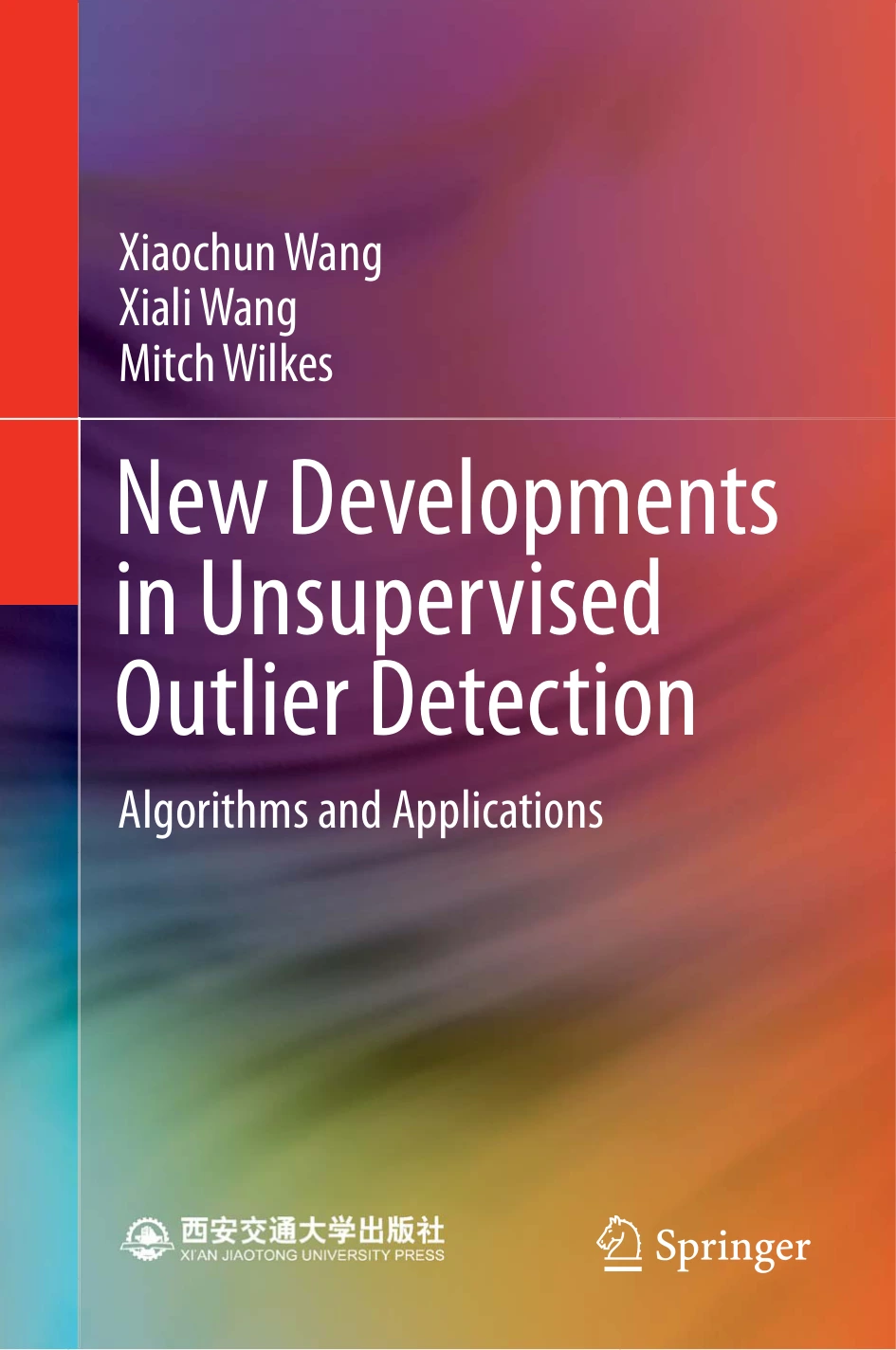
New Developments in Unsupervised Outlier Detection: Algorithms and Applications
Original price was: $5.00.$2.50Current price is: $2.50.

Xiaochun Wang
Product Specs:
- File Type: PDF
- File Size: 9.6 MB
- Book Language: English
- Total Page Count: 287
- Instant Download
A Focused Guide to Finding the Unusual in Data 🔍
Outlier detection sits at the intersection of statistics, machine learning, and practical data analysis. This monograph narrows in on the unsupervised side of the problem: how to surface anomalies when no labels are available to guide the search. Xiaochun Wang, Xiali Wang, and Mitch Wilkes bring together established ideas and recent algorithmic work, with particular attention to k-nearest neighbor-based methods and their limits.
The book does not treat outlier detection as a single trick. It examines how distance-based and density-based approaches define and rank unusual points, then explores ways to combine those perspectives with clustering algorithms. The result is a technical reference for readers who want to understand both the theory behind outlier scores and the design choices that make an algorithm workable on real datasets.
Inside the Monograph
The material is organized into three parts, moving from research context to new methods and then to application.
- Part I — Introduction and research landscape: Chapter 1 frames the research issues and contributions, while Chapter 2 reviews standard unsupervised outlier detection techniques, including probabilistic, clustering-based, distance-based, density-based, and time-series approaches, along with evaluation metrics such as precision, recall, and rank power.
- Part II — New algorithmic developments: Five chapters present recent methods, including a divisive hierarchical clustering algorithm for fast distance-based detection, a k-nearest neighbor centroid-based method for distance and density tasks, a minimum spanning tree-inspired algorithm, a spectral clustering-based approach, and an outlier indicator designed to make parameter selection more meaningful.
- Part III — Applications: The final chapters show how these ideas can be applied to boundary point detection, novel object detection, and fraud detection in environmental time series data.
New Algorithms for Distance and Density Outliers 💻
Distance-based methods tend to identify more globally oriented outliers, while density-based methods capture locally distributed ones. This book proposes new global and local outlier factors and builds efficient algorithms around them. A recurring concern is the sensitivity of k-nearest neighbor methods to the value of k, as well as the difficulty of ranking top outliers consistently. By connecting k-nearest neighbor ideas with genetic clustering and other clustering approaches, the authors aim for methods that are easier to implement and competitive with existing solutions.
Chapters on spectral clustering, minimum spanning trees, and centroid-based detection show how different mathematical structures can be used to compute outlier scores from multi-dimensional data. The outlier indicator approach is especially notable for treating parameter selection as part of the detection problem rather than an afterthought.
From Boundary Points to Fraud Detection 📊
The application chapters extend the algorithms into practical settings. Boundary point detection considers points that sit between normal and abnormal regions. Novel object detection asks whether previously unseen patterns form new dense clusters in feature or image space. The time-series chapter addresses fraud detection in environmental data, where unexpected events and structural changes can be difficult to separate from ordinary variation. Together, these applications show the range of problems that unsupervised outlier detection can address.
Who Will Find It Useful
The book is written for readers with a solid foundation in mathematics, statistics, and computer science. It is intended to serve as an introductory text for advanced undergraduate or graduate courses, and as a reference for researchers and professionals working in data mining, machine learning, and related fields. Those already familiar with standard outlier detection will find the newer algorithmic chapters particularly relevant, while readers new to the area can use the opening review as a structured entry point.
Why This Research Matters
As datasets grow larger and more complex, the ability to identify unusual observations without predefined labels becomes increasingly valuable. Outliers can signal fraud, faults, novel phenomena, or data quality issues. By focusing on unsupervised methods, this monograph addresses a setting that is common in practice but often challenging in theory. The authors’ emphasis on bridging k-nearest neighbor-based detection and clustering-based detection gives readers a coherent view of where the field has been and where it may go next.
An Invitation to Explore the Field
For course preparation, data mining research, or algorithmic work in industry, this monograph provides a detailed and technically grounded treatment of unsupervised outlier detection. It is a specialized resource, but one that rewards careful reading with a deeper understanding of how anomalous patterns can be found, scored, and applied.
User Reviews
Be the first to review “New Developments in Unsupervised Outlier Detection: Algorithms and Applications”
You must be logged in to post a review.
Original price was: $5.00.$2.50Current price is: $2.50.





There are no reviews yet.