

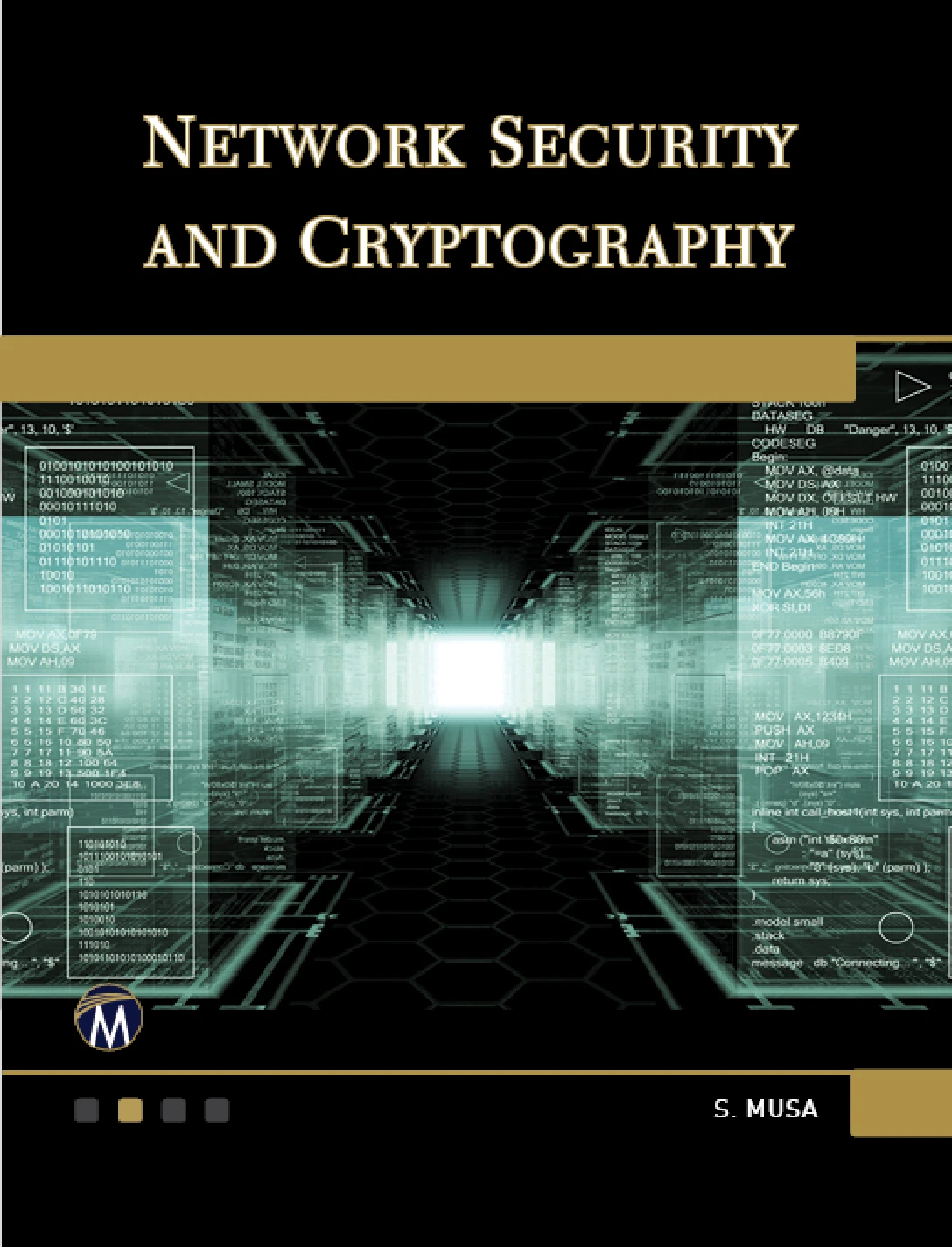
Network Security and Cryptography: A Self-Teaching Introduction
Original price was: $5.00.$2.50Current price is: $2.50.

Sarhan M. Musa
Product Specs:
- File Type: PDF
- File Size: 13.3 MB
- Book Language: English
- Total Page Count: 581
- Instant Download
A Ground-Up Introduction to Secure Communication
Network Security and Cryptography: A Self-Teaching Introduction is designed for readers who want to understand how data moves across networks and how it is protected. It starts with the architecture of computer networks, then builds the mathematical background needed to reason about traffic, reliability, and risk, before moving into cryptographic systems and the number theory that supports them. The result is a path from networking fundamentals to the foundations of modern encryption.
Start with How Networks Actually Work 💻
The opening chapters cover the OSI model, TCP/IP, network equipment, network types, and topology. These are the basic structures that make network security meaningful: before you can protect a system, you need to understand how its components communicate and where vulnerabilities can appear.
The Mathematics Behind Network Behavior
A substantial section introduces probability, distributions, random processes, and queueing models. Topics include Bernoulli, binomial, geometric, Poisson, uniform, exponential, Erlang, hyperexponential, and Gaussian distributions, along with Markov processes and several queueing systems. This material gives readers a quantitative lens for network performance and reliability rather than treating networking as only a hardware-and-protocol subject.
Cryptography as a System, Not Just Ciphers 🔐
The cryptography chapters explain basic terms, cryptographic primitives and protocols, encryption and decryption, and the requirements of secure communication. The text also examines the OSI security architecture X.800, including security attacks, services, and mechanisms. Symmetric encryption and conventional encryption models are introduced alongside the types of attacks those systems must withstand.
Number Theory for Encryption 🧮
To support the cryptography material, the book develops mathematical foundations such as groups, rings, fields, modular arithmetic, residue classes, primes and co-primes, Euclid’s algorithm for greatest common divisors, and the extended Euclidean algorithm. These concepts are central to understanding how many encryption schemes are constructed and why they work.
Who This Book Is For
Students taking introductory courses in networking, cybersecurity, or cryptography will find a structured presentation that connects theory to practical systems. Self-learners and professionals who need a solid conceptual base in network security and cryptography can also use the book as a guided starting point. The self-teaching format is intended to make the material approachable without oversimplifying the underlying mathematics.
Why the Subject Matters
Networks carry financial transactions, private messages, medical records, and industrial control signals. Cryptography helps protect that data, while network security addresses the systems and protocols around it. Understanding both sides—how networks operate and how encryption secures them—provides a stronger foundation for further study and for making better security decisions.
Digital Delights is pleased to offer this ebook for readers who want a serious but accessible introduction to the field.
User Reviews
Be the first to review “Network Security and Cryptography: A Self-Teaching Introduction”
You must be logged in to post a review.
Original price was: $5.00.$2.50Current price is: $2.50.





There are no reviews yet.