

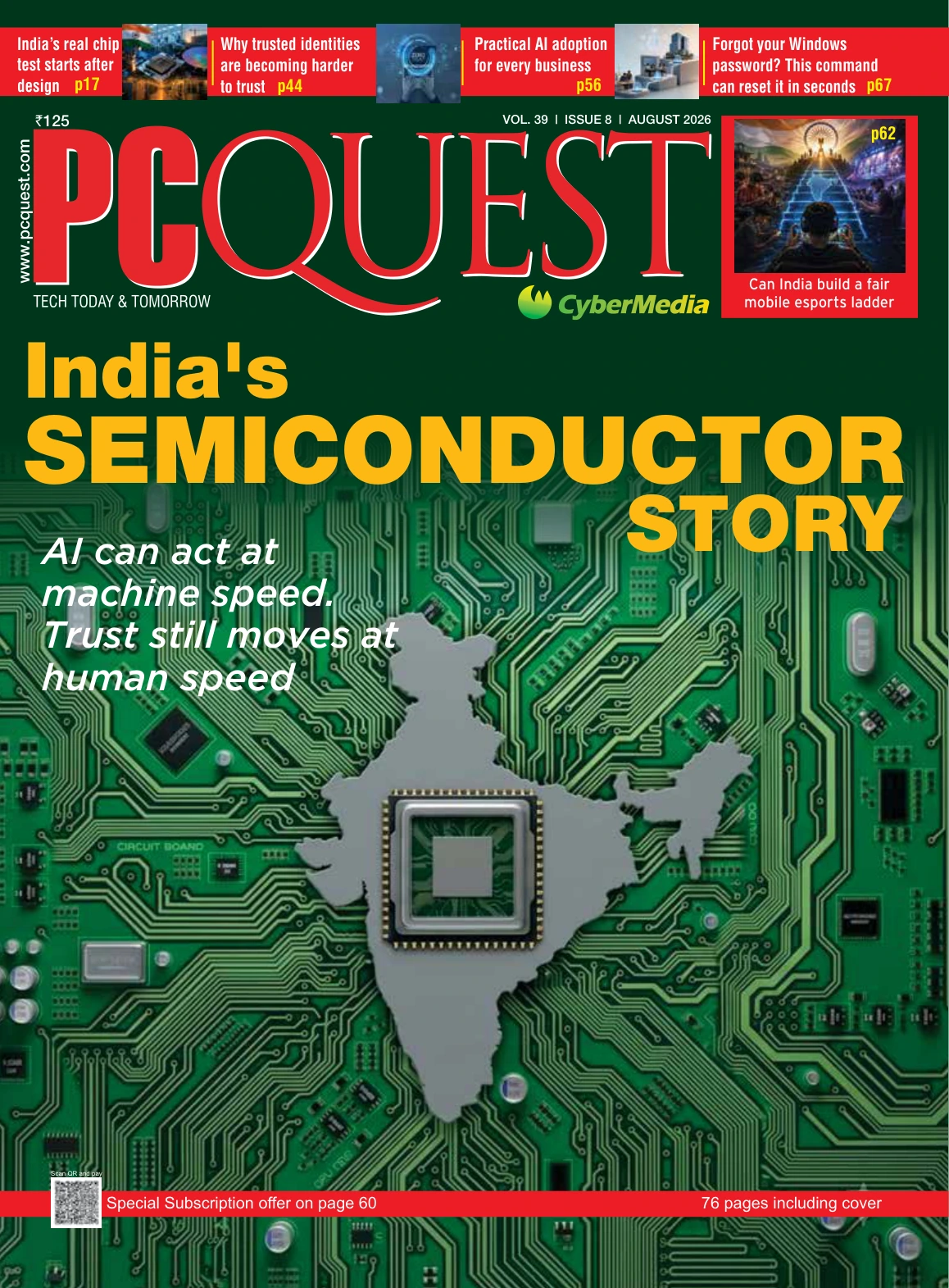
PCQuest – August 2026 (Vol. 39, Issue 8)
Original price was: $5.00.$2.50Current price is: $2.50.

Ashok Kumar Pandey
Product Specs:
- File Type: PDF
- File Size: 4.3 MB
- Book Language: English
- Total Page Count: 76
- Instant Download
The Chip Story Behind Everything Else
Every phone, vehicle and data centre depends on the same material, and PCQuest’s August 2026 issue opens with the uncomfortable follow-up: that material is running out of room. The cover story treats silicon as a subject in its own right rather than a policy slogan — what it is, why it behaves unlike either a conductor or an insulator, and how engineers turn it into billions of microscopic switches that have now shrunk to only a few atoms across.
From Wafer to Working Logic ⚙️
A six-step manufacturing cycle anchors the reporting: high-purity silicon grown and sliced into wafers, coated with photoresist, exposed to extreme ultraviolet light at a 13.5 nm wavelength, developed, etched, and doped — then repeated until full layers of logic and interconnects are built. The issue is equally clear about where physics pushes back. Electrons tunnel through barriers that are supposed to block them, heat density climbs as transistors are packed closer together, and techniques such as dark silicon leave parts of a chip deliberately inactive to keep temperatures under control. Moore’s Law gets an honest reading too: an observation made in 1965, not a law of nature.
Beyond the First Fab: India’s Semiconductor Question
The issue’s semiconductor coverage extends past the milestone moment. One article makes the case that India’s first chips are only the beginning, while another argues that the real test starts after design — in testing, validation and the unglamorous engineering that decides whether a chip is genuinely manufacturable. A third piece looks at what it takes to build an ecosystem around first silicon rather than a single celebrated facility.
Security at Machine Speed 🔐
The editorial takes on ransomware that now automates reconnaissance, credential theft and evasion, and asks whether security operations centres can respond quickly enough. Its answer is architectural rather than additive: AI-native SOCs that combine telemetry across endpoints, identities and networks, contextual reasoning against frameworks such as MITRE ATT&CK, and automated or escalated response. Governance gets attention as well, including model poisoning risks, human oversight for high-stakes decisions, and alignment with CERT-In reporting and the Digital Personal Data Protection Act.
Two further articles follow the same thread: why trusted identities are becoming harder to trust as verification spreads across more of daily life, and whether enterprises can secure code that AI now writes faster than humans review it. A separate feature on practical AI adoption stays with deployment decisions — what a business actually gains, and where the effort belongs — rather than demonstrations.
Phones, Esports and a Password You Forgot
On the consumer side, the issue examines why an AI phone needs more than a TOPS figure to be worth buying, and asks whether India can build a fair mobile esports ladder for players competing on phones rather than PCs. The How-To section is a short, practical one: the command that resets a forgotten Windows password in seconds.
Hands-On Reviews in This Issue
- Acer Aspire 5 A514 54H — a mainstream laptop put through its paces
- Intex Roar 1000 — budget audio tested
- EvoFox Ronin X75 — gaming peripheral on the bench
- UBON Series SP-220 Speaker Karaoke — party audio, assessed
- ViewSonic Projector M1 Max — portable projection reviewed
Who Gets the Most From This Issue
IT decision-makers and security teams will find the SOC and identity coverage directly relevant. Developers, engineering students and anyone following India’s chip ambitions get a readable technical grounding in how semiconductors are actually made and where the limits sit. Buyers weighing a laptop, speaker, peripheral or projector get tested opinions rather than spec sheets, and the How-To page earns its place for anyone who has ever locked themselves out of a Windows machine.
This 76-page issue of PCQuest covers a lot of ground without losing the thread: the physical constraints of computing, the security consequences of speed, and the everyday gadgets that carry both. Available as a digital edition from Digital Delights.
User Reviews
Be the first to review “PCQuest – August 2026 (Vol. 39, Issue 8)”
You must be logged in to post a review.
Original price was: $5.00.$2.50Current price is: $2.50.






There are no reviews yet.