

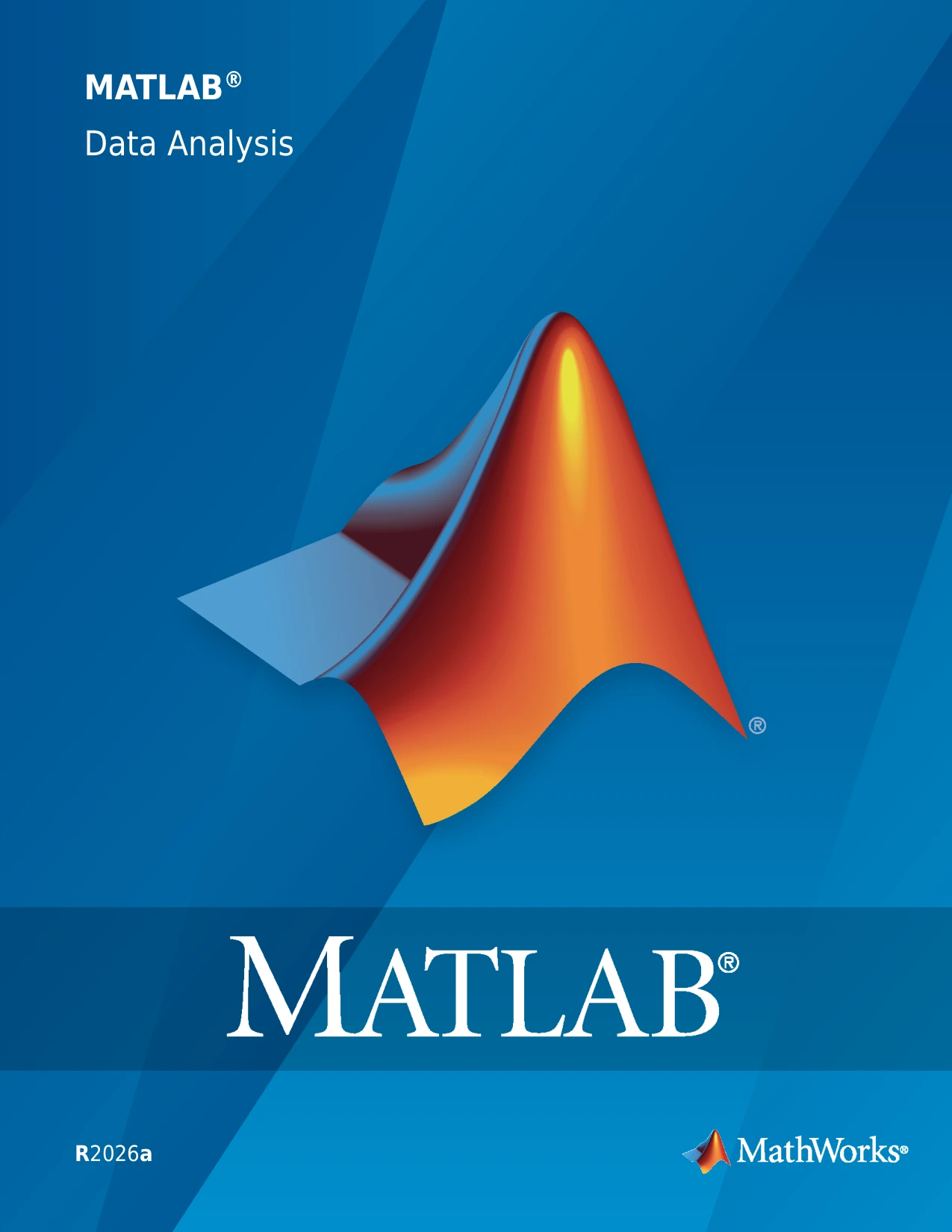
MATLAB Data Analysis (R2026a)
Original price was: $5.00.$2.50Current price is: $2.50.

The MathWorks
Product Specs:
- File Type: PDF
- File Size: 2.3 MB
- Book Language: English
- Total Page Count: 156
- Instant Download
Official MathWorks Documentation for Data Analysis in MATLAB 💻
This is the MathWorks manual that ships alongside MATLAB R2026a (Version 26.1). It is reference documentation rather than a narrative textbook, and that is precisely its value: when you need to know how a specific analysis task is meant to be done in the current release, the answer is here, written by the people who build the software.
At 156 pages, it stays focused. There is no filler about the history of computing, no padding — just a working description of the tools MATLAB provides for getting from a raw dataset to a result you can defend.
Where the Manual Begins: Getting Data In and Making Sense of It 📊
The opening chapter deals with the unglamorous part of analysis that consumes most of the actual time. Importing data into the workspace and exporting it again. Loading and plotting a text file. Removing linear trends from timetable data. Finding and handling missing values properly, rather than letting them quietly distort a mean.
From there the material moves into smoothing and outlier detection, summarising or pivoting tables by groups, and cleaning messy data with Live Editor tasks. Filtering gets its own attention, including difference equations, a moving-average filter applied to traffic data, and amplitude modification. Convolution-based smoothing, correlation between variables, and basic statistics plotted directly on a 2-D chart round out the section, with descriptive statistics such as mean and median shown alongside global, moving, and cumulative comparisons.
Regression Analysis Without the Guesswork
The regression chapter builds a coherent path rather than presenting a menu. It starts with correlation coefficients, then linear regression with a single predictor variable, then models that include nonpolynomial terms, then multiple predictors. Interactive fitting is shown alongside the programmatic approach, so you can see both the exploratory route and the reproducible one. The programmatic portion covers the MATLAB functions for polynomial models, linear models with nonpolynomial terms, multiple regression, and the fitting workflow in code form.
Time Series and Structured Experimentation ⚙️
Time series work is introduced through time series objects and collections, giving you a structured container for sequential data instead of a loose array of numbers.
The Experiment Manager chapter is substantial and unusually practical. It documents keyboard shortcuts for navigation, the experiment browser, and the results table, then moves into running experiments in parallel — multiple simultaneous trials, a single trial spread across multiple workers, and setting up the parallel environment. Offloading experiments as batch jobs to a cluster is covered step by step, including creating the job and tracking its progress. Debugging general-purpose experiments gets its own treatment.
Several worked examples tie the tooling to real problems: predator-prey equations, comparing air-resistance models for projectile motion, converting existing MATLAB code into an experiment, exploring parameters with a simple computational experiment, visualising results with plots, using an initialisation function to improve performance, and configuring an experiment to solve ordinary differential equations.
Who Gets the Most From This Documentation 💡
This is a reference for people already working in MATLAB — engineers, researchers, analysts, and students — who want current, version-accurate guidance rather than a beginner’s tour. If your work involves cleaning measurement data, fitting models, or running parameter sweeps, the chapters map closely onto what you actually do. Readers who prefer learning by example will appreciate that nearly every concept is demonstrated with a concrete task.
About the R2026a Release
This revision corresponds to MATLAB R2026a, released March 2026. The manual has been maintained continuously since its first online edition in September 2005 (MATLAB 7.1, Release 14SP3) and revised with each subsequent release — a long editorial track record that shows in the precision of the writing and the consistency of the terminology. Published by The MathWorks, Inc. of Natick, Massachusetts.
Available as a digital edition from Digital Delights for readers who want the documentation in a convenient, self-contained form.
User Reviews
Be the first to review “MATLAB Data Analysis (R2026a)”
You must be logged in to post a review.
Simulink Test User’s Guide
Sold by The MathWorks
Partial Differential Equation Toolbox User’s Guide (R2025a)
Sold by The MathWorks
Symbolic Math Toolbox User’s Guide R2025a
Sold by The MathWorks Original price was: $5.00.$2.50Current price is: $2.50.




There are no reviews yet.