

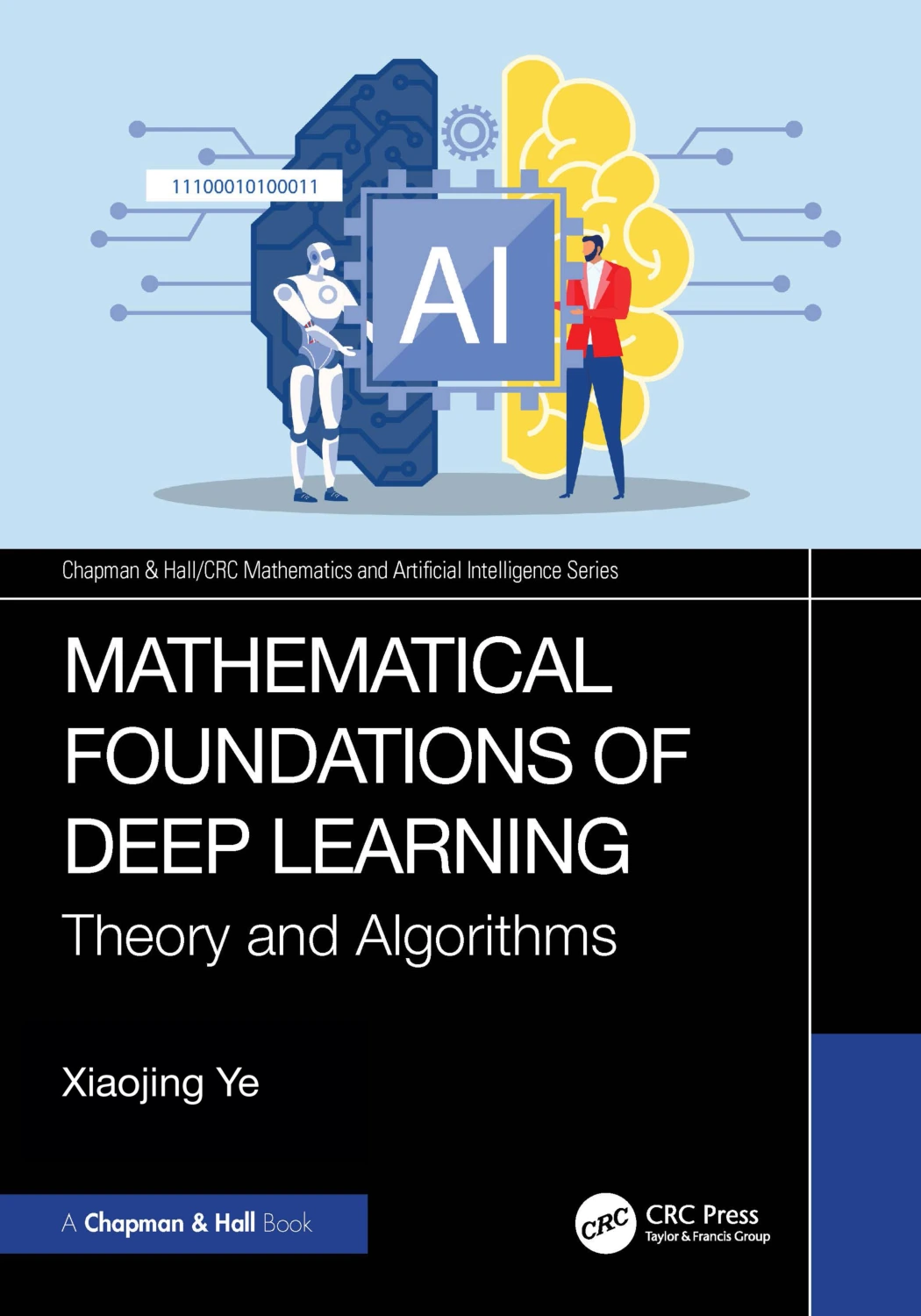
Mathematical Foundations of Deep Learning: Theory and Algorithms
Original price was: $5.00.$2.50Current price is: $2.50.

Xiaojing Ye
Product Specs:
- File Type: PDF
- File Size: 6.8 MB
- Book Language: English
- Total Page Count: 285
- Instant Download
A Rigorous Mathematical Companion to Modern Deep Learning
Deep learning changes quickly, but its foundations rest on durable mathematical ideas. This book gives those ideas the space they deserve. It builds a careful path from function approximation to network training, then extends into optimal control, reinforcement learning, and the generative models behind many of today’s AI advances.
What the Book Covers
The chapters are organized around core theoretical pillars rather than software recipes:
- Deep Neural Networks: function approximation, shallow and deep architectures, the universal approximation theorem and its proof, activation functions, network blocks, and architecture design.
- Network Training: optimality conditions, automatic differentiation, deterministic optimization, and stochastic optimization algorithms.
- Deep Optimal Control: Euler–Lagrange equations, Hamiltonian dynamics, Pontryagin maximum principle, Hamilton–Jacobi–Bellman equations, probability density control, and neural ODE methods.
- Deep Reinforcement Learning: Markov decision processes, Bellman operators, policy optimality, and model-based and model-free algorithms.
- Generative Models: variational autoencoders, generative adversarial networks, diffusion models, probability density control, and flow matching.
From Theory to Algorithms
Mathematical foundations are not treated as background decoration. Proofs, optimality conditions, and algorithmic frameworks appear throughout, showing how theoretical results connect to practical training and decision-making methods. Supplementary material covers Monte Carlo integration, Banach space and fixed-point theory, information theory, and stochastic differential equations.
Who Will Find It Useful
Graduate students and advanced undergraduates in mathematics, computer science, statistics, and engineering will find a structure suitable for a full-semester course. Researchers, scientists, and engineers working with modern AI systems will also find a principled reference for analyzing models, training procedures, and generative methods with mathematical rigor.
Why the Mathematical View Matters
When neural networks are understood through approximation theory, optimization, control, and probability, their behavior becomes easier to reason about, compare, and improve. This book is for readers who want that deeper layer of understanding—not just a working model, but the mathematical reasoning that explains why it works and where its limits lie.
A Focused Reference for AI Theory
Concise, precise, and proof-oriented, this volume belongs on the shelf of anyone who needs the mathematical language behind deep learning. It is especially valuable for those who want to move between theory and algorithm design without losing rigor along the way.
User Reviews
Be the first to review “Mathematical Foundations of Deep Learning: Theory and Algorithms”
You must be logged in to post a review.
Original price was: $5.00.$2.50Current price is: $2.50.

There are no reviews yet.