

Mathematics for Computer Graphics and Game Programming: A Self-Teaching Introduction
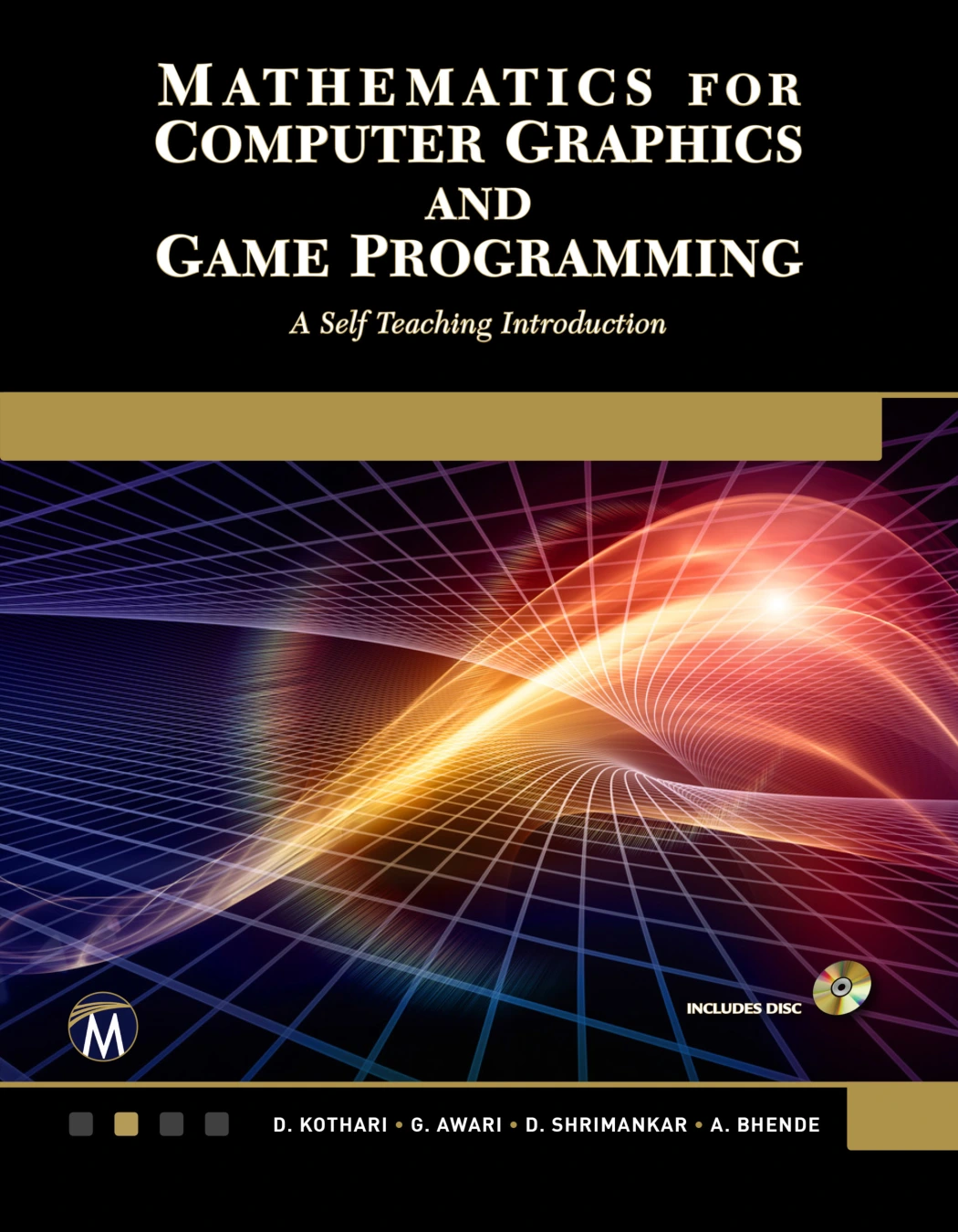
Original price was: $5.00.$2.50Current price is: $2.50.

D. P. Kothari
Product Specs:
- File Type: PDF
- File Size: 15.3 MB
- Book Language: English
- Total Page Count: 413
- Instant Download
Where the Numbers Behind the Picture Come From 💻
Every rendered frame, every smoothly rotating character model, every perfectly clipped polygon rests on mathematics that most people never see. Mathematics for Computer Graphics and Game Programming is written for readers who want to understand that layer instead of treating it as a black box. Subtitled A Self-Teaching Introduction, it assumes you are willing to work through derivations and algorithms rather than skim past them — and it rewards that effort chapter by chapter.
The book comes from four authors with doctoral credentials in the field — D. P. Kothari, G. K. Awari, D. D. Shrimankar, and A. R. Bhende — and was published by Mercury Learning and Information in 2019, revised and reprinted from the earlier Computer Graphics in Mathematical Approaches.
From Screen Hardware to Vector Geometry ⚙️
The opening chapter grounds the subject in physical reality: what computer graphics actually is, how CAD fits into the picture, how cathode ray tubes and deflection mechanisms generate images, how refresh rates and laser printers shape what we see, and where graphical user interfaces enter the story. It is a useful orientation before the mathematics begins in earnest.
Chapter 2 then introduces the vector representation of geometric entities — line generation via the equation of a line, the DDA algorithm, Bresenham’s line, midpoint circle, and midpoint ellipse algorithms, plus arc generation through trigonometric functions. These are the classic primitives that show up again and again in interviews, coursework, and real rasterization code.
Transformations, Curves, and Surfaces in Depth
Two full chapters are devoted to transformation mathematics. The 2D chapter covers scaling, rotation, translation, the need for homogeneous coordinates, reflection, shear, and inverse transformations. The 3D chapter extends all of this to three dimensions and goes further, deriving rotation about an arbitrary line and reflection about an arbitrary plane in 3D space — the kind of material that separates a surface-level tutorial from a genuine reference.
Parametric geometry receives equally careful treatment. Planar curves (circle, ellipse, parabola, hyperbola) lead into space curves: cubic splines, B-splines, Bézier curves, and non-uniform rational B-splines with their control points. From there, surfaces of revolution, sweep surfaces, and helical springs complete the geometric toolkit.
Windowing, Clipping, and Building 3D Models
Chapter 8 explains why windowing and clipping matter and walks through viewing transformation, the Cohen-Sutherland subdivision line clipping algorithm, midpoint subdivision, polygon clipping with Sutherland-Hodgman, 3D clipping, and character clipping. The comparison between the two line-clipping approaches is a genuinely practical piece of analysis.
Chapter 9 approaches model generation from the other direction, comparing wireframe, surface, and solid modeling, covering constructive solid geometry, boundary representation, and sweeping, and closing with rendering techniques including scanline, ray trace, and radiosity. Projections — perspective versus parallel — round out the theoretical portion.
Putting It to Work with C and OpenGL 💡
Theory turns into running code in the final third of the book. Ten graphics programs in C demonstrate the algorithms in action, and two OpenGL chapters introduce graphical functions, window creation, drawing primitives, coordinate systems, viewports, mouse and keyboard interaction, affine transformations, and the design of Bézier curves and B-spline basis functions. For readers who learn by compiling and modifying, this is where the book earns its keep.
Who Will Get the Most From This Book
Each chapter closes with exercises and objective questions, with answers provided, which makes the volume unusually self-contained. It suits undergraduate computer science and engineering students taking a graphics or game mathematics course, developers who want a firmer theoretical base before moving into engines or shaders, and self-taught programmers comfortable with C who prefer a structured, derivation-led route through the subject. A working grasp of algebra, trigonometry, and basic calculus will help, though the explanations build gradually.
If you would rather understand why Bresenham’s algorithm steps the way it does than simply call a library function, this is the kind of book that pays that curiosity back. 📚
User Reviews
Be the first to review “Mathematics for Computer Graphics and Game Programming: A Self-Teaching Introduction”
You must be logged in to post a review.
Original price was: $5.00.$2.50Current price is: $2.50.




There are no reviews yet.