

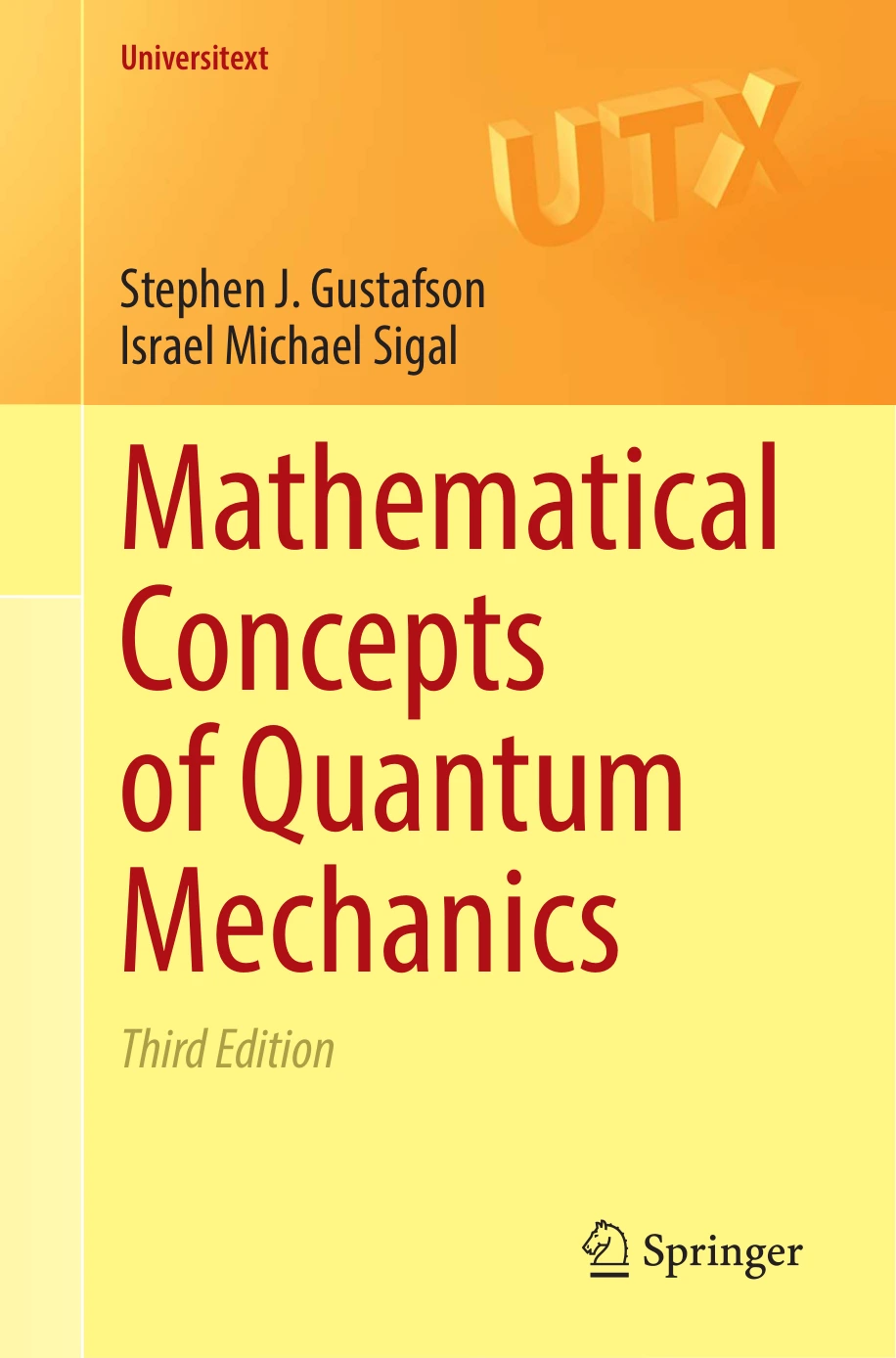
Mathematical Concepts of Quantum Mechanics, Third Edition
Original price was: $5.00.$2.50Current price is: $2.50.

Stephen J. Gustafson
Product Specs:
- File Type: PDF
- File Size: 6.1 MB
- Book Language: English
- Total Page Count: 453
- Instant Download
A Mathematical Approach to Quantum Mechanics
Stephen J. Gustafson and Israel Michael Sigal’s Mathematical Concepts of Quantum Mechanics offers a detailed bridge between the physical ideas of quantum theory and the mathematical structures that support them. This third edition, published in Springer’s Universitext series, expands the elementary material to make the book more self-contained while adding intermediate-level topics tied to recent developments. It is written for readers who want to understand not only what quantum mechanics predicts, but how its central concepts are formulated and analyzed.
From Foundations to Advanced Topics
The book moves through three broad levels of difficulty. The early chapters introduce the physical background, the Schrödinger equation, operators, observables, conservation laws, and many-particle systems. The middle chapters develop more advanced methods, and the later chapters reach subjects such as radiation, quantum electrodynamics, and quantum field theory. The preface identifies the first eleven chapters as elementary, Chapters 13-18 as intermediate, and Chapters 20-24 as advanced, giving instructors and independent readers a flexible path through the material.
New in the Third Edition
This edition adds substantial new material. It includes sections on the time-dependent Born-Oppenheimer approximation, adiabatic theory, geometrical phases, the Aharonov-Bohm effect, and density functional theory. A separate chapter on quantum open systems develops concepts that lie at the heart of quantum information theory. These additions connect the book to active areas of research while preserving its focus on fundamental mathematical ideas.
What the Book Covers
- The double-slit experiment and the physical background of quantum theory
- The Schrödinger equation, dynamics, and the free propagator
- Position and momentum operators, general observables, and the Heisenberg representation
- Conservation laws, conserved currents, and many-particle systems
- Identical particles, quantization, and the correspondence principle
- Adiabatic theory, geometrical phases, and the Born-Oppenheimer approximation
- Quantum open systems and concepts from quantum information theory
- Advanced topics in radiation, quantum electrodynamics, and field theory
Who This Text Is For
The authors note that the book can serve senior undergraduate and graduate courses in both mathematics and physics departments. Prerequisites are introductory real and complex analysis and elementary differential equations; familiarity with Lebesgue integration is helpful, though the text explains that readers may initially treat Lebesgue integrals like Riemann integrals. The presentation is not leisurely, especially in the later chapters, but it aims to keep the mathematical level as elementary as possible.
Why It Remains Useful
Rather than separating physics from its mathematical underpinnings, this book shows how operator theory, probability, differential equations, and differential geometry interact in quantum mechanics. It also flags where an argument is an established result and where it depends on a conjecture, which makes it valuable for students learning to read mathematical physics carefully. For readers who need a rigorous yet adaptable guide to the mathematical foundations of quantum theory, this third edition offers both a broad course text and a reference for deeper study.
User Reviews
Be the first to review “Mathematical Concepts of Quantum Mechanics, Third Edition”
You must be logged in to post a review.
Original price was: $5.00.$2.50Current price is: $2.50.

There are no reviews yet.