

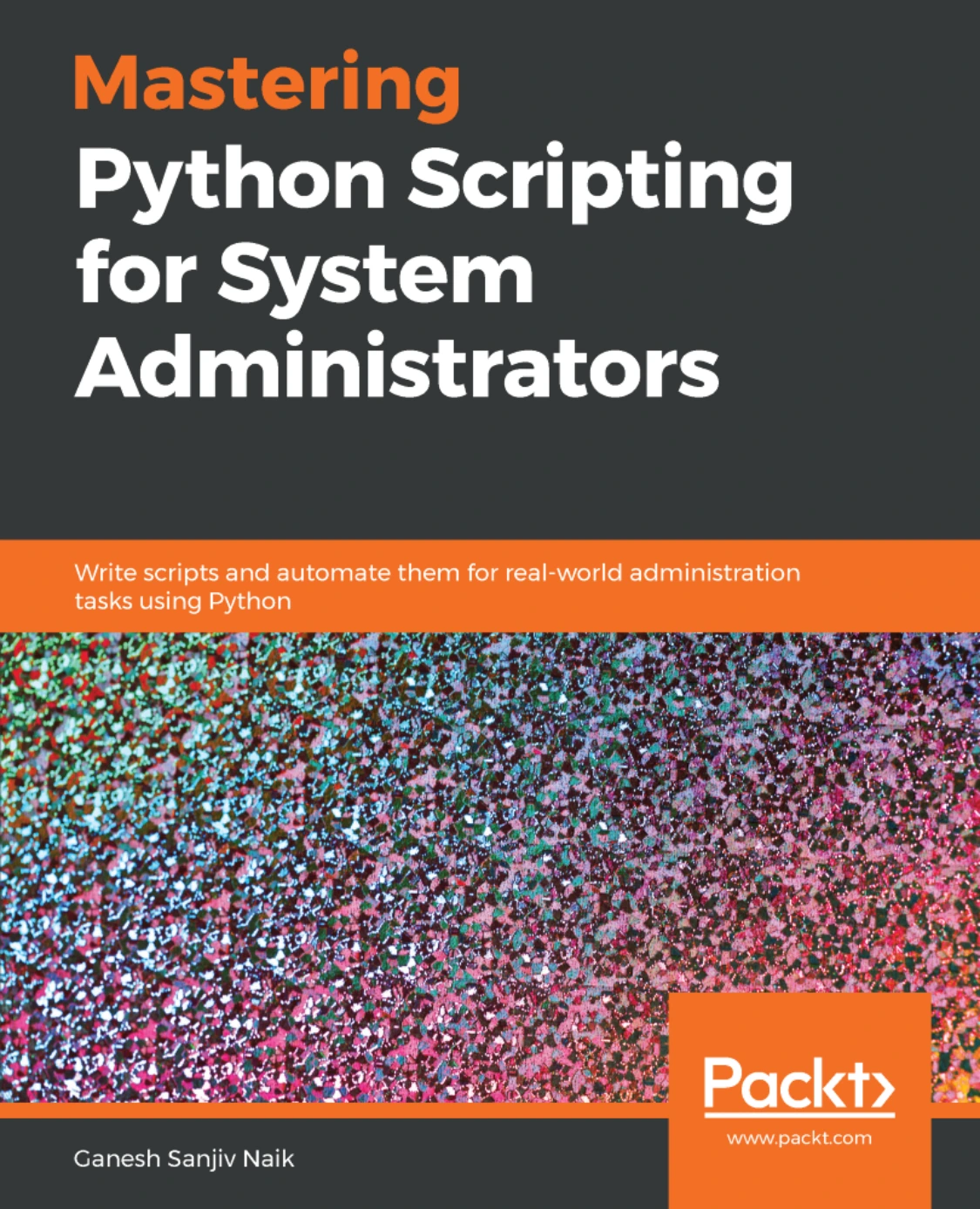
Mastering Python Scripting for System Administrators
Original price was: $5.00.$2.50Current price is: $2.50.

Ganesh Sanjiv Naik
Product Specs:
- File Type: PDF
- File Size: 5.1 MB
- Book Language: English
- Total Page Count: 308
- Instant Download
Turn Repetitive Admin Work into Reliable Python Scripts
System administrators often juggle shell one-liners, cron jobs, and manual checks. This book shows how Python can bring structure to that work. Ganesh Sanjiv Naik starts with the language itself—syntax, variables, strings, lists, tuples, sets, dictionaries, loops, functions, and modules—then applies those fundamentals to the tasks that fill an admin’s day.
What the Book Covers 💻
The opening chapters build a working Python foundation before moving into administration-specific territory. You will see how to parse command-line arguments, make decisions with if/elif/else, work with iterators and generators, and organize code into reusable modules. Later chapters move into debugging, profiling, unit testing, and automation.
- Python essentials: variables, numbers, strings, lists, tuples, sets, dictionaries, indexing, slicing, loops, functions, and modules.
- Scripting mechanics: command-line arguments,, user input, redirection, pipes, and input files.
- Debugging and profiling: exception handling, pdb, cProfile, timeit, and techniques for making programs run faster.
- Unit testing: the unittest framework, writing tests, and the methods used to validate code.
- Administrative automation: password handling, subprocess output capture, configuration files, logging, warnings, CPU and memory limits, and launching a web browser.
- File and directory work: the os module, creating and deleting directories, examining filesystems, and backups with rsync.
Debug, Test, and Profile with Confidence 🧠
Scripts that run unattended need to be trustworthy. The book treats debugging and testing as core admin skills, not afterthoughts. You will learn how to step through code with pdb, profile performance with cProfile, time small sections with timeit, and write unit tests that catch problems before they reach production. These chapters are especially useful for administrators who maintain scripts over time or hand them off to a team.
Automate the Work That Eats Your Day ⚙️
From reading configuration files to capturing subprocess output, the automation chapters focus on tasks that repeat. The book shows how to accept input through redirection and pipes, handle passwords at runtime, generate warnings, set resource limits, and interact with the operating system through Python. It also covers practical filesystem operations and backup workflows with rsync, giving you patterns you can adapt to your own environment.
Who This Book Is For
This guide is written for system administrators, Linux professionals, and IT staff who want to use Python for automation. It is also useful for developers moving into operations work or anyone who needs to replace brittle shell scripts with clearer, testable Python. The early chapters make the book accessible if you are new to Python, while the later chapters provide enough depth for readers who already write scripts and want to improve reliability and performance.
Why It Stays Useful
Rather than treating Python as a list of isolated features, the book connects language basics to real administrative outcomes: fewer manual steps, clearer error handling, and scripts that are easier to debug. The final chapters on testing, profiling, and automation give you a foundation you can keep using as your environment changes.
User Reviews
Be the first to review “Mastering Python Scripting for System Administrators”
You must be logged in to post a review.
Original price was: $5.00.$2.50Current price is: $2.50.


There are no reviews yet.