

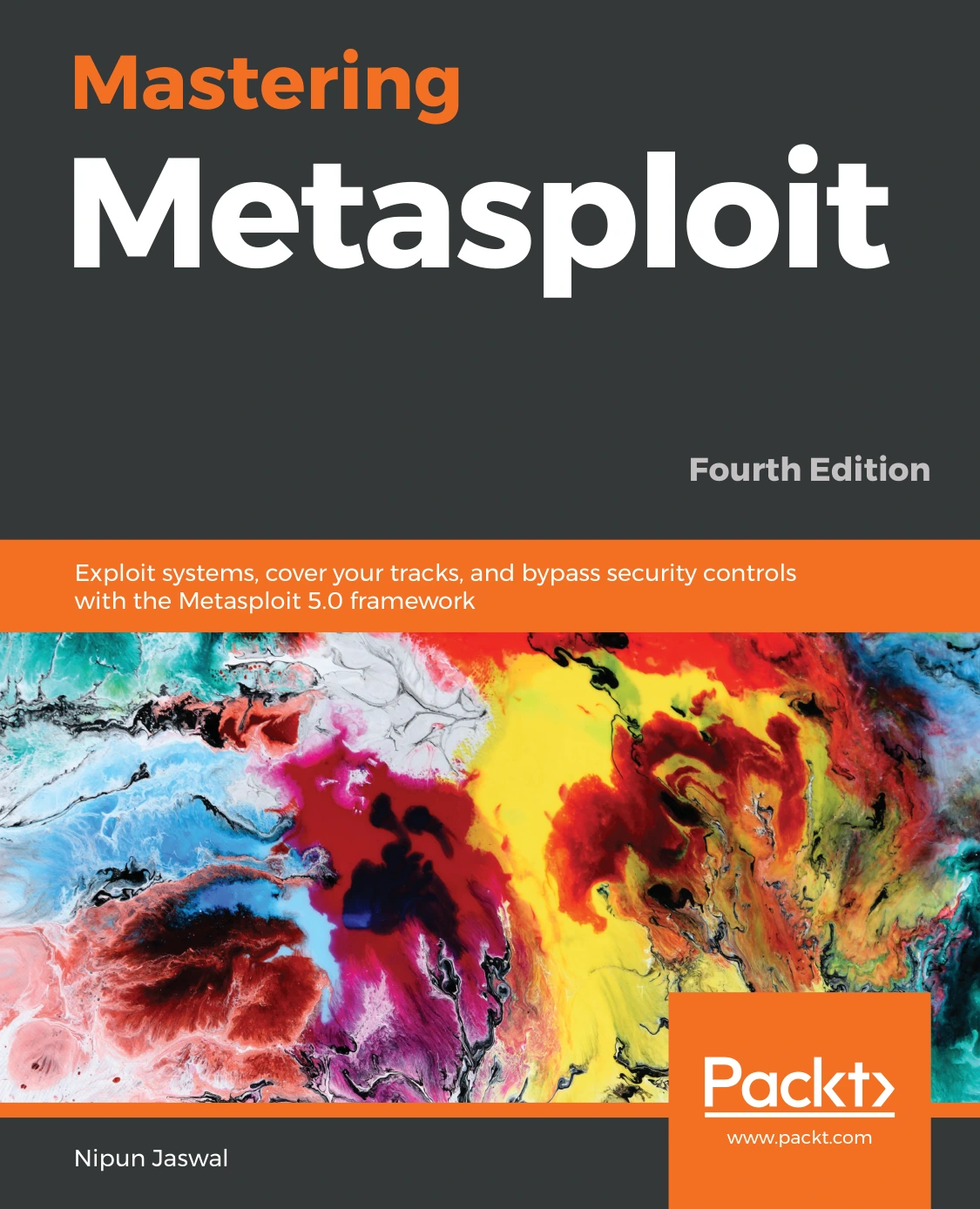
Mastering Metasploit, Fourth Edition
Original price was: $5.00.$2.50Current price is: $2.50.

Nipun Jaswal
Product Specs:
- File Type: PDF
- File Size: 35.8 MB
- Book Language: English
- Total Page Count: 503
- Instant Download
A Framework Deep Dive, Not a Surface Tour 💻
Metasploit is one of the most widely used tools in offensive security, and plenty of material covers how to fire off a module. This fourth edition of Mastering Metasploit takes a different route: it treats the framework itself as something worth understanding from the inside out. Nipun Jaswal, a security researcher with more than a decade of penetration testing and red team experience, walks readers from the anatomy of a penetration test up to the demanding work of writing and porting exploits.
The book is built around the Metasploit 5.0 framework, and its subtitle sets an honest expectation: exploit systems, cover your tracks, and bypass security controls. The scope is broad, but the through-line is practical understanding.
Two Sections, One Progression
The material is arranged in two logical halves that mirror how real engagements unfold.
- Section 1 — Preparation and Development: reconnaissance, threat modeling, vulnerability analysis, exploitation, post-exploitation, and reporting, followed by the Ruby foundations behind Metasploit and the process of building your own modules.
- Section 2 — The Attack Phase: testing real services, including industrial control and SCADA environments and database systems such as SQL Server.
That structure rewards readers who want context rather than isolated tricks. A chapter on module development means very little without the earlier grounding in how an assessment is scoped and reasoned through.
Ruby as the Engine of Metasploit ⚙️
Metasploit modules are written in Ruby, and the book does not skip that reality. It introduces variables, data types, ranges, arrays, methods, decision operators, loops, regular expressions, and object-oriented programming, then connects each concept to how modules are actually constructed. Readers disassemble an existing HTTP server scanner, then build auxiliary modules such as an FTP scanner and an SSH brute-force tool. Understanding this layer is what separates people who use Metasploit from people who can extend it.
Into Exploit Formulation
A substantial portion of the book is devoted to the exploit formulation process. It covers the absolute basics of exploitation, system architecture, and the practical mechanics of turning a crash into working code, including a Windows 10 exploitation walkthrough. Stack overflow vulnerabilities are demonstrated, along with SEH-based overflows and the use of the script for pattern generation and ROP chain creation.
Modern protections do not stay out of the discussion. The book addresses DEP bypassing through return-oriented programming, using tools such as msfrop to locate ROP gadgets, while acknowledging that other mitigation mechanisms exist and shape how exploits must be built.
Porting Exploits into the Framework
Finding a proof-of-concept is one skill; integrating it cleanly into Metasploit is another. The book covers importing stack-based buffer overflow exploits, HTTP exploits, and web-based remote code execution exploits, generating Metasploit modules for each, and implementing a check method so modules behave predictably. TCP server and browser-based exploits are also brought into the framework.
Post-Exploitation and Real Targets 🧠
Post-exploitation receives serious attention through several purpose-built modules, including a credential harvester, a Windows Defender exception harvester, and a drive-disabler. Meterpreter interaction is explored via the Interactive Ruby Shell, along with RailGun objects and the addition of custom DLLs.
The attack phase chapters extend beyond the familiar desktop target. Readers work through SCADA and industrial control system fundamentals, HMI exploitation in SCADA servers, and Modbus protocol testing, alongside guidance on securing those systems. Database exploitation focuses on scanning MSSQL with Metasploit modules and brute-forcing passwords.
Who This Edition Serves
This is not an entry-level introduction to security concepts. It suits penetration testers, red teamers, security researchers, and technically confident developers who already understand networks and operating systems and want to work at the framework level. Instructors and students in offensive security programs will also find the progression from fundamentals to module authoring useful for structured study.
If your goal is to build, adapt, and reason about exploits rather than simply run them, this edition offers the depth to get there.
User Reviews
Be the first to review “Mastering Metasploit, Fourth Edition”
You must be logged in to post a review.
Original price was: $5.00.$2.50Current price is: $2.50.






There are no reviews yet.