

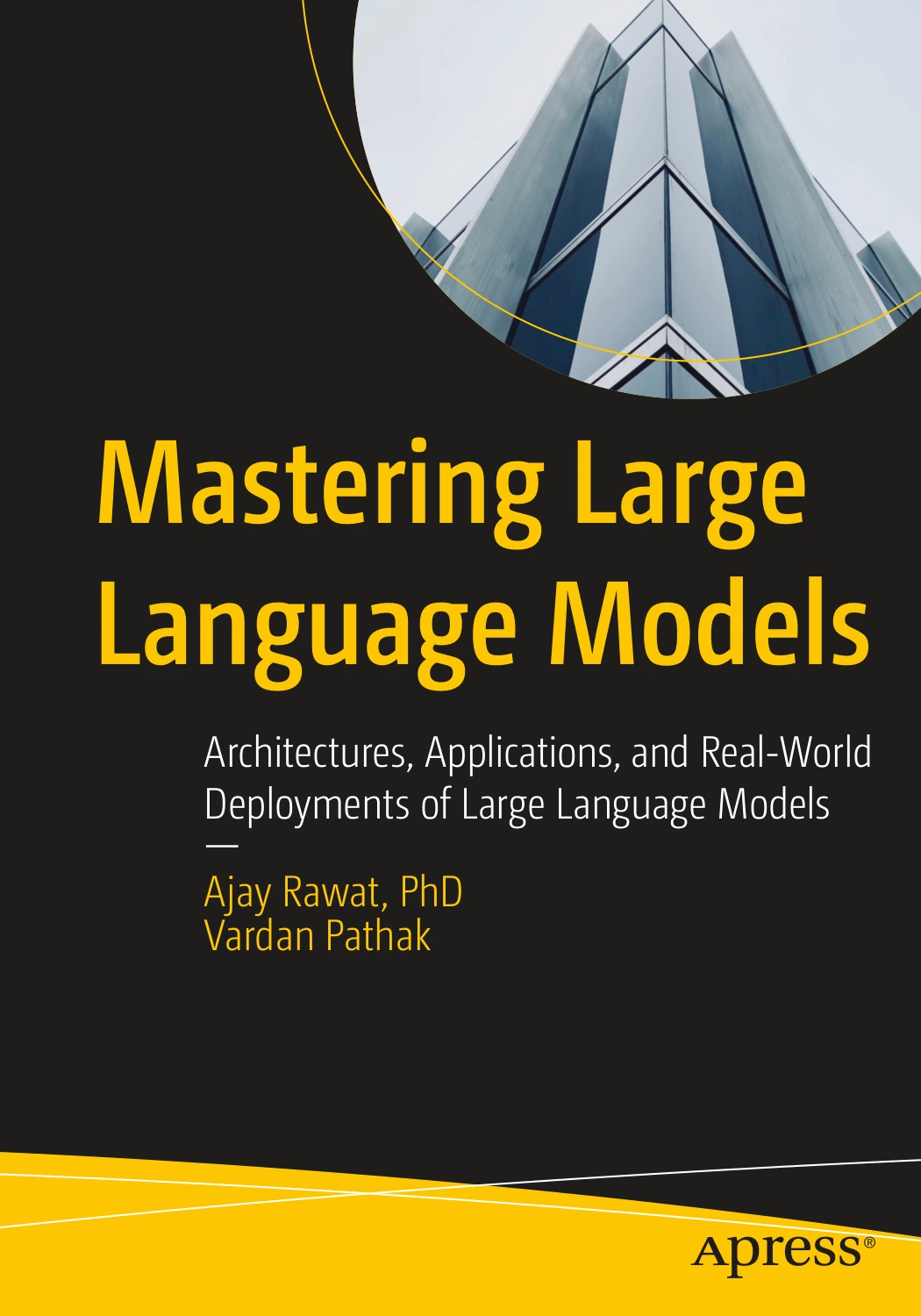
Mastering Large Language Models: Architectures, Applications, and Real-World Deployments of Large Language Models
Original price was: $5.00.$2.50Current price is: $2.50.

Ajay Rawat
Product Specs:
- File Type: PDF
- File Size: 43.4 MB
- Book Language: English
- Total Page Count: 613
- Instant Download
Large language models went from research curiosity to everyday infrastructure faster than most teams could plan for. One quarter they were an experiment in a notebook; the next they were writing code, answering customer questions, and quietly reshaping how whole industries handle text. Mastering Large Language Models is a hands-on guide to that shift, written for readers who want to understand what is actually happening inside these systems and then build something that works.
Ajay Rawat and Vardan Pathak split the material into two clear arcs. First, the machinery. Then, the applications. Along the way they lean on plain-language analogies — models as super-readers, tokenization as a secret code room, retrieval as a detective search — so the concepts stay anchored while the technical depth keeps climbing.
Foundations: What Is Really Happening Inside a Model 🧠
The opening chapters start with the broad picture before narrowing to architecture. Readers get the evolution of language models, the role of the transformer, and a survey of how the technology is already being used in healthcare, software development, customer service, legal and compliance work, financial services, manufacturing, and retail. Three structural trends frame the discussion: the democratization of AI capabilities, the push toward smaller and more efficient models, and enterprise adoption and customization.
From there the book opens the hood. Tokenization and positional encoding lead into the encoder and decoder layers, then to the final output and the autoregressive loop that generates text one step at a time. It is the part of LLM literature many introductions skip, and it is treated here with enough detail to be genuinely useful.
Fine-Tuning, Alignment, and Prompt Craft ✨
Raw models are not finished products, and this section explains why. Prompt engineering gets a full treatment — what separates a weak prompt from a strong one, how a prompt evolves through iteration, and how few-shot prompting changes results. Worked examples include a creative writing game, an emoji translator, and a tone converter that turns corporate language into something more casual.
Supervised fine-tuning and reinforcement learning from human feedback follow, explained through narrative models rather than abstract notation. Chapter exercises invite readers to step into the role themselves, including a prompt-engineering challenge and an “AI Whisperer” exercise tied to reward-based training.
Working With LLM APIs and Tooling ⚙️
Chapter 4 shifts to the practical realities of calling models in production. The book compares hosted API access against running your own hardware, surveys the major providers, and walks through setting up a development environment with a deliberately minimal dependency footprint. Attention is paid to the unglamorous essentials: keeping credentials in file, running health checks, initializing authenticated clients, and working in JSON mode for structured outputs.
Hosting options are compared honestly — Hugging Face Hub, the free Inference API, and paid Inference Endpoints — with guidance on when each choice makes sense. LangChain appears as the glue layer that lets teams swap providers with a single line, wire up callbacks and streaming, and assemble a complete retrieval-augmented generation pipeline without rewriting everything.
Building Applications: Chatbots and RAG 💻
Part II turns concepts into systems. The chatbot chapter traces the path from rigid rule-based assistants through intent recognition and NLU to today’s generative designs, then covers the decisions that actually shape a build: defining purpose and scope, mapping the key architectural components, and choosing between no-code or low-code platforms such as Botpress and Landbot versus a code-based Python stack.
Conversation flow design gets concrete attention — nodes and edges, intents as triggers, entity and slot filling, boolean branching paths, and graceful exception handling. A basic question-and-answer chatbot is then assembled step by step, covering system prompts, hyperparameters, few-shot patterns, and a sentiment-aware layer for more empathetic responses, followed by implementation labs.
The retrieval-augmented generation chapter tackles the misconception that RAG and fine-tuning are interchangeable. It separates the ingestion pipeline from the runtime pipeline, explains why retrieval matters technically, and builds up the supporting theory: embeddings as coordinates, encoder architectures, popular embedding models, semantic similarity, and the shift to dense retrieval.
Vector databases take center stage next, including why general-purpose databases struggle here, how FAISS works, and how the major options compare. The book closes by assembling a RAG pipeline across six phases — configuration, chunking, vectorization, indexing, retrieval, and generation — and explains the reasoning behind a FAISS-over-Pinecone decision.
Who Will Get the Most From It
The material assumes comfort with code, particularly Python, and rewards readers who plan to move from experimentation toward something deployed. Software engineers, data scientists, ML practitioners, and technical leads evaluating LLM tooling will find the architecture chapters and API guidance directly applicable. Students and instructors working through modern NLP coursework should appreciate the structured progression and the built-in exercises.
Supplementary source code referenced by the authors is available to readers through the publisher’s standard companion-material channel, giving the implementation chapters something to run rather than merely read.
Why It Belongs on Your Shelf
Plenty of LLM books stop at the headline. This one keeps going into tokenizers, encoders, reward modeling, vector indexes, and the plumbing that makes an API call survive contact with production. The analogies keep it readable; the exercises keep it honest. If you want a working understanding of large language models rather than a summary of them, this is a solid place to spend your time.
User Reviews
Be the first to review “Mastering Large Language Models: Architectures, Applications, and Real-World Deployments of Large Language Models”
You must be logged in to post a review.
Original price was: $5.00.$2.50Current price is: $2.50.






There are no reviews yet.