

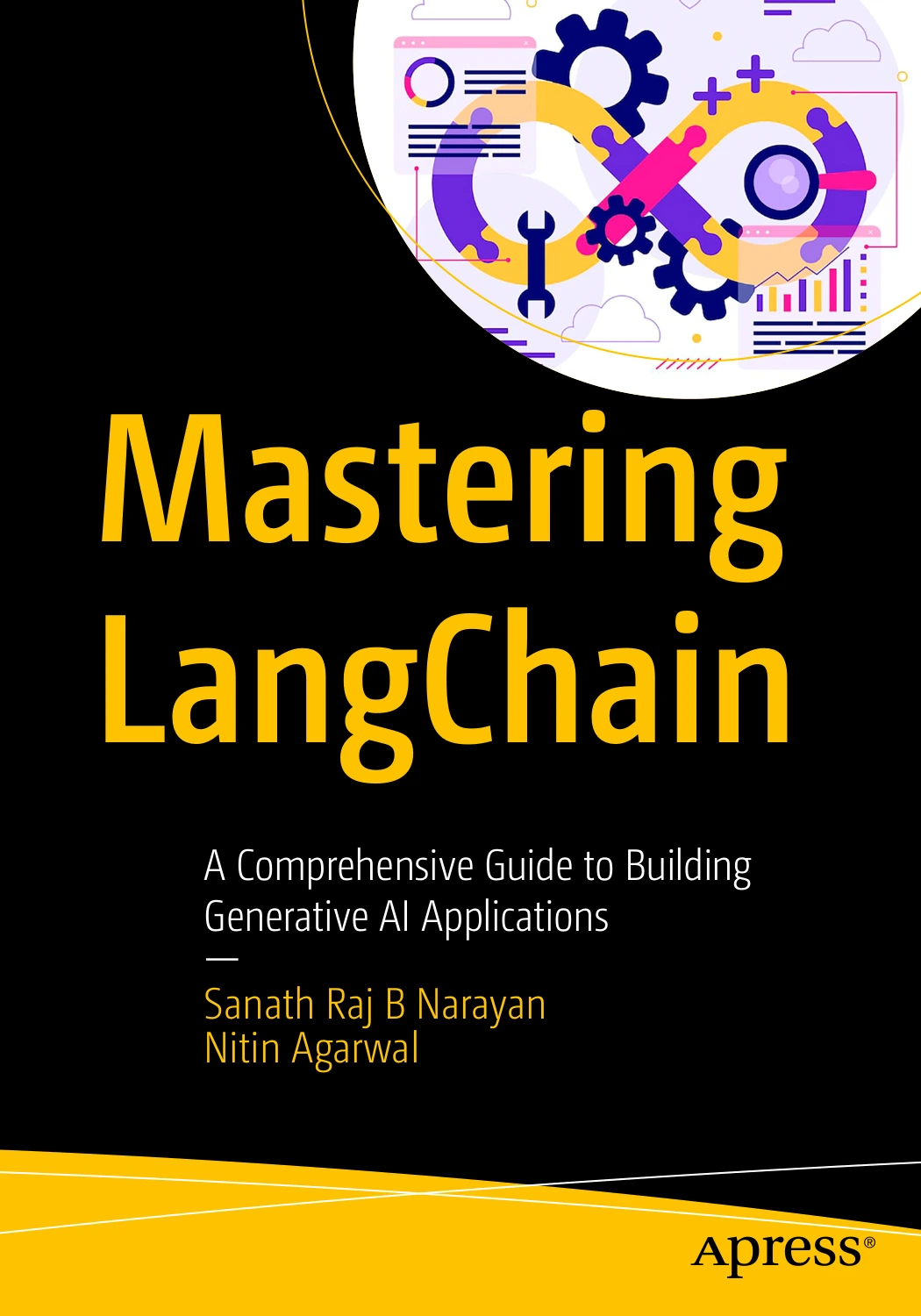
Mastering LangChain: A Comprehensive Guide to Building Generative AI Applications
Original price was: $5.00.$2.50Current price is: $2.50.

Sanath Raj B Narayan
Product Specs:
- File Type: PDF
- File Size: 5.8 MB
- Book Language: English
- Total Page Count: 251
- Instant Download
Mastering LangChain: From Framework Basics to Generative AI Applications
LangChain has become one of the most practical ways to connect large language models to real software. This Apress guide by Sanath Raj B Narayan and Nitin Agarwal takes a developer-focused route through that ecosystem, starting with the framework’s building blocks and steadily moving toward chatbots, retrieval systems, agents, and deployment-ready workflows.
It is a book for readers who want more than isolated snippets. The material is organized as a structured path through the LangChain stack, with each chapter building on concepts introduced earlier.
What This LangChain Guide Covers
Across eleven chapters, the book moves from foundational ideas to advanced application patterns:
- Core components: chains, prompts, prompt templates, tools, memory, output parsers, embeddings, and vector stores.
- Application patterns: chatbots, context-aware conversations, multi-turn dialogue, and retrieval-augmented generation.
- Advanced tooling: LangChain Expression Language, LangServe, LangSmith, LangGraph, and AI agent architectures.
- Production concerns: API integration, testing, evaluation, scaling, performance tuning, ethical AI, and regulatory compliance.
From Prompt Templates to RAG Pipelines 💻
Retrieval-augmented generation receives substantial attention, and for good reason. The book walks through data loading, cleaning, chunking strategies, text embeddings, vector indices, similarity search, dense and sparse retrieval, hybrid approaches, re-ranking, and prompt engineering for RAG systems. These chapters help readers understand how retrieved context and model knowledge work together, and why retrieval quality can shape the usefulness of an LLM application.
Build Chatbots, RAG Systems, and AI Agents
Chapter 4 focuses on chatbot development, including conversation flows, context awareness, complex queries, and multi-turn dialogues. Chapter 5 expands into full RAG implementations. Later, Chapter 8 introduces LangGraph for autonomous agents, covering state management, conditional routing, plan-and-execute architecture, multi-agent systems, reflection-based agents, and agentic text-to-SQL generation.
Deployment, Evaluation, and Best Practices
The later chapters address what happens after the prototype works. Readers explore LangServe, LangSmith, and LangGraph for deploying, optimizing, and designing language-model workflows. There is also material on integrating LangChain with popular APIs and frameworks such as TensorFlow and PyTorch, testing and evaluating applications, performance tuning, scaling for production, and avoiding common project mistakes.
Who Will Get the Most from This Book
This title is well suited to developers, machine-learning engineers, data scientists, software architects, and technical leads who are building or planning generative AI applications. It can also serve students and researchers who need a coherent map of the LangChain ecosystem rather than a loose collection of tutorials. The strongest fit is a reader who is comfortable with programming concepts and wants to understand how LangChain components fit together in real systems.
A Structured Path Through the Generative AI Stack
Mastering LangChain balances framework fundamentals with practical architecture. It explains what the pieces do, how they connect, and where production concerns enter the picture. For developers who prefer a guided, chapter-by-chapter route through LangChain, RAG, agents, and deployment tooling, this digital edition offers a focused and organized resource.
User Reviews
Be the first to review “Mastering LangChain: A Comprehensive Guide to Building Generative AI Applications”
You must be logged in to post a review.
Original price was: $5.00.$2.50Current price is: $2.50.

There are no reviews yet.