
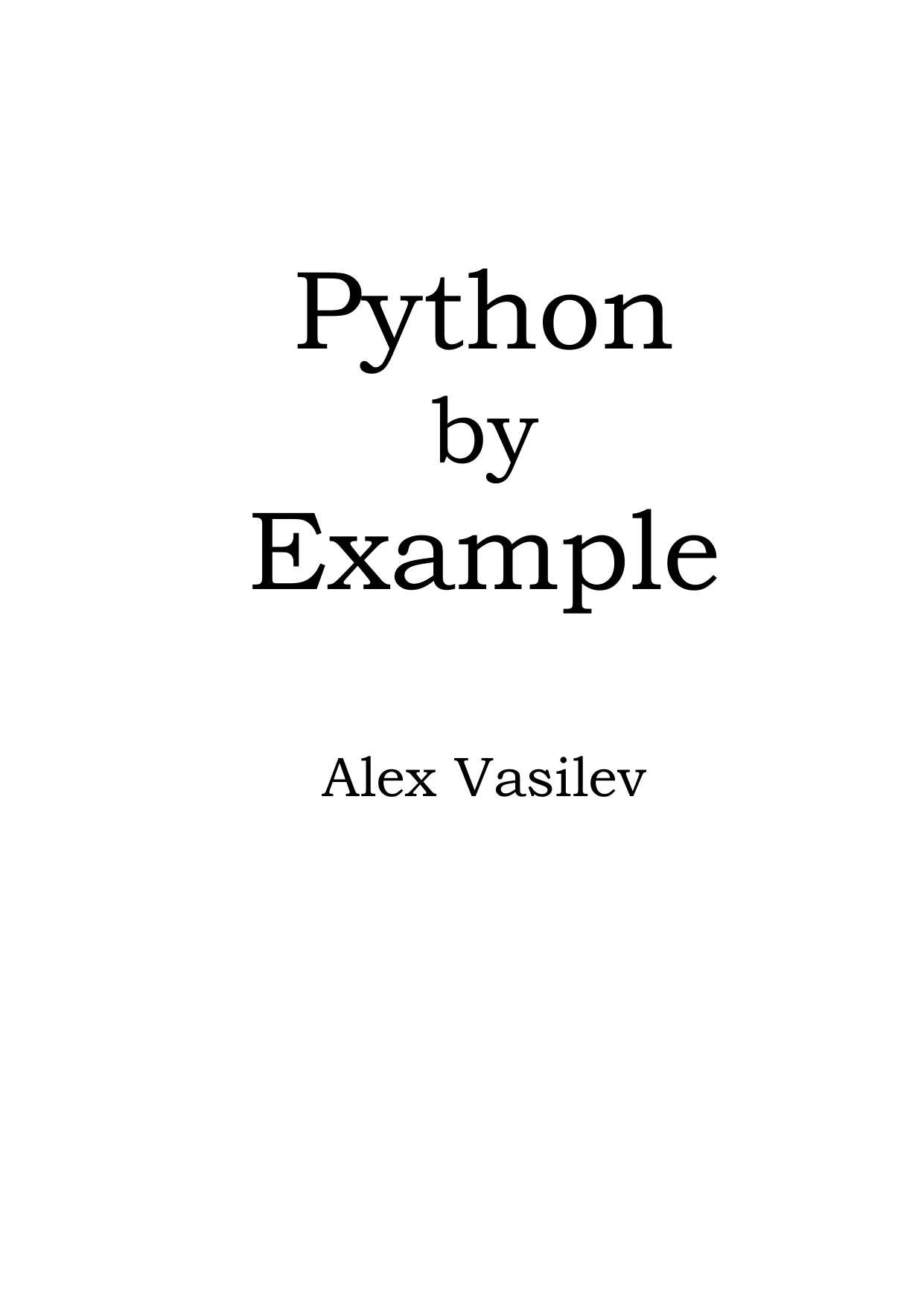
Python by Example
Original price was: $5.00.$2.50Current price is: $2.50.

Alex Vasilev
Product Specs:
- File Type: PDF
- File Size: 15.6 MB
- Book Language: English
- Total Page Count: 636
- Instant Download
Learn Python by Building Real Code 💻
Alex Vasilev’s Python by Example is built on a simple idea: programming concepts stick when you use them. Rather than spending page after page on theory, this 636-page guide moves from essential syntax to working programs, then widens the view chapter by chapter. Published in 2025, it is written for readers who want to learn Python through practice, examples, and repetition in different contexts.
From First Script to Practical Programs
The opening chapter gives a fast, functional introduction to Python. You meet the first program, learn how to use an IDE, work with variables, accept input, call eval(), create lists, write conditional statements, use loops, and define functions. That early groundwork lets you build small but complete programs before the book turns to deeper material.
What the Book Covers
- Basic operations and control flow: while loops, for loops, if statements, the ternary operator, and exception handling
- Core data structures: lists, tuples, sets, and dictionaries, including nesting, copying, and built-in methods
- Strings and text processing: literals, operations, methods, and practical examples
- Functions: arguments, default values, scope, nested functions, lambda expressions, recursion, decorators, generators, annotations, and documentation
- Files and data: numerical data, Boolean values, date and time, and file handling
- Object-oriented Python: classes, objects, constructors, attributes, copying, inheritance, multiple inheritance, method overriding, special methods, indexing, callable objects, and iterators
- Exceptions and threads: handling different exception types, custom exception classes, thread basics, interaction between threads, and practical examples
- GUI programming with Tkinter: windows, labels, buttons, entry fields, drop-down lists, menus, graphics, and other interface components
Why Examples First? 🧠
Vasilev keeps theoretical explanation deliberately lean. The book is organized around applied implementation: you see how a concept works in code, then revisit it later in a new context. Topics grow more complex from chapter to chapter, and important points are repeated on purpose. Each chapter closes with a summary, which helps you consolidate what you have just practiced before moving on.
Who This Python Book Is For
The book is primarily designed for self-study. Beginners can start with the first chapter and build functional programs quickly. Readers with some programming experience can move into the later chapters for deeper work with classes, inheritance, special methods, exception handling, threads, and GUI applications. If you learn best by typing code, breaking it, fixing it, and seeing the result, this example-driven approach is likely to fit.
A Structured Path Through the Language 📚
Across 11 chapters plus an introduction and afterword, Python by Example offers a long, deliberate route through Python. It is not a quick reference or a collection of disconnected snippets. It is a teaching book that expects you to work through the material, and it rewards that effort with a broad working knowledge of the language.
Start Coding with Python by Example
If you want a Python ebook that puts code at the center of the learning process, this edition gives you hundreds of pages of examples to study and adapt. From your first script to object-oriented design, threads, and Tkinter interfaces, it provides a structured path you can follow at your own pace. Available now from Digital Delights.
C++20 in Examples
Sold by Alex Vasilev Original price was: $5.00.$2.50Current price is: $2.50.



There are no reviews yet.