

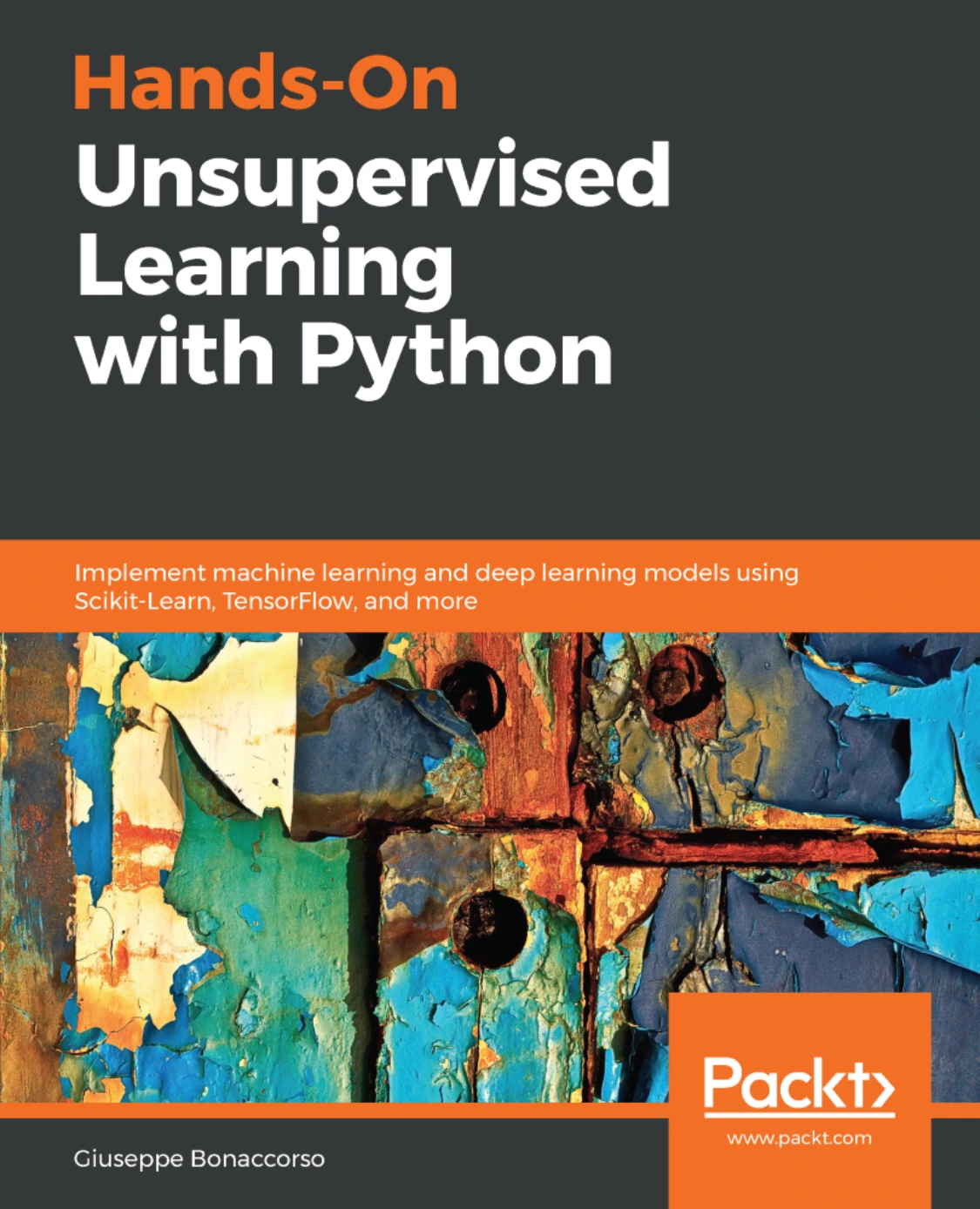
Hands-On Unsupervised Learning with Python: Implement machine learning and deep learning models using Scikit-Learn, TensorFlow, and more
Original price was: $35.99.$18.00Current price is: $18.00.

Giuseppe Bonaccorso
Product Specs:
- File Type: PDF
- File Size: 41.7 MB
- Book Language: English
- Total Page Count: 375
- Instant Download
Unlabeled data can hold structure that is easy to miss at first glance. In Hands-On Unsupervised Learning with Python, Giuseppe Bonaccorso explores how machine-learning methods can help uncover that structure, with practical Python examples spanning clustering, anomaly detection, dimensionality reduction, and neural networks.
The book builds from core concepts toward more advanced models, making it a substantial technical study for readers who want to understand not just what unsupervised algorithms do, but how to put them to work on data.
Start with the shape of the data
The opening chapters introduce unsupervised learning alongside other machine-learning approaches, then establish clustering fundamentals. K-means, distance functions, and evaluation measures provide a foundation before the discussion expands to spectral clustering, DBSCAN, mean shift, online methods, and hierarchical clustering. Examples involving real datasets help connect the algorithms with practical analysis.
Compare clusters—and model uncertainty
Rather than treating clustering as a single recipe, the book considers different ways to group observations and assess the results. Later chapters explore soft clustering, fuzzy c-means, and Gaussian mixture models, including methods for evaluating and selecting mixture components. This broader view is useful when crisp, fixed group assignments do not tell the whole story.
Find unusual patterns and simplify complex data
Coverage of anomaly detection ranges from probability density functions and kernel density estimation to one-class support vector machines and Isolation Forests. The dimensionality-reduction chapter adds principal component analysis, factor analysis, sparse PCA, non-negative matrix factorization, independent component analysis, and latent Dirichlet allocation—tools for exploring representation, structure, and topics in data.
Explore neural approaches to unsupervised learning
The final chapters turn to autoencoders, including denoising, sparse, and variational approaches, as well as restricted Boltzmann machines and deep belief networks. Generative adversarial networks and self-organizing maps round out the tour. Together, these topics offer readers a wide survey of how neural models can learn useful patterns without conventional labels.
A structured reference for hands-on study
Chapter summaries, questions, further-reading lists, and end-of-book assessments make the material easier to revisit and review. The book is intended for statisticians, data scientists, machine-learning developers, and deep-learning practitioners; some prior knowledge of machine learning and statistics is desirable. If you are building your understanding of unsupervised methods in Python, this ebook offers a detailed path from clustering basics to generative models.
User Reviews
Be the first to review “Hands-On Unsupervised Learning with Python: Implement machine learning and deep learning models using Scikit-Learn, TensorFlow, and more”
You must be logged in to post a review.
Original price was: $35.99.$18.00Current price is: $18.00.

There are no reviews yet.