
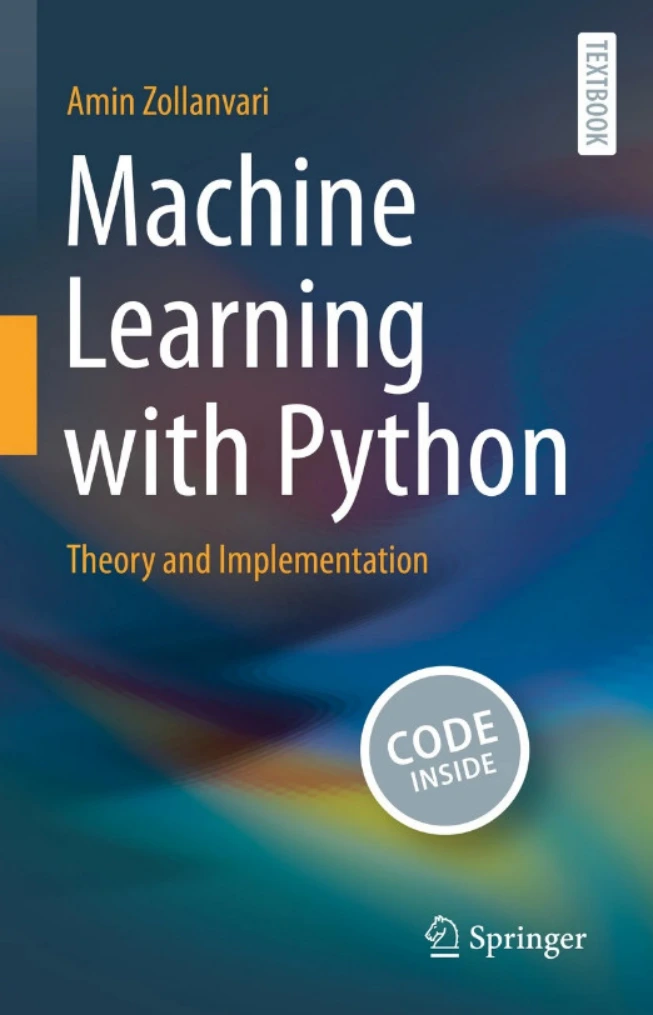
Machine Learning with Python: Theory and Implementation
Original price was: $13.99.$7.00Current price is: $7.00.

Amin Zollanvari
Product Specs:
- File Type: PDF
- File Size: 41.9 MB
- Book Language: English
- Total Page Count: 426
- Instant Download
Machine learning becomes easier to follow when the mathematics and the code are taught side by side. Amin Zollanvari’s Machine Learning with Python: Theory and Implementation takes that approach, guiding readers from Python foundations through core learning methods and into deep neural networks. It is designed to help readers understand not only how to apply familiar algorithms, but also the ideas behind them.
Start with the tools, then build the models
The opening chapters introduce Python and key data-science packages, including NumPy, pandas, and Matplotlib. From there, the book works through a practical supervised-learning example using Scikit-Learn, introducing steps such as preparing data, training a model, making predictions, and evaluating results. Readers already comfortable with the language and these packages can skip the introductory material.
Core machine-learning methods, explained and implemented
The central chapters explore k-nearest neighbors, linear models, decision trees, and ensemble learning. Classification and regression receive attention across these methods where applicable, helping readers connect related approaches rather than treating each task in isolation. Python implementations accompany the theoretical discussion, keeping practical work close to the underlying concepts.
Learn to assess the whole process
Building a model is only part of the work. Zollanvari also covers model evaluation and selection, feature selection, and how common learning stages fit together. This broader view helps readers consider how preparation, model choice, and performance assessment interact when developing a machine-learning solution.
From clustering to deep learning
The final sections move into clustering and neural networks. Coverage includes deep learning with Keras and TensorFlow, followed by convolutional and recurrent neural networks. The progression gives readers a route from established supervised-learning techniques toward more complex model families and their implementations.
Who may find this textbook useful?
Undergraduate and graduate students are the stated primary audience, while the book may also serve machine-learning practitioners as a working reference. A basic grounding in probability and linear algebra is useful for the mathematical material. Readers new to Python can begin with the programming chapters before moving into the algorithms.
For readers who want both the reasoning behind machine-learning methods and a practical path to implementing them in Python, this textbook offers a structured place to begin.
User Reviews
Be the first to review “Machine Learning with Python: Theory and Implementation”
You must be logged in to post a review.
Original price was: $13.99.$7.00Current price is: $7.00.
There are no reviews yet.