

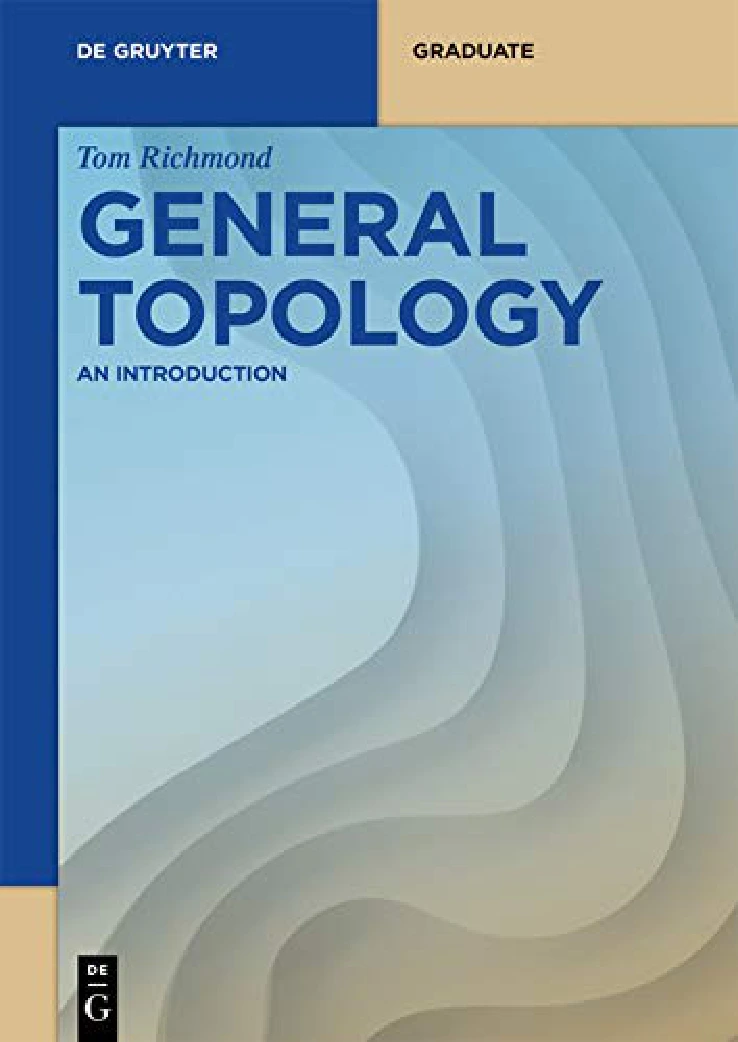
General Topology: An Introduction
Original price was: $138.88.$69.44Current price is: $69.44.

Tom Richmond
Product Specs:
- File Type: PDF
- File Size: 6.2 MB
- Book Language: English
- Total Page Count: 319
- Instant Download
Topology asks which properties survive continuous change—and gives precise language to ideas such as nearness, convergence, and continuity. In General Topology: An Introduction, Tom Richmond builds those ideas from the ground up, then follows them into less familiar territory where topology meets order theory and computer science.
From familiar spaces to general topologies
The opening chapters establish the groundwork with sets, functions, real numbers, equivalence relations, and partial orders before developing topologies and their bases. The text then moves through subspaces, products, quotient spaces, continuity, connectedness, compactness, metric spaces, separation axioms, and compactifications. The progression offers students a way to see how central concepts in point-set topology fit together.
Where topology and order meet
Richmond gives particular attention to the links between topological spaces and ordered structures. Later chapters consider Alexandroff spaces, lattice properties, and partially ordered topological spaces. These connections also open a path toward finite topologies, a useful perspective in settings such as computer science where models may involve finite sets.
Beyond symmetric distance
The book also explores variations on familiar metric ideas, including pseudometrics, quasi-metrics, and partial metrics, as well as uniform structures. These extensions let readers consider notions of distance and nearness that do not have to behave exactly like ordinary Euclidean distance. The final chapter returns to continuous deformation, this time examining sets and curves.
Practice built into the mathematics
More than 740 exercises accompany the exposition, ranging from standard reinforcement to problems that suggest further investigation. That breadth makes the book useful for working through a course as well as revisiting definitions and results during independent study.
Who may find it useful?
The publisher identifies undergraduate and graduate mathematics students and computer science researchers as readers. The author’s course outline describes material for upper-undergraduate and beginning-graduate study, with the early chapters forming a classical introduction and later selections extending the course toward asymmetric topology and applications.
For readers ready to move from the language of open sets and continuity toward the richer connections between topology, order, and computation, this text offers a carefully structured place to begin.
User Reviews
Be the first to review “General Topology: An Introduction”
You must be logged in to post a review.
Original price was: $138.88.$69.44Current price is: $69.44.


There are no reviews yet.