

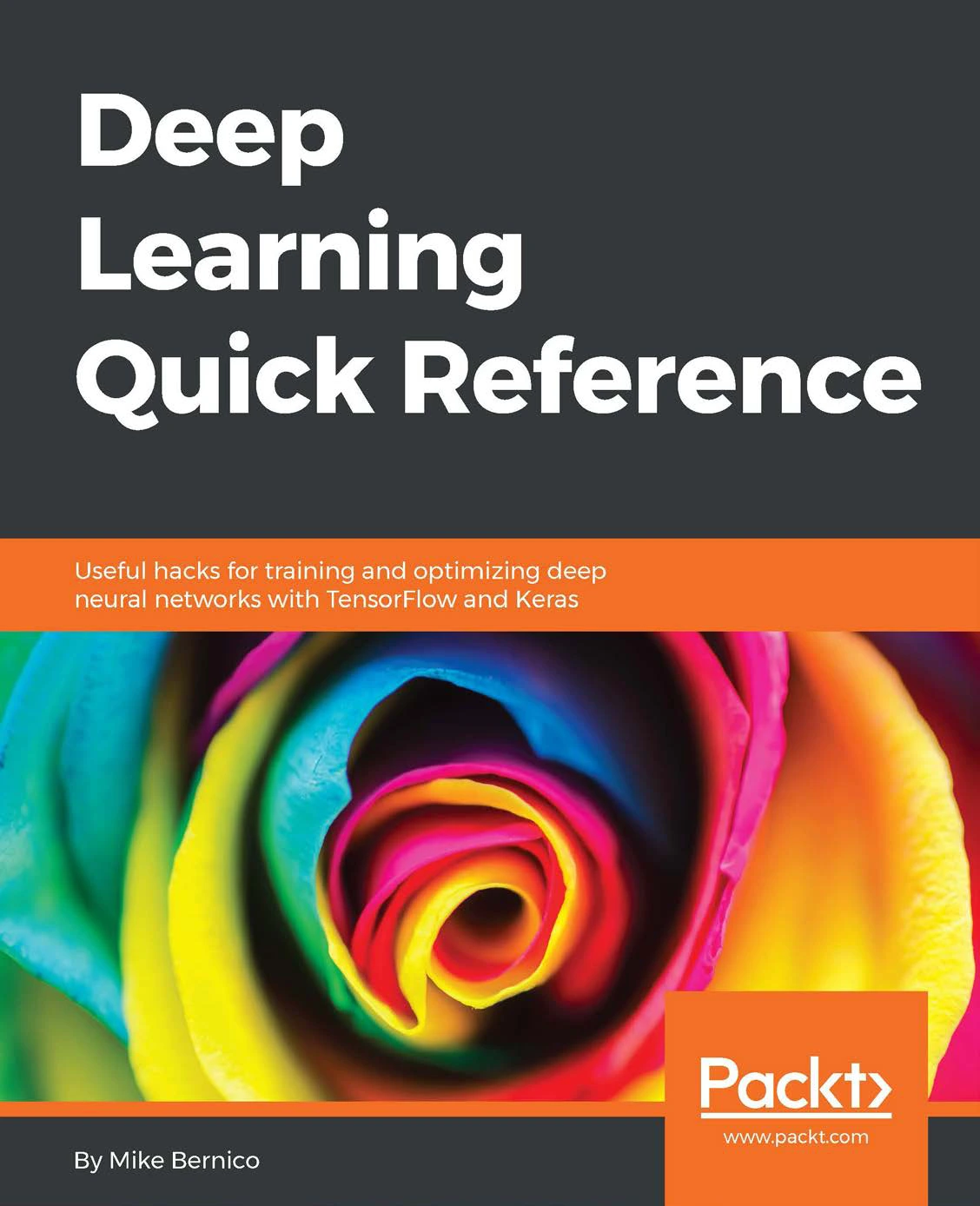
Deep Learning Quick Reference: Useful hacks for training and optimizing deep neural networks with TensorFlow and Keras
Original price was: $34.19.$17.09Current price is: $17.09.

Mike Bernico
Product Specs:
- File Type: PDF
- File Size: 7.3 MB
- Book Language: English
- Total Page Count: 261
- Instant Download
Deep learning can feel like a tangle of architectures, training choices, and framework details. Mike Bernico’s Deep Learning Quick Reference takes a hands-on route through that terrain, pairing essential concepts with practical examples in TensorFlow and Keras. Its emphasis is on helping readers approach real modeling tasks and find a useful starting point when a network needs to be built, trained, or tuned.
Start with the working parts of a neural network
The opening chapters review network architecture, neurons, activation and cost functions, forward and backpropagation, and optimization methods including momentum, RMSProp, and Adam. Bernico also introduces dataset preparation, validation approaches, and ways to think about bias and variance. This grounding gives later implementation examples a clearer context: model choices are connected to the training process, not presented as isolated code.
Put TensorFlow and Keras to work
Framework setup and practical model-building run through the book. Examples address regression and classification, with guidance on defining network layers, training models, measuring performance, and tuning hyperparameters. Readers also encounter TensorBoard for monitoring training and visualizing networks, along with Keras callbacks for tasks such as checkpointing and custom evaluation.
Explore several kinds of deep-learning problems
The material extends beyond introductory feed-forward networks to convolutional and recurrent approaches, LSTMs, text and word embeddings, sequence-to-sequence models, Deep Q Networks, and generative adversarial networks. That range makes the book useful as a topic-by-topic reference for practitioners comparing methods across structured data, sequences, language, and image-generation examples.
A practical reference for hands-on learners
This book is best suited to readers who already know Python and basic machine-learning concepts and want implementation-oriented guidance. It favors practical examples and approachable explanations over a mathematically exhaustive treatment, so readers seeking proofs or a theory-first textbook may want to pair it with a more specialized title. Keep in mind that the examples reflect the software context of the book’s 2018 publication.
For data scientists, machine-learning practitioners, and technically curious students, Bernico’s guide offers a broad, example-led way to navigate common deep-learning workflows with TensorFlow and Keras.
User Reviews
Be the first to review “Deep Learning Quick Reference: Useful hacks for training and optimizing deep neural networks with TensorFlow and Keras”
You must be logged in to post a review.
Original price was: $34.19.$17.09Current price is: $17.09.


There are no reviews yet.